
Suncor's 2026 Strategy and Shareholder Returns: Assessing Cash Flow Durability in a Maturing Energy Cycle
The energy sector is at a crossroads, with maturing commodity cycles and evolving policy frameworks reshaping the landscape for oil and gas producers. Suncor EnergySU--, a Canadian integrated energy giant, has positioned itself as a case study in balancing growth, operational efficiency, and shareholder returns. As the company unveils its 2026 corporate strategy, investors must scrutinize the durability of its cash flow and the sustainability of its aggressive buyback program. This analysis evaluates Suncor's strategic priorities, financial metrics, and risk management practices to determine whether its 2026 ambitions align with long-term value creation.
Strategic Priorities: Growth and Operational Excellence
Suncor's 2026 strategy emphasizes production growth and operational efficiency, with upstream output projected to reach 840,000–870,000 barrels per day, exceeding its 2024 Investor Day targets. This growth is underpinned by investments in high-value projects such as the Mildred Lake East and Fort Hills North Pit oil sands in-situ developments, as well as the West White Rose offshore oilfield. The company also aims to maintain refining utilization rates of 99%–102%, leveraging its integrated business model to buffer against commodity price volatility.
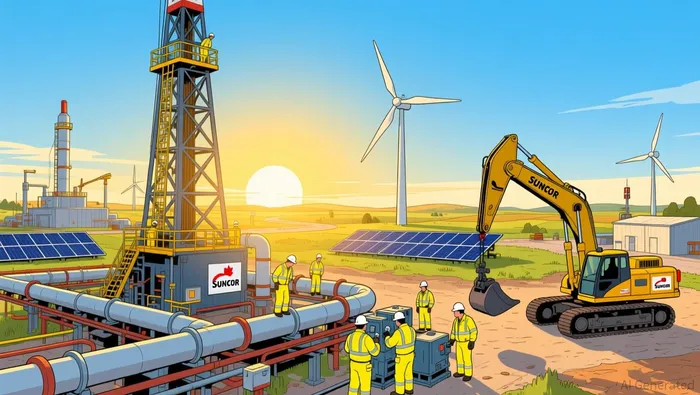
Capital discipline remains a cornerstone of Suncor's approach. Its 2026 capital expenditure guidance of C$5.6 billion to C$5.8 billion reflects a C$400 million reduction from 2025 levels, prioritizing sustaining capital and projects with high returns. This disciplined allocation ensures that SuncorSU-- can fund growth while preserving flexibility to respond to market shifts.
Shareholder Returns: Buybacks and Dividend Policy
Suncor has intensified its commitment to returning value to shareholders, raising monthly share buybacks to C$275 million in December 2025-a 10% increase from prior levels-projecting total repurchases of C$3.3 billion in 2026. This aligns with the company's policy of returning 100% of excess funds to shareholders. Analysts project that Suncor's free cash flow will remain robust, with estimates of C$5.6 billion in 2026 rising to C$8.8 billion by 2029. These figures suggest the buyback program is well-supported by cash flow, even as the energy cycle matures.
However, the sustainability of these returns hinges on Suncor's ability to maintain strong operating cash flow. In Q3 2025, the company generated C$3.785 billion in operating cash flow, with trailing twelve-month totals reaching C$12.667 billion. While cash flow from financial activities has been negative in recent years C$4.437 billion in 2023 and C$5.752 billion in 2024), the projected increase in free cash flow indicates a narrowing of this gap.
Financial Health and Risk Management
Suncor's balance sheet remains resilient, with a 2025 debt-to-EBITDA ratio of 0.7x and an interest coverage ratio of 12.6x. These metrics, coupled with a stable credit outlook from Fitch Ratings, underscore the company's capacity to fund both growth and shareholder returns without overleveraging.
The company's risk management strategies further bolster cash flow durability. Suncor aims to reduce its breakeven oil price by USD10/barrel by 2026 through operational efficiency and cost optimization. Its integrated business model also acts as a natural hedge: in Q2 2025, downstream operations offset more than half of the financial impact from an C$8 drop in WTI prices. Additionally, Suncor has trimmed capital expenditures to preserve free cash flow, demonstrating agility in navigating a maturing energy cycle.
Energy Transition and Long-Term Challenges
While Suncor's 2026 guidance focuses on traditional hydrocarbon projects, the company has not ignored the energy transition. Its capital program includes investments in in-situ technologies and efficiency improvements that reduce carbon intensity. However, the broader challenge lies in aligning long-term fossil fuel demand with decarbonization goals. Analysts note that policy debates over energy infrastructure and the pace of the transition could influence investor sentiment, even as Suncor's operational performance remains strong.
Analyst Perspectives and Valuation
Independent analysts highlight Suncor's attractive valuation. A discounted cash flow model suggests the stock is undervalued by 66.7%, with an intrinsic value of C$183 per share compared to its current price of C$61 according to analyst projections. The company's free cash flow yield exceeds 10%, outperforming peers and offering a compelling return profile. However, the market's conservative pricing reflects lingering uncertainties about the energy transition and regulatory risks as noted by market analysts.
Conclusion: A Balanced Approach in a Shifting Landscape
Suncor's 2026 strategy reflects a pragmatic balance between growth, operational efficiency, and shareholder returns. Its disciplined capital allocation, strong cash flow generation, and integrated business model position it to navigate a maturing energy cycle. While the company's buyback program is well-supported by current financial metrics, long-term durability will depend on its ability to adapt to evolving policy frameworks and decarbonization pressures. For investors, Suncor represents a compelling case of a traditional energy firm leveraging its strengths to remain competitive in a transforming sector.







Comentarios
Aún no hay comentarios