
Sumitomo Realty's Mumbai Ambition: A Strategic Bet on India's Growth
Sumitomo Realty & Development is doubling down on Mumbai, India’s financial capital, with plans to construct two new office towers in the Bandra-Kurla Complex (BKC)—a move that underscores its confidence in India’s real estate market and its vision to become a global player in commercial property. The projects, part of a broader ¥1 trillion ($6.9 billion) investment in India, reflect a calculated strategy to capitalize on rising demand for premium office space in one of Asia’s fastest-growing economies.
The Investment Breakdown
Sumitomo’s Mumbai projects are split between two prime locations:
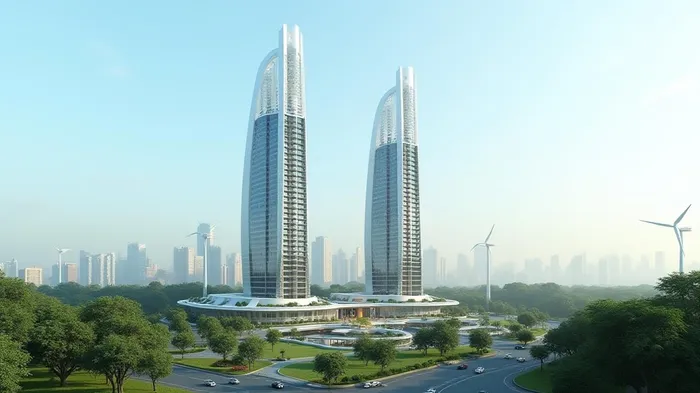
1. BKC Office Towers: Two high-quality office buildings targeting multinational corporations, with a combined gross floor area of 260,000 square meters and an investment of ¥200 billion.
2. Worli Mixed-Use Development: A super high-rise project including offices, a hotel, and retail spaces, spanning over 1 million square meters and funded by an initial ¥500 billion allocation. Together, these form part of a 1.2 million-square-meter portfolio in Mumbai.
The BKC sites were acquired through an 80-year lease from the Mumbai MetropolitanMCB-- Region Development Authority (MMRDA), while the Worli property—a former Bombay Dyeing factory—was purchased outright after 150 years of single ownership. This vertically integrated approach allows Sumitomo to control entire buildings, a rarity in India’s fragmented real estate market.
Why Mumbai? Why Now?
Mumbai’s BKC is India’s equivalent of Tokyo’s Marunouchi or New York’s Midtown—a hub for financial institutions, tech firms, and global headquarters. Office rents in BKC rival those in central Tokyo, but Sumitomo expects returns nearly double those in Japan due to India’s growth trajectory. Key drivers include:
- High Demand, Limited Supply: Multinational companies face a shortage of well-managed, centrally located office spaces.
- Infrastructure Backing: Mumbai’s Mumbai Trans Harbour Link and Metro Line 3 (scheduled for completion by 2024–2026) will enhance accessibility to BKC.
- Japan-India Ties: Sumitomo’s projects align with Japan’s ¥5 trillion ($33.8 billion) pledge to India over five years, announced by Prime Minister Fumio Kishida.
Sustainability as a Competitive Edge
Sumitomo’s Mumbai developments will integrate Japanese environmental technologies, such as water recycling systems, renewable energy-driven air filtration, and compliance with renewable portfolio standards. These features address Mumbai’s environmental challenges—air pollution and flooding—while positioning the buildings as ESG leaders. The company’s prior Tokyo projects, like its ZEB Oriented Certification initiatives, hint at a blueprint for energy efficiency and green credentials.
Challenges and Risks
Despite the opportunities, Sumitomo faces hurdles common to Indian real estate:
- Land Costs and Ownership: Mumbai’s prime land is scarce and expensive, though long-term leases mitigate risks.
- Regulatory Delays: Permitting in India is complex, but Sumitomo’s early approvals for both BKC projects suggest progress.
- Interest Rate Pressures: India’s high borrowing costs (currently ~6.5%) could strain local developers, but Sumitomo’s ¥2 trillion green financing quota (announced in 2024) provides a buffer.
Timeline and Expected Outcomes
Construction for both BKC towers began in 2025, with underground excavation completed by mid-year. Completion is post-2026, likely targeting 2027–2028. Meanwhile, the Worli project, with its 1.2 million-square-meter footprint, is scheduled for completion in the 2030s.
Conclusion: A Pivotal Move for Sumitomo
Sumitomo Realty’s Mumbai investments mark a bold step toward diversifying its overseas portfolio. With ¥700 billion allocated to Mumbai alone—nearly 70% of its total Indian investment—the company is betting on the city’s status as a global financial center.
The data backs this strategy:
- Returns: Office rents in BKC are comparable to Tokyo, but Sumitomo forecasts triple the returns after accounting for India’s growth (projected GDP growth of 5–6% annually).
- Market Gap: India’s real estate sector suffers from fragmented ownership and outdated infrastructure, which Sumitomo’s integrated model aims to fill.
- ESG Alignment: Green technologies will attract ESG-conscious tenants, a growing priority for global firms.
In a market where 70% of India’s office stock is over a decade old (per Knight Frank), Sumitomo’s modern, sustainable towers are poised to dominate. The projects also signal a shift in Japanese corporate strategy: leveraging India’s growth to offset slower expansion in mature markets like Tokyo.
For investors, Sumitomo’s Mumbai play is a high-risk, high-reward bet. But with ¥1 trillion at stake and a 30-year leasehold, the company is playing the long game—one that could redefine its role in Asia’s real estate landscape.
In sum, Sumitomo’s Mumbai towers are not just buildings—they’re a stake in India’s future. And with the right mix of timing, technology, and tenacity, they may just pay off.







Comentarios
Aún no hay comentarios