
SUI's TVL Surge: A Catalyst for Long-Term Value Capture in the Layer-1 Ecosystem
The SuiSUI-- blockchain has emerged as a formidable contender in the Layer-1 space, driven by a meteoric rise in Total Value Locked (TVL) and a rapidly maturing DeFi ecosystem. As of September 2025, Sui's TVL reached a record $2.388 billion, reflecting a 44.3% surge in Q2 alone and a 220% growth in Q3 2025 since its 2023 launch, according to a BeInCrypto report. This outpaces even Solana's 140% TVL growth during the same period, positioning Sui as a high-velocity challenger in a market dominated by Ethereum's $46.293 billion TVL, per a BingX comparison.
On-Chain Growth Dynamics: A New Paradigm for DeFi
Sui's TVL surge is notNOT-- merely a function of token price appreciation but a reflection of organic demand for its infrastructure. Daily decentralized exchange (DEX) trading volume averaged $367.9 million in Q2 2025, with protocols like CetusCETUS-- and Bluefin contributing $170.7 million and $78.5 million, respectively, according to Sui's Q2 DeFi roundup. This liquidity depth is further amplified by institutional adoption, including 21Shares' U.S. spot SUI ETF filing and Fireblocks' integration of Sui, as noted in The Currency Analytics article.
The network's architecture-optimized for high throughput and low latency-has also attracted gaming and NFT projects, driving TVL to $2.03 billion by September 2025, a 25% monthly increase according to an FXStreet analysis. This diversification into non-traditional DeFi use cases underscores Sui's ability to capture value beyond token trading pairs.
Capital Efficiency: The Engine Behind Sui's Momentum
Capital efficiency metrics highlight Sui's competitive edge. The TVL-to-yield ratio has improved significantly, with protocols like Suilend reporting $701 million in TVL by Q2 2025, while yield aggregators such as AlphaFi and Kai Finance optimize returns for liquidity providers. Additionally, Sui's gas fee model-where a portion of transaction fees is burned-creates a deflationary pressure that balances inflation from staking rewards, an effect discussed in a MEVX tokenomics analysis. This mechanism not only incentivizes long-term participation but also aligns tokenomics with sustainable growth.
Institutional infrastructure further enhances capital efficiency. The launch of native USDCUSDC-- on Sui by exchanges like MEXC and Kraken has improved interoperability between centralized and decentralized markets, reducing friction for large-scale liquidity provision, as outlined in a BlockEden review. Meanwhile, innovations like BluefinX and Bluefin Spot 2.0 have introduced low-slippage trading and MEV protection, addressing critical pain points for DeFi users, according to a Blockchain.News report.
The Price-Value Disconnect: A Temporary Divergence?
Despite these fundamentals, SUI's token price remains at $3.51, over 34% below its all-time high, noted in a CryptoNews report. This divergence suggests a misalignment between on-chain metrics and investor sentiment, potentially driven by macroeconomic factors or market sentiment toward altcoins. However, the 31.3% quarterly increase in SUI's circulating market cap to $12.34 billion indicates growing confidence in the ecosystem (BeInCrypto).
The introduction of institutional products, such as Grayscale's DeepBook and Walrus Trusts, could bridge this gap by attracting a new class of investors seeking exposure to Sui's infrastructure-driven growth (The Currency Analytics). Furthermore, the launch of suiUSDe-a stablecoin pegged to the U.S. dollar-has already spurred an 8% price rally for SUI, signaling improved utility for cross-chain transactions (FXStreet).
Long-Term Value Capture: A Layer-1 Play for the Future
Sui's TVL surge and capital efficiency metrics position it as a unique Layer-1 play. Unlike Ethereum's dominance-driven model or Solana's throughput-centric approach, Sui's focus on modular design and developer-friendly tools (e.g., the Seal decentralized secretSCRT-- management solution) enables rapid iteration and scalability, as covered in BlockEden. This adaptability is critical in an ecosystem where user adoption and institutional trust are increasingly intertwined.
For investors, the key question is whether Sui can sustain its growth trajectory while addressing token price volatility. The network's ability to attract Bitcoin-based assets (e.g., sBTC and xBTC) and expand into derivatives markets via platforms like Typus PerpPERP-- suggests a diversified path to value capture (Sui's Q2 2025 DeFi roundup). If institutional adoption continues to accelerate-particularly with the pending 21Shares ETF approval-Sui's TVL could serve as a flywheel for token appreciation, aligning on-chain utility with market fundamentals.
Conclusion
Sui's TVL surge is more than a short-term anomaly; it represents a structural shift in how DeFi ecosystems capture value. By combining high-throughput infrastructure, capital-efficient protocols, and institutional-grade tools, Sui has created a compelling narrative for long-term growth. While the token price lags, the underlying metrics-DEX volume, TVL-to-yield ratios, and institutional adoption-paint a picture of a network poised to redefine Layer-1 competition in 2025 and beyond.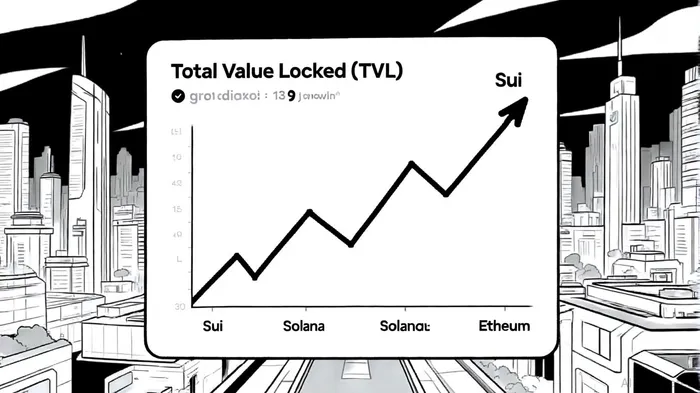






Comentarios
Aún no hay comentarios