
Sui Network's Four-Layer AI Stack and Its Implications for the Future of Verifiable AI Infrastructure
The convergence of artificial intelligence (AI) and blockchain technology is reshaping the landscape of decentralized systems, with SuiSUI-- Network emerging as a pivotal player. By integrating a four-layer AI stack, Sui has positioned itself as a foundational infrastructure for verifiable, privacy-preserving, and scalable AI applications. This analysis explores how Sui's architecture addresses critical challenges in centralized AI ecosystems and why its integrated stack represents a definitive infrastructure play in the AI + blockchain convergence.
A Modular Foundation for Verifiable AI
Sui's four-layer stack-comprising Sui, Walrus, Seal, and Nautilus-creates a cohesive framework for decentralized AI systems. At the base, Sui serves as the coordination and execution layer, leveraging its Mysticeti v2 consensus engine to achieve sub-second transaction finality. This ensures high throughput and low latency, critical for AI workflows that require rapid data processing and model updates according to Sui's stack developments.
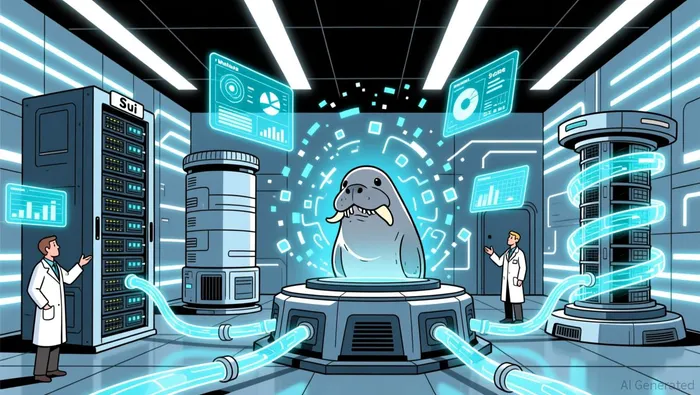
The second layer, Walrus, introduces decentralized storage optimized for large-scale data integrity and programmability. By treating data as a native, verifiable resource, WalrusWAL-- eliminates reliance on off-chain intermediaries, enabling AI applications to access high-integrity datasets directly on-chain as detailed in technical documentation. This is particularly transformative for AI training, where data provenance and authenticity are paramount.
Seal, the third layer, enforces on-chain access control through programmable policies. Developers can define granular permissions for data access, ensuring compliance with privacy regulations and user sovereignty. This layer is essential for AI systems that handle sensitive data, as it allows for composable and verifiable access controls without compromising transparency according to technical specifications.
Nautilus bridges on-chain and off-chain ecosystems by enabling hybrid applications to incorporate external data in a trustless manner. This layer addresses computational and privacy constraints, allowing AI models to process sensitive or resource-intensive tasks off-chain while maintaining verifiability through cryptographic proofs as described in technical documentation. Together, these layers form an end-to-end infrastructure that aligns with the principles of decentralization, transparency, and security.
Enabling Autonomous AI Agents
Sui's stack is not merely a technical framework but a platform for deploying autonomous AI agents. The Model Context Protocol (MCP), implemented via the Sui MCP Server by dwong, acts as a universal translator between AI agents and the blockchain. Built on the Sui SDK and TypeScript, this toolkit allows agents to securely interact with on-chain tools, data sources, and payment protocols according to technical documentation. By Q4 2025, Sui has transitioned from conceptual speculation to production-ready systems, with AI agents capable of executing economic activities such as asset management and autonomous decision-making through the Agentic Finance Protocol as reported in industry analysis.
This integration is further enhanced by Sui's support for verifiable compute and privacy-preserving AI. For instance, AI agents can perform inference on encrypted data while generating proofs of correctness, ensuring that outputs are both accurate and tamper-proof according to technical specifications. Such capabilities are critical for applications in finance, healthcare, and governance, where trust and accountability are non-negotiable.
Strategic Implications for the AI + Blockchain Ecosystem
Sui's four-layer stack addresses three core limitations of existing AI infrastructure: centralization, insecurity, and unaccountability. By decentralizing data storage, enforcing access controls, and enabling hybrid on/off-chain execution, Sui reduces the risk of data monopolies and algorithmic bias. Moreover, its modular design allows developers to compose AI systems with blockchain-native tools, fostering innovation in areas like autonomous economies and decentralized identity according to industry analysis.
The Agentic Finance Protocol exemplifies this potential, enabling AI agents to participate in on-chain economies by holding, earning, and transacting assets like USDCUSDC--. This blurs the line between human and machine-driven economic activity, creating new paradigms for value creation and distribution as reported in industry analysis. As AI agents become more sophisticated, Sui's stack provides the necessary coordination layer to ensure their actions are transparent, auditable, and aligned with user-defined policies.
Conclusion: A Definitive Infrastructure Play
Sui's four-layer AI stack represents a strategic leap forward in the AI + blockchain convergence. By combining high-performance execution, decentralized storage, programmable access controls, and hybrid execution capabilities, Sui addresses the technical and ethical challenges of centralized AI. Its production-ready integration with AI agents-powered by tools like the Sui MCP Server and Agentic Finance Protocol-positions it as a foundational infrastructure for the next generation of decentralized applications.
For investors, Sui's stack is not just a technological innovation but a structural enabler of trustless AI ecosystems. As the demand for verifiable and privacy-preserving AI grows, Sui's integrated approach offers a scalable, modular, and economically viable solution. In an era where AI governance and data sovereignty are critical concerns, Sui's infrastructure is poised to redefine the boundaries of what is possible in decentralized systems.






Comentarios
Aún no hay comentarios