
SUI DEX Volume Surge: A Tipping Point for On-Chain Trading?
The Sui blockchainSUI-- (SUI) has emerged as a formidable force in decentralized finance (DeFi), with its decentralized exchange (DEX) trading volume surging to $90.79 billion as of May 2025. This growth, driven by protocols like CetusCETUS-- and Bluefin, has positioned SUISUI-- as a top-10 blockchain by DeFi Total Value Locked (TVL) and a key competitor to established chains like SolanaSOL-- and EthereumETH--. But is this surge a fleeting anomaly or a structural shift in on-chain trading?
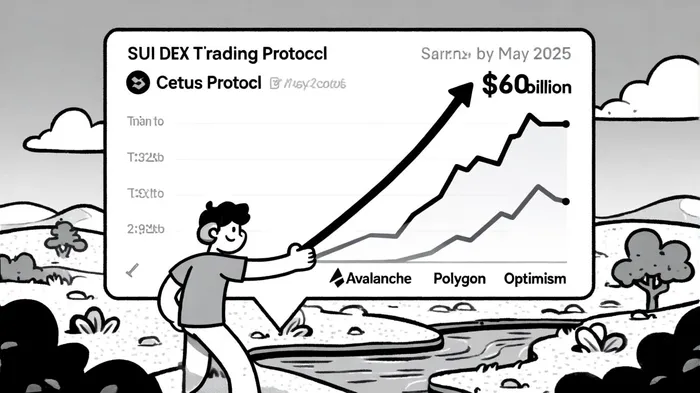
The DEX Volume Surge: A Network Effect in Motion
SUI's DEX volume has grown at an unprecedented pace. By May 2025, the network surpassed $48.4 billion in DEX volume, outpacing Avalanche, Polygon, and Optimism [1]. By mid-2025, this figure had climbed to $60 billion, a 23.27% increase in 30 days [2]. Cetus ProtocolCETUS--, SUI's leading DEX, accounts for 58.83% of this volume, leveraging its central limit order book model to attract liquidity providers and traders [3]. Bluefin and FlowX Finance further diversify the ecosystem, with FlowX's DEX aggregator and Concentrated Liquidity Market Maker (CLMM) models optimizing slippage and capital efficiency [4].
This surge is notNOT-- just a function of protocol design but also of network scalability. SUI processes up to 297,000 transactions per second (TPS)-far exceeding Ethereum's 12-15 TPS-while maintaining average transaction costs of $0.01 to $0.02 [5]. Gas pricing is further optimized through a rebate system, where users receive partial refunds for data deletion, reducing effective costs [6]. These metrics suggest SUI is solving a critical pain point for traders: high throughput without sacrificing affordability.
DeFi Adoption Catalysts: Protocols, Partnerships, and Liquidity
SUI's growth is underpinned by a confluence of technological and strategic catalysts. First, innovative protocols like Suilend and Steamm have redefined capital efficiency. Suilend, with $745 million in TVL, introduced advanced automated market makers (AMMs) that allow liquidity providers to earn yield on idle assets by reinvesting into lending pools [7]. Momentum Finance, another key player, saw a 249% TVL increase in Q2 2025, driven by its ve(3,3) incentive model [8].
Second, cross-chain liquidity has expanded SUI's reach. Projects like BabylonBABY-- and LombardBARD-- brought wrapped BitcoinWBTC-- (LBTC) onto the chain, injecting $156.4 million in TVL into DEXs like Momentum [9]. This integration not only diversified SUI's asset base but also attracted BitcoinBTC-- holders seeking yield.
Third, institutional partnerships have accelerated adoption. A high-profile collaboration with Microsoft in early 2025 pushed SUI's TVL to $2.1 billion [10], while integrations with Phantom and Backpack wallets reduced entry barriers for retail users. These partnerships, combined with SUI's focus on developer tooling (e.g., Mysticeti v2 and SIP-45 upgrades), have created a flywheel effect: better tools attract developers, who build better apps, which attract users and liquidity.
User Activity: The Human Element Behind the Numbers
SUI's success is also reflected in its user base. Daily active addresses surged to 2.2 million in Q2 2025, with over 1 million new wallets created daily-80% of daily active addresses [11]. This growth is not just quantitative but qualitative: 73% of new users engage with DeFi protocols, and DEX trading volume frequently exceeds $400 million daily [12].
The rise of wallets like Wave and the integration of AI-driven vault strategies in platforms like FlowX Finance have further lowered the learning curve for new users [13]. Meanwhile, SUI's TVL growth-up 160% year-over-year-reflects strong organic demand, with protocols like Navi and Steamm capturing 44.3% of new capital inflows in Q2 2025 [14].
Is This a Tipping Point?
SUI's DEX volume surge is more than a statistical anomaly-it's a symptom of a broader shift in on-chain trading. The network's combination of high throughput, low fees, and DeFi innovation has created a self-reinforcing ecosystem where liquidity providers, traders, and developers all benefit. However, challenges remain: SUI's TVL ($2.6 billion as of Q3 2025) still lags behind Solana's $12 billion, and competition from TON and Ethereum's Layer-2s is intensifying [15].
Yet, the underlying fundamentals are compelling. SUI's TVL growth (37% MoM) and DEX volume (23.27% 30-day increase) suggest a network effect that is hard to replicate. If SUI continues to execute on its roadmap-particularly with the launch of SuiDEX, a native DEX offering cross-chain swaps and hybrid liquidity pools-the chain could cement its position as a DeFi powerhouse.
For investors, the question is not whether SUI's DEX volume surge is significant, but whether it represents a tipping point in the evolution of on-chain trading. The data points to a "yes"-but only if SUI can maintain its pace of innovation and execution.






Comentarios
Aún no hay comentarios