
Sudden ETH Accumulation by Suspected BitMine Address: A New Crypto Megatrend?
The sudden surge in EthereumETH-- (ETH) accumulation by suspected BitMineBMNR-- addresses has ignited a debate about whether this represents a new crypto megatrend. On-chain data reveals a pattern of aggressive, large-scale transactions that suggest institutional confidence in Ethereum's long-term value proposition. As of October 2025, BitMine Immersion TechnologiesBMNR-- has amassed 2.83 million ETH, valued at over $13.4 billion, positioning itself as the largest public holder of Ethereum, according to a RiskWhale analysis. This accumulation, driven by a combination of private placements, OTC deals, and strategic treasury management, has significant implications for market dynamics and institutional adoption.
On-Chain Behavior as a Leading Indicator
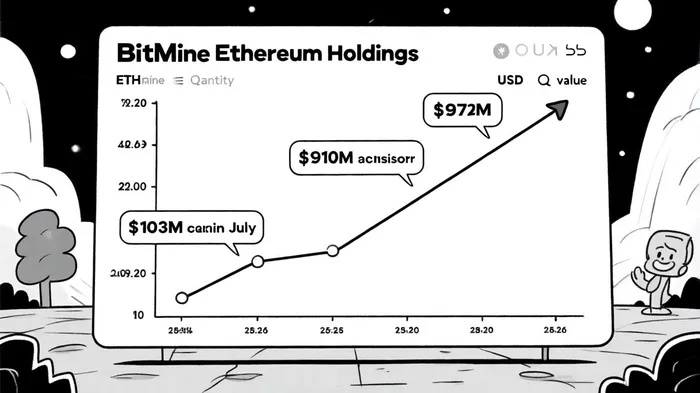
On-chain activity has long served as a barometer for market sentiment, and BitMine's actions provide a textbook example of institutional positioning. In late September 2025, a suspected BitMine address withdrew 25,369 ETH ($107 million) from FalconX, a move consistent with its strategy of hoarding Ethereum, according to a MarketMinute report. Similarly, in July 2025, the company executed a $970 million ETH accumulation within seven days, increasing its holdings to 566,776 ETH ($2.06 billion), as reported in a Blockchain.News piece. These transactions, analyzed by on-chain experts like @EmberCN and @lookonchain, signal a deliberate effort to reduce circulating supply and create buying pressure; the Blockchain.News piece highlights this pattern as part of BitMine's broader accumulation strategy.
The pattern is further reinforced by BitMine's use of cold storage. As of October 2025, over 1.71% of Ethereum's total supply is held in BitMine's treasury, according to a PR Newswire release, with a significant portion stored in non-custodial wallets. This shift from exchange-based holdings to secure, long-term storage reflects a broader institutional trend of treating ETH as a strategic asset rather than a speculative trade, as noted in a Coinotag analysis.
Institutional Backing and Capital Mobilization
BitMine's accumulation strategy is underpinned by robust institutional support. A $250 million private placement in July 2025 (detailed in the RiskWhale analysis) and subsequent fundraising targeting $20–$24.5 billion (outlined in the Coinotag analysis) have enabled the company to execute its purchases without relying on volatile market conditions. Prominent investors, including Cathie Wood's ARK Invest, Founders Fund (Peter Thiel), and Bill Miller III, have signaled confidence in Ethereum's future, validating its role in corporate treasuries, as reported by MarketMinute.
The company's stock performance further underscores this momentum. BitMine's shares have averaged $2.5 billion in daily trading volume, making it one of the most liquid stocks in the U.S. market, according to the PR Newswire release. This liquidity, combined with its Ethereum holdings, creates a flywheel effect: rising ETH prices boost the company's balance sheet, which in turn attracts more institutional capital.
Market Implications and the "Alchemy of 5%"
BitMine's goal of acquiring 5% of Ethereum's total supply (approximately 6 million ETH) has broader market implications (MarketMinute coverage). By reducing circulating supply, the company's strategy could tighten liquidity and drive up ETH's price. Data from on-chain analytics firm EmberCN indicates that Ethereum's exchange-held supply fell from 20 million ETH in July 2025 to 16.1 million by October 2025, a 20% decline, a trend also discussed in the Coinotag analysis. This reduction, coupled with corporate and ETF demand, may create a self-reinforcing cycle of scarcity and institutional adoption.
The potential for staking rewards further amplifies BitMine's value proposition. With 2.83 million ETH in its treasury, the company could generate $87–145 million annually in staking yields, per the RiskWhale analysis, creating a recurring revenue stream. This model mirrors traditional asset management strategies, where long-term holdings generate passive income, and positions Ethereum as a core component of corporate balance sheets, as the Coinotag analysis suggests.
A Megatrend in the Making?
While BitMine's actions are unprecedented in scale, they reflect a broader shift in how institutions view digital assets. Ethereum's transition to a proof-of-stake consensus model has enhanced its appeal for staking and long-term holding (noted in the PR Newswire release), while its integration into AI-driven macroeconomic narratives (e.g., blockchain's role in decentralized computing) has expanded its utility, as discussed in Coinotag's coverage.
However, risks remain. BitMine's balance sheet is heavily concentrated in ETH, exposing it to price volatility and regulatory scrutiny. Additionally, the reduced liquidity from institutional accumulation could exacerbate market volatility during periods of high trading activity, a concern highlighted in the RiskWhale analysis.
Conclusion
The sudden ETH accumulation by BitMine is not merely a corporate strategy-it is a leading indicator of a larger megatrend. By treating Ethereum as a strategic asset, BitMine and its institutional backers are reshaping market dynamics, reducing supply, and reinforcing Ethereum's role in the global financial system. As on-chain data continues to reveal large-scale transactions and cold storage movements, investors should monitor these patterns closely. The "alchemy of 5%" may yet redefine the crypto landscape in 2025 and beyond.





Comentarios
Aún no hay comentarios