
Student Loan Debt Crisis: Market Implications and Investment Opportunities in Financial Services and Alternatives
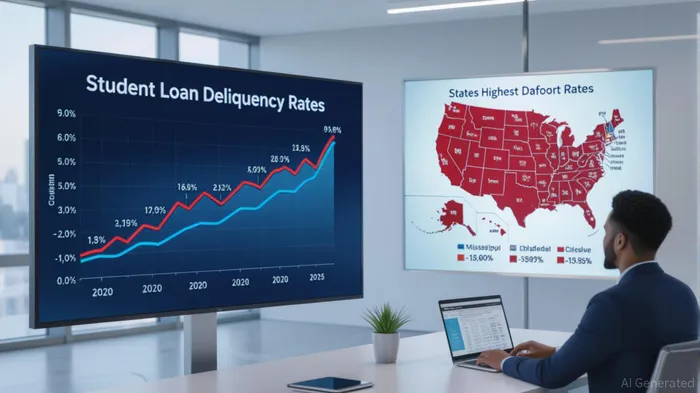
The U.S. student loan debt crisis has evolved from a simmering concern into a full-blown structural challenge, reshaping financial markets and investment strategies in 2025. With total student debt now exceeding $1.814 trillion—91.6% of which is federal—borrowers are grappling with a delinquency rate of 11.3% for federal loans and 1.61% for private loans. The resumption of repayments post-pandemic, coupled with the expiration of the one-year on-ramp period, has triggered a delinquency surge, with 13.7% of borrowers (nearly six million individuals) now 90+ days past due. This crisis is not just a financial burden for individuals but a systemic risk with cascading effects on credit markets, housing demand, and broader economic growth.
The Rising Default Risk: A Perfect Storm of Policy and Economic Pressures
The pandemic-era payment pause and forbearance programs created a false sense of stability, masking the fragility of borrower financial health. As of Q1 2025, the conditional delinquency rate for borrowers required to make payments hit 23.7%, with seven states—Mississippi, Alabama, and West Virginia among them—reporting rates above 30%. Age demographics further underscore the crisis: borrowers over 40 now constitute a significant portion of delinquent accounts, with the average age of a delinquent borrower rising from 38.6 to 40.4 since 2020.
The credit score fallout is equally alarming. Over 2.2 million borrowers saw their scores drop by more than 100 points, with 1 million experiencing declines of 150+ points. This deterioration has ripple effects, as borrowers with subprime scores face higher borrowing costs or outright denial of credit for mortgages, auto loans, and small business financing. The U.S. Department of Education's aggressive collection efforts—wage garnishment, tax refund offsets, and Social Security deductions—further exacerbate financial strain, potentially dampening consumer spending and aggregate demand.
Emerging Financial Sectors: Innovation in Debt Relief and Credit Repair
Amid the crisis, a new wave of financial services and alternative investment opportunities is emerging to address distressed borrowers. Fintech platforms like AffirmAFRM-- (AFRM) and SoFi (SOFI) are leveraging structured repayment tools and AI-driven underwriting to help borrowers navigate repayment. The SECURE 2.0 Act of 2022, which allows employers to match student loan payments as retirement contributions, has spurred growth in firms like Fidelity (FSS) and SchwabSCHW-- (SCHW), which now offer integrated debt management solutions.
Private credit funds and distressed debt platforms are also capitalizing on the crisis. Yrēfy, a Regulation D offering, targets distressed private student loans with a minimum investment of $50,000, promising fixed returns while expediting debt relief for borrowers. Similarly, AI-driven platforms like UpstartUPST-- (UPST) and EdTech (EDU) are streamlining refinancing and repayment processes, using machine learning to assess borrower creditworthiness and optimize loan structures.
Investment Opportunities: Balancing Risk and Reward
For investors, the student loan crisis presents both hedging opportunities and high-growth prospects. Here are three key strategies:
Fintech ETFs and Private Credit Funds:
ETFs like VanEck's BIZD and GPZ offer exposure to private credit strategies, including those targeting distressed student loan portfolios. These funds provide liquidity and diversification, while private credit funds specializing in high-yield, below-investment-grade loans can capitalize on weakened borrower profiles.Alternative Education Models:
Platforms like CourseraCOUR-- (COUR) and Lambda School are addressing the root causes of student debt by offering low-cost, income-share agreements (ISAs) tied to post-graduation earnings. These models reduce upfront costs and align education expenses with future income, creating a scalable solution for borrowers and investors alike.Credit Repair and Debt Relief Services:
Firms specializing in credit score restoration and debt negotiation are seeing increased demand. For example, companies that help borrowers transition to income-driven repayment (IDR) plans or navigate the Federal Fresh Start Program are well-positioned to benefit from policy tailwinds.
The Broader Economic Implications
The student debt crisis is not confined to individual borrowers; it is a macroeconomic wildcard. The housing market, for instance, has been hit hard, with 29% of Americans delaying home purchases due to debt. The average monthly student loan payment of $299 for young borrowers competes directly with savings for down payments, contributing to a 11.3% delinquency rate in federal loans. This dynamic is likely to persist, with implications for real estate markets and construction sectors.
Moreover, the healthcare workforce is facing a crisis, as professionals with average debt exceeding $200,000 increasingly opt for high-earning specialties over underserved communities. This exacerbates labor shortages and strains public health systems, creating indirect risks for healthcare investors.
Conclusion: Navigating the Crisis with Foresight
The student loan debt crisis is a structural shift, not a transient issue. For investors, the key lies in balancing caution with innovation. Hedging against vulnerabilities in housing and healthcare while investing in fintech, debt relief services, and alternative education models can position portfolios to weather the storm. As the market adapts to this new normal, those who recognize the interplay between policy, borrower behavior, and financial innovation will find opportunities in the chaos.
Final Note: The path forward requires a nuanced approach—combining regulatory advocacy, technological disruption, and strategic capital allocation. For now, the market is signaling a clear message: the future of finance will be shaped by those who navigate this crisis with both foresight and agility.





Comentarios
Aún no hay comentarios