
StubHub's Volatile Market Debut and Long-Term Growth Potential
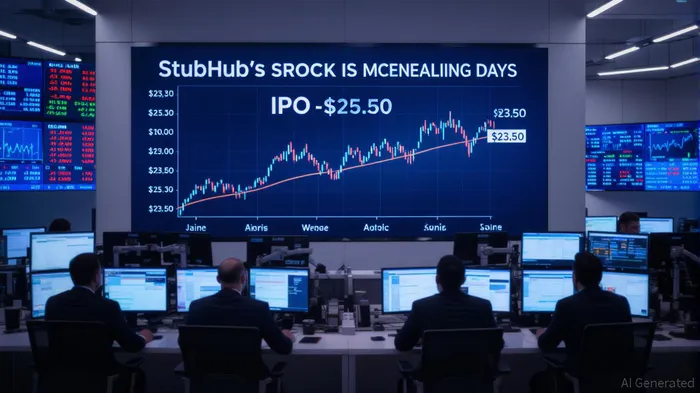
The initial public offering of StubHubSTUB--, the dominant player in the event ticket resale market, has ignited a debate between market optimism and fiscal caution. Trading under the ticker symbol STUBSTUB--, the company's debut on the New York Stock Exchange on September 17, 2025, was met with a mix of enthusiasm and skepticism. Shares opened at $25.35—above the IPO price of $23.50—before retreating to hover near the issue price, reflecting the delicate balance between investor appetite for a high-profile tech IPO and concerns over the company's unresolved path to profitability [4]. This volatility underscores the broader tension between market sentiment and fundamental value in newly public event platforms.
Market Sentiment: A Cautious Optimism
StubHub's IPO valuation of $8.6 billion—down sharply from its initial $16.5 billion target—signals a recalibration of expectations in a post-pandemic market [1]. The offering raised $800 million by selling 34 million shares, with underwriters granted an option to purchase an additional 5.1 million shares [1]. Analysts noted that the muted valuation reflects investor wariness about the company's financial health, particularly its widening net losses. In the first half of 2025 alone, StubHub reported a $111.8 million net loss, driven by high debt costs and regulatory pressures [5].
Market participants appear to be betting on StubHub's entrenched position in a $10 billion global ticket resale industry. The company's gross merchandise sales hit $1.77 billion in 2024, with a 29.5% revenue growth rate, albeit slowing to 3% in H1 2025 [1]. Its expansion into primary ticketing, including partnerships with Major League Baseball and European soccer leagues, has added $100 million in gross merchandise sales since 2024 [3]. These moves, coupled with ancillary revenue streams like VIP packages and travel bundles, have positioned StubHub as a multifaceted platform. However, the question remains: Can these growth levers offset persistent unprofitability?
Fundamental Analysis: A Tale of Two Metrics
StubHub's business model relies on a 20-25% cut of each transaction, derived from service fees on buyers and sellers [2]. While this model has driven robust top-line growth, it has also exposed the company to regulatory scrutiny. All-in pricing mandates, which require sellers to disclose total ticket costs upfront, threaten to erode StubHub's fee structure—a critical revenue driver [1]. Additionally, the company's $2.38 billion in long-term debt looms large, with interest expenses likely to strain margins in a rising-rate environment [5].
The IPO's dual-class share structure further complicates the fundamental picture. CEO Eric Baker controls 88% of voting power, raising governance concerns about shareholder alignment and decision-making transparency [5]. This concentration of power could deter institutional investors wary of concentrated control, particularly in a sector where regulatory risks are mounting.
Governance and Regulatory Risks: A Double-Edged Sword
StubHub's IPO comes amid a regulatory reckoning for ticketing platforms. Consumer backlash over “drip pricing” and high fees has prompted legislative action in several states, forcing companies to adopt more transparent pricing models [1]. While these changes could standardize the industry, they also threaten to compress StubHub's margins. The company's response—investing in primary ticketing and ancillary services—remains unproven at scale.
Conclusion: A High-Stakes Gamble
StubHub's market debut reflects a classic IPO paradox: a company with a dominant market position but unresolved profitability challenges. The stock's first-day performance suggests that investors are willing to overlook short-term losses in favor of long-term growth potential, particularly in a sector where demand for live events remains resilient. However, the fundamentals—slowing revenue growth, regulatory headwinds, and governance concerns—demand a more cautious approach.
For StubHub to justify its valuation, it must demonstrate that its expansion into primary ticketing and ancillary services can offset declining margins in its core resale business. Until then, the stock will remain a high-stakes bet, where market sentiment dances precariously on the edge of fundamentals.





Comentarios
Aún no hay comentarios