
Structural Shifts in the Crypto Perpetual Swaps Market: Institutional Adoption and Leverage Dynamics Reshape Risk and Liquidity
The crypto perpetual swaps market in 2025 has undergone a seismic transformation, driven by institutional adoption and evolving leverage dynamics. These shifts have redefined risk profiles, liquidity structures, and the interplay between traditional and digital asset markets. As highlighted in BitMEX's State of Crypto Perpetual Swaps 2025 report, the year marked the end of an era characterized by "easy yield" strategies and the emergence of a more complex, institutionalized derivatives landscape. For traders and investors, understanding these structural changes is critical to navigating the heightened volatility and recalibrating exposure to digital assets.
Institutional Adoption and the Convergence of Markets
Institutional participation in crypto perpetual swaps has accelerated in 2025, driven by the launch of hybrid products like Equity Perps-24/7 perpetual contracts on US stocks and indices collateralized by crypto assets. This innovation reflects a broader convergence between crypto and traditional markets, with institutions leveraging perpetual swaps to hedge or speculate on equities while maintaining liquidity in digital assets. However, this convergence has also compressed funding rates, which had historically offered attractive arbitrage opportunities. By mid-2025, funding rates for major crypto pairs had stabilized near 4%, often underperforming risk-free US Treasury yields.
The BitMEX report underscores that institutional demand for sophisticated risk management tools has outpaced the capacity of legacy market infrastructure. For instance, the October ADL (Auto-Deleveraging) crisis exposed vulnerabilities in delta-neutral strategies, as forced liquidations disrupted hedging mechanisms for professional market makers. This event, which triggered $20 billion in liquidations, revealed that institutional-scale leverage amplifies systemic risks during periods of stress, particularly when order books thin due to liquidity provider withdrawals.
Leverage Dynamics and Liquidity Risks
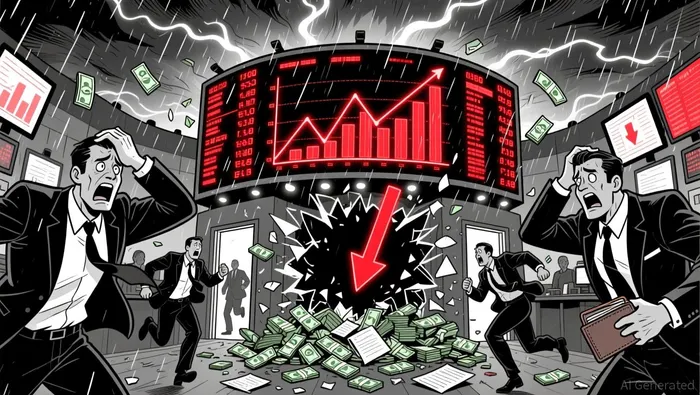
The October 2025 market crash exemplifies how leverage dynamics now dominate crypto perpetual swaps. Unlike retail-driven liquidation events in prior years, this crisis disproportionately impacted institutional players, whose large, leveraged positions exacerbated volatility. Auto-deleveraging protocols, designed to stabilize markets, instead created cascading effects by forcibly unwinding short hedges, further destabilizing order books. The result was a liquidity vacuum: by late 2025, perpetual swap order books had deteriorated to levels not seen since 2022, raising concerns about the reliability of exchange risk engines during crises.
This liquidity fragility is compounded by the rise of decentralized perpetual exchanges (perp DEXs). While these platforms offer transparency and innovation, they also introduce novel risks, such as oracle manipulation and targeted liquidation attacks on illiquid assets. For example, pre-token generation event (pre-TGE) squeezes-where speculative positions are liquidated to manipulate token price trajectories- have eroded trust in decentralized derivatives markets.
Implications for Traders and Investors
For traders and investors, the 2025 shifts necessitate a recalibration of risk management frameworks. The compression of funding rates and the decline of arbitrage opportunities signal a move toward more capital-efficient strategies, such as standalone trading of funding rate derivatives or cross-asset hedging via Equity Perps. However, these strategies require deeper technical expertise and access to real-time liquidity analytics, as thin order books increase slippage risks.
Investors must also contend with regulatory and operational risks. The BitMEX report highlights growing skepticism toward centralized exchanges, particularly those with opaque "abnormal trading" clauses that allow platforms to void profitable trades. Decentralized alternatives, while promising, remain vulnerable to smart contract exploits and oracle inaccuracies. This duality of risk-centralized vs. decentralized-demands a nuanced approach to capital allocation.
Conclusion
The crypto perpetual swaps market in 2025 is no longer a niche corner of the financial ecosystem but a battleground for institutional innovation and systemic resilience. As leverage dynamics and liquidity structures evolve, participants must balance the allure of high-yield strategies with the realities of a post-yield era. For those seeking to optimize exposure to digital assets through derivatives, the path forward lies in adaptive risk management, cross-market diversification, and a keen awareness of the structural fragilities that define this new landscape.







Comentarios
Aún no hay comentarios