
The Structural Shift in Retail Access to Alternative Assets and Its Implications for Portfolio Diversification
The financial landscape is undergoing a seismic transformation as tokenization, regulatory innovation, and evolving investor behavior converge to redefine access to alternative assets. For decades, alternative investments-real estate, private equity, infrastructure, and more-were the exclusive domain of institutional players and ultra-high-net-worth individuals. Today, however, blockchain-based tokenization is dismantling barriers to entry, enabling retail investors to participate in these markets with unprecedented liquidity and flexibility. This shift is not merely technological; it is structural, with profound implications for portfolio diversification, risk management, and long-term alpha generation.
Tokenization: Democratizing Access and Enhancing Liquidity
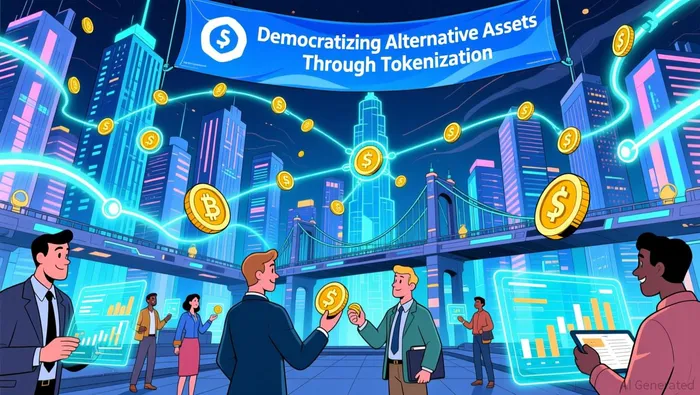
At the heart of this transformation is tokenization, which converts real-world assets into digital tokens on blockchain networks. By fractionalizing ownership, tokenization allows retail investors to access high-value assets with minimal capital. For instance, the tokenization of the Aspen St. Regis Resort enabled an $18 million investment to be split into smaller, tradable units, allowing smaller investors to participate and later trade their tokens on digital exchanges. This model is not limited to real estate. Tokenized U.S. Treasuries have seen explosive growth in 2025, with over 80% year-to-date gains, offering real-time settlement and reduced counterparty risk.
The benefits extend beyond accessibility. Tokenization automates compliance, dividend distributions, and settlements via smart contracts, reducing operational friction. For real estate, this means faster transactions, lower costs, and increased transparency. By 2035, real estate tokenization is projected to grow from $10 billion in 2025 to $4 trillion, driven by these efficiencies. Such advancements are critical for retail investors, who historically faced liquidity constraints in illiquid alternative assets.
Regulatory Tailwinds and Investor Behavior
Regulatory developments in 2025 have further accelerated this shift. The European Union's recognition of real estate tokens as utility tokens and the U.S. executive order permitting 401(k) investors to access real estate tokens have created a legal framework that supports broader adoption. Offshore funds are also playing a role, offering tax-neutral structures that streamline compliance for both U.S. and international investors.
Simultaneously, investor behavior is evolving. With traditional fixed-income yields at historic lows, retail investors are increasingly allocating to alternatives. High-net-worth individuals now allocate 80% of their portfolios to private markets, while millennials-familiar with digital assets-allocate 20% of their portfolios to alternatives compared to 6% for Baby Boomers. This generational shift underscores a growing appetite for innovation and diversification, particularly in asset classes like private real estate and infrastructure, which offer inflation protection and long-term yield.
Strategic Integration: Balancing Liquidity and Risk-Adjusted Returns
The integration of tokenized alternatives into retail portfolios requires a phased approach to balance liquidity management and risk-adjusted returns. A key challenge lies in managing the inherent illiquidity of assets like real estate and private credit. However, tokenization introduces novel solutions. For example, tokenized real estate platforms enable 24/7 trading, allowing investors to exit positions more easily than in traditional markets. Similarly, tokenized investment funds-such as BlackRock's BUIDL and Franklin Templeton's FOBXX-facilitate secondary trading and collateral use in derivatives markets, enhancing liquidity.
Risk-adjusted returns are another critical consideration. Tokenized portfolios can be diversified across asset classes and narratives, mitigating volatility. AI-driven strategies, such as those employed by Token Metrics, optimize risk management by automating rebalancing and position sizing. For instance, AI-powered crypto indices have historically outperformed Bitcoin-only portfolios by maintaining balanced exposure across multiple asset classes. These tools are now being adapted for tokenized alternatives, enabling retail investors to achieve Sharpe ratios comparable to institutional-grade portfolios.
Case Studies: Lessons from the Frontlines
Several 2025 case studies illustrate the potential of tokenized alternatives. The tokenization of a New York luxury hotel allowed fractional ownership starting at $1,000, generating $50 million in capital while automating rental income distribution via smart contracts. Similarly, the European Investment Bank's digital bonds and BlackRock's Ethereum-based fund demonstrate how institutional-grade tokenization can create regulated secondary markets with atomic settlement mechanisms.
In the realm of risk management, tokenized U.S. Treasuries have become a cornerstone of RWA ecosystems, offering real-time settlement and transparency. These assets, combined with tokenized real estate and private credit, enable investors to construct portfolios that balance yield, liquidity, and risk.
The Path Forward: A Phased Integration Framework
To harness these opportunities, retail investors should adopt a phased integration framework:
1. Education and Due Diligence: Begin with small allocations to tokenized assets with proven track records, such as U.S. Treasuries or real estate.
2. Liquidity Layering: Use tokenized funds and interval funds to maintain liquidity while accessing illiquid assets.
3. AI-Driven Optimization: Leverage AI tools to rebalance portfolios dynamically, ensuring risk-adjusted returns align with investor objectives.
4. Regulatory Compliance: Partner with platforms that adhere to evolving regulations, such as EU utility token frameworks and U.S. 401(k) guidelines.
This approach mitigates the risks of overexposure while capitalizing on the scalability of tokenized alternatives. As the market matures, early adopters will likely reap significant rewards, with tokenized assets projected to reach $13–18 trillion by 2033.
Conclusion
The structural shift in retail access to alternative assets is not a passing trend but a fundamental reconfiguration of global capital markets. Tokenization, regulatory innovation, and evolving investor behavior are converging to create a more inclusive, liquid, and efficient ecosystem. For retail investors, the challenge lies in navigating this complexity through strategic, phased integration. By prioritizing liquidity management and risk-adjusted returns, investors can harness the long-term alpha potential of tokenized alternatives while mitigating the inherent risks of this nascent market.







Comentarios
Aún no hay comentarios