
The Structural Shift in Institutional Bitcoin Demand: What ETF Outflows Reveal About Market Maturation
The institutional BitcoinBTC-- market is undergoing a profound transformation. While 2025 witnessed significant outflows from Bitcoin ETFs-driven by macroeconomic headwinds, regulatory uncertainty, and profit-taking-these developments are not indicative of a collapse in demand. Instead, they reveal a maturing market where institutional investors are recalibrating risk strategies and redefining Bitcoin's role in their portfolios. By 2026, the interplay of regulatory clarity, capital preservation imperatives, and structural shifts in ETF dynamics suggests Bitcoin is evolving from a speculative momentum trade to a strategic, capital-preserving asset class.
2025 Outflows: A Correction, Not a Collapse
In early 2025, U.S.-listed Bitcoin ETFs experienced sustained outflows, with over $7.2 billion withdrawn over five weeks. This exodus was fueled by the Federal Reserve's hawkish stance, rising interest rates, and a broader rotation into fixed-income assets. Additionally, the aftermath of Bitcoin's 2024 bull run-peaking at $108,000-triggered profit-taking as investors sought higher-yielding opportunities in AI, robotics, and machine learning ETFs.
However, these outflows masked a deeper trend: institutional investors were not abandoning Bitcoin but re-evaluating its risk profile. Regulatory uncertainty, particularly the stalled progress on U.S. crypto legislation and concerns over token unlock schedules, exacerbated caution. Yet, even amid outflows, BlackRock's iShares Bitcoin Trust (IBIT) attracted modest inflows, signaling residual institutional trust in regulated crypto products.
The 2025 Liquidation Crisis and Institutional Rebalancing
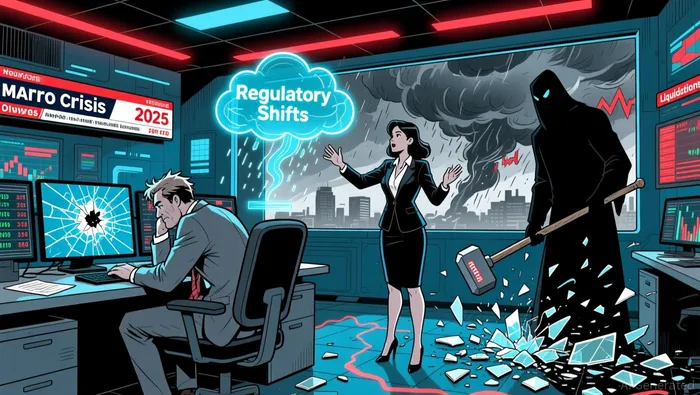
The year 2025 also saw a liquidity vacuum in crypto derivatives markets, with over $1.2 trillion in market value erased due to leveraged position liquidations. Bitcoin's 30% plunge in late 2025 challenged its "safe-haven" narrative, prompting institutions to prioritize risk mitigation. Long-term holders, who had weathered the 2022 bear market, began aggressive sell-offs in December 2025, compounding downward pressure.
These events forced institutional investors to adopt a more defensive posture. By Q4 2025, Bitcoin ETFs recorded a net outflow of $4.57 billion, yet the broader ETF and ETP market still saw record inflows of $1.3 trillion for the year. This duality highlights a critical shift: while short-term volatility spooked some, long-term capital remained attracted to Bitcoin's structural appeal.
2026: Regulatory Clarity and Capital Preservation Take Center Stage
By 2026, the institutional Bitcoin landscape has matured. Regulatory frameworks such as the EU's MiCA and the U.S. approval of spot Bitcoin ETFs have created structured environments for institutional participation. BlackRock's IBIT and Fidelity's FBTC now hold over $115 billion in combined AUM, reflecting growing confidence in regulated crypto vehicles.
Institutional adoption has shifted from speculative bets to strategic allocations. Digital assets now account for 16% of average institutional portfolios, up from 7% in 2023. This growth is driven by Bitcoin's dual role as an inflation hedge and a store of value amid concerns over fiat currency debasement and rising public debt. Harvard Management Company's 257% increase in its IBITIBIT-- position in Q3 2025 exemplifies this trend.
Moreover, 2026 projections suggest Bitcoin could trade between $120,000 and $250,000, depending on sustained institutional buying and regulatory progress. EthereumETH--, too, is gaining traction as a programmable infrastructure for DeFi and tokenization, with price targets ranging from $4,500 to $12,000.
Structural Maturation: From Speculation to Strategic Allocation
The structural changes in ETF flow dynamics underscore this maturation. While 2025 saw volatility and outflows, 2026 is marked by reduced price swings and stronger risk-adjusted returns. Institutional investors are prioritizing integration, cybersecurity, and multi-jurisdictional compliance over speculative gains. The rise of tokenized real-world assets (RWAs) and on-chain treasury products further demonstrates confidence in blockchain's operational readiness.
Notably, the supply-demand imbalance in Bitcoin-driven by ETF demand exceeding annual production by 4.7 times-suggests upward pressure if demand remains robust. This dynamic, coupled with miners scaling back operations post-2024 halving, reinforces Bitcoin's scarcity narrative.
Conclusion: A New Era for Institutional Bitcoin
The 2025 outflows and liquidation events were not a rejection of Bitcoin but a necessary correction in its journey toward institutional legitimacy. By 2026, the market has entered a phase of consolidation, where Bitcoin is increasingly viewed as a capital-preserving asset rather than a speculative play. Regulatory clarity, structural ETF innovations, and macroeconomic tailwinds position Bitcoin as a cornerstone of diversified institutional portfolios. For investors, this signals a compelling case for long-term strategic positioning in 2026 and beyond.





Comentarios
Aún no hay comentarios