
The Structural Risks in Prediction Market Trading: Lessons from a $2M Polymarket Whale Loss
The $2 million loss incurred by a Polymarket whale in 2025 serves as a cautionary tale for investors navigating decentralized prediction markets. This incident, rooted in a confluence of structural vulnerabilities and behavioral finance pitfalls, underscores the fragility of these markets despite their growing popularity. By dissecting the interplay between oracle manipulation, liquidity shocks, and cognitive biases, this analysis reveals critical lessons for risk management in a rapidly evolving financial ecosystem.
Structural Risks: Liquidity Shocks and Oracle Manipulation
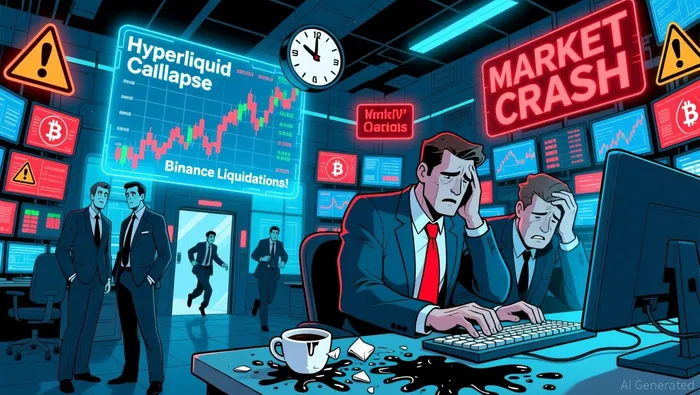
Decentralized prediction markets like Polymarket rely on oracles to resolve outcomes, yet these systems are inherently susceptible to manipulation. In 2025, a UMA tokenUMA-- holder exploited the platform's governance model by staking 5 million UMAUMA-- tokens to sway a vote on a Ukraine mineral deal market, artificially settling a $7 million contract. This manipulation was compounded by the broader liquidity crisis triggered by U.S. tariffs on Chinese software, which caused a $20 billion crypto liquidation event. Platforms like Hyperliquid and Binance faced cascading failures as Auto-Deleveraging mechanisms punished profitable traders to offset insolvent positions.
Oracle vulnerabilities were further exposed by the "Zelenskyy Suit Case," where a $240 million market was resolved against media consensus due to a $25 million UMA token challenge. These incidents highlight how concentrated voting power and inadequate dispute resolution protocols can distort market outcomes. Meanwhile, liquidity shocks-exacerbated by fragmented exchange pricing (e.g., 5% BTC/USD divergences on Coinbase)-eroded the reliability of decentralized price benchmarks.
Behavioral Finance Biases: Overconfidence and Herding
Behavioral biases amplified the structural risks. Overconfidence, a well-documented phenomenon in speculative markets, led traders to overestimate their predictive accuracy. A 2024 study found that 60% of volume-based signals were misleading, encouraging herding behavior as traders followed perceived trends without critical analysis. This was evident in the Maduro arrest incident, where three newly created wallets exploited non-public information to secure $630,484 in profits. Such cases reveal how information asymmetry and lack of regulatory oversight create fertile ground for manipulation.
Retail traders, often unaware of these dynamics, face a 99% probability of losses due to their inability to compete with institutional-grade data and speed. The absence of traditional market makers in decentralized platforms further exacerbates speculative fervor, as seen in the $317.91 million TVL in NFT floor price crash prediction markets.
Interactions Between Structural and Behavioral Risks
The $2M loss exemplifies how structural and behavioral risks compound. Oracle manipulation created artificial certainty in market outcomes, which overconfident traders then leveraged. For instance, the UMA-based optimistic oracle system's vulnerability to 51% attacks-where a single actor could manipulate settlements-was exploited during the liquidity crisis. Simultaneously, herding behavior amplified losses as traders followed flawed signals, compounding the impact of oracle errors and liquidity crunches.
Risk Mitigation Strategies
To prevent such losses, investors must adopt multi-layered risk management strategies. Diversifying across AMM and order-book platforms reduces exposure to platform-specific vulnerabilities. Oracle redundancy-using multi-feed aggregators like UMA or hybrid systems-can mitigate single-point failures as proposed by DeFi platforms. Additionally, AI-driven monitoring tools, as proposed by DeFi platforms, enable real-time detection of suspicious wallet activity and liquidity manipulation.
Regulatory innovations, such as delayed settlement mechanisms, could curb insider trading. Meanwhile, hybrid prediction markets integrating stablecoin collateral with yield-bearing options may stabilize outcomes while capturing regulatory tailwinds as proposed by DeFi platforms.
Conclusion
The $2M Polymarket loss is a microcosm of the broader challenges facing decentralized prediction markets. Structural risks like oracle manipulation and liquidity shocks, when combined with behavioral biases such as overconfidence and herding, create a volatile environment where only the most informed and diversified participants thrive. As these markets mature, robust governance, technological innovation, and behavioral awareness will be essential to preserving their integrity and utility.







Comentarios
Aún no hay comentarios