
Structural Retirement: A Macro-Driven Framework for the 2026-2035 Decade
The retirement savings crisis is structural, not incidental. The data reveals a staggering systemic gap: fewer than 5% of Americans have actually reached the $1 million milestone that many consider a baseline for a comfortable retirement. This isn't a failure of individual effort alone. It points to a fundamental flaw in the conventional planning models that have dominated for decades. The math simply doesn't work for the vast majority, creating a macro-level risk that transcends personal finance.
The traditional 60/40 portfolio, once the gold standard, is proving insufficient for this new reality. Its sustainability is not guaranteed but is highly dependent on a narrow set of conditions. Research shows that poor market returns early in retirement can greatly reduce savings, a phenomenon known as sequence-of-returns risk. This isn't a theoretical concern; it's a critical vulnerability. For a retiree drawing down a portfolio for 30 years, a string of negative returns in the first five years can devastate the capital base, making it nearly impossible to recover even if markets rebound later. A static allocation model cannot adapt to this dynamic threat.
This creates a dangerous mismatch. The 60/40 strategy was designed for a different era, one where defined benefit pensions were common and market volatility was more predictable. Today, it is a starting point, not a finish line. Its effectiveness is a function of initial savings and market conditions, both of which are now less favorable for the average saver. The bottom line is that conventional planning fails to address the scale of the problem. A dynamic, multi-decade strategy is required-one that moves beyond a fixed asset mix to incorporate flexible withdrawal rules, proactive risk management, and a clear understanding that retirement security is a journey, not a destination.
The Dual-Engine Portfolio: Growth Infrastructure Meets Income Stability
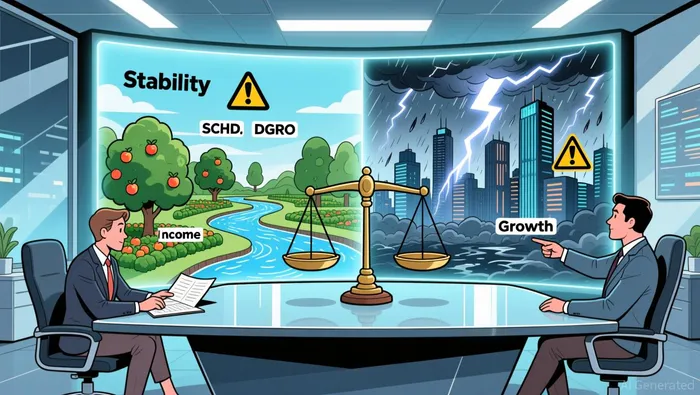
The modern investor's challenge is balancing two opposing forces: the need for long-term capital growth and the imperative for near-term income stability. The solution lies in a dual-engine portfolio architecture-one that systematically combines high-growth speculative assets with diversified, income-generating vehicles. This framework acknowledges that growth is not free; it carries volatility that must be offset by a stable foundation.
The income engine is built on exchange-traded funds that provide broad diversification and a buffer against market swings. Funds like the Schwab U.S. Dividend Equity ETF (SCHD) offer a yield of 3.7%, more than three times the average S&P 500 stock, while maintaining a low beta of less than 0.7. This stability is achieved through a portfolio of 102 stocks with a modest price-to-earnings multiple, heavily weighted toward sectors like energy and consumer staples. Similarly, the iShares Core Dividend Growth ETFDGRO-- (DGRO) provides a more modest 2% yield but focuses on companies with a history of growing payouts, offering a dual benefit of income and potential capital appreciation. These vehicles dramatically reduce the risk of a single dividend cut, a vulnerability inherent in individual stock picking.
Against this stable base, the growth engine targets transformative infrastructure plays. For investors with a long time horizon, the power of compounding is undeniable. A simple $100,000 investment in an S&P 500 index fund could still blossom to $259,000 if it grows at a 10% CAGR over ten years. This demonstrates the foundational role of broad market exposure. To capture outsized returns, a portion of capital can be allocated to high-conviction, high-risk names like Plug Power or ChargePoint. These are not income generators; they are bets on the scaling of new technologies, with the potential for multi-bagger returns if successful.
The critical discipline is sizing. Growth assets like these speculative stocks must be carefully calibrated within the broader portfolio to manage concentration risk. They are not replacements for the income engine but supplements to it. The framework's strength is its structural acknowledgment of this duality: it provides a mechanism to pursue aggressive growth while simultaneously building a defensive, income-producing core. This is the essence of a balanced, forward-looking portfolio.
Mechanics of Income Generation: From Cash Reserves to Tax Efficiency
The mechanics of generating reliable retirement income are less about chasing high returns and more about constructing a resilient, multi-layered system. The foundation is a deliberate, defensive allocation designed to protect capital during market stress. The first rule is to hold a year's worth of spending in cash. This provides a buffer against the need to sell equities during a downturn, a critical move given that the average recovery time for stocks after a bear market is roughly three and a half years. Beyond that, holding two to four years' worth of living expenses in short-term bonds or CDs creates a second safety net. This structure ensures that regular income needs can be met without touching the growth-oriented portion of the portfolio, preserving its ability to compound over the long retirement horizon.
This defensive posture is then balanced with a strategic allocation to growth assets. The portfolio's remaining assets should be diversified across stocks, bonds, and cash, with the exact mix shifting as the retiree ages. A younger retiree might maintain a moderate portfolio (60% stock, 35% bonds, 5% cash), prioritizing longevity risk protection. As age increases, the focus naturally shifts toward income generation and capital preservation. This dynamic balance is essential; being too conservative too soon can jeopardize the portfolio's ability to outpace inflation over decades.
A third, often overlooked, pillar is tax efficiency. Required Minimum Distributions (RMDs) from traditional retirement accounts create a predictable tax liability that must be planned for. The key is to view RMDs not just as a compliance burden but as a planning opportunity. One powerful tool is the Qualified Charitable Distribution (QCD), which allows individuals to send money directly from their IRA to a registered charity, satisfying the RMD requirement without it being counted as taxable income. This strategy can significantly reduce a retiree's tax bill, especially for those who itemize deductions or are otherwise in a higher tax bracket.
Finally, the ultimate source of control comes from diversifying across account types. Relying solely on tax-deferred accounts like traditional 401(k)s or IRAs concentrates tax risk. By contrast, holding assets in a mix of taxable, tax-deferred, and tax-free (Roth) accounts provides flexibility. This diversification allows retirees to manage their tax bracket in any given year by choosing which account to draw from. It also simplifies planning, as consolidating assets under a single advisor can streamline RMD calculations and beneficiary management. In practice, this layered approach-cash for safety, bonds for stability, stocks for growth, and tax planning for efficiency-transforms a retirement portfolio from a simple savings account into a sophisticated, self-sustaining income engine.
Risk Management & Scenario Planning: Navigating Volatility and Policy Shifts
The core of any robust investment framework is stress-testing. For a portfolio, this means mapping the key risks-market, policy, and behavioral-and defining clear metrics to monitor health. Three critical metrics emerge from the current environment.
First, extreme volatility demands strict position sizing. Consider the case of a stock like ChargePoint, which has seen a year-to-date decline of -65.79% and a rolling annual return of -68.17%. This isn't just a bad year; it's a signal of concentration risk. A single position with this kind of drawdown can destabilize a portfolio. The rule here is simple: size positions so that even a catastrophic loss on one holding doesn't threaten the overall capital base. This is the first line of defense against volatility.
Second, policy shifts can directly erode retirement income. For retirees, the 2026 budget must account for known cost increases. Medicare Part B premiums are scheduled to rise, and Social Security benefits will receive a 2.8% cost-of-living adjustment. The net effect on disposable income is not automatic. The COLA may be offset by higher premiums, leaving the retiree with less real purchasing power. This requires proactive planning, not passive acceptance. Monitoring the actual premium hike and its impact on net Social Security checks becomes a key metric for income sustainability.
Third, portfolio rebalancing is essential to maintain the intended risk profile. Over time, winning assets grow faster than losing ones, causing the portfolio to drift from its target allocation. This drift creates unintended concentration risk. For instance, a stock that has doubled in value may now represent 15% of the portfolio, a level that was never the intended exposure. The solution is disciplined rebalancing-selling some of the winners to buy more of the laggards. This forces a rational check on behavioral biases and ensures the portfolio remains aligned with the investor's long-term risk tolerance and return objectives.
The bottom line is that risk management is an active, ongoing process. It requires monitoring metrics for volatility, policy impacts, and portfolio drift. By focusing on these three areas, investors can build a more resilient framework capable of navigating both market turbulence and structural shifts in income.





Comentarios
Aún no hay comentarios