
Structural Limitations of FVD and the Struggle of Dividend-Focused Strategies in a Growth-Dominated Market
The past five years have underscored a stark divergence between growth and value investing paradigms. As of December 2025, growth-oriented ETFs-particularly those tracking indices like the S&P 500 Pure Growth Index-have delivered explosive returns, with a . In contrast, value ETFs like the First Trust Value Line® Dividend Index Fund (FVD) have lagged, in the past year. This underperformance reflects broader structural challenges facing dividend-focused strategies in a market increasingly dominated by high-growth, low-yield sectors.
FVD's Strategy: A Defensive Approach in a High-Growth Environment
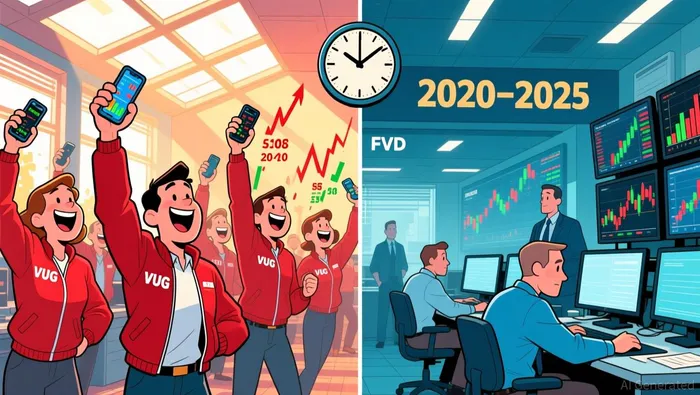
FVD's investment thesis centers on low-volatility, dividend-paying stocks with strong financial stability and above-average yields. Its portfolio is equally weighted across utilities, industrials, and financials, excluding companies with market capitalizations below $1 billion. While this approach prioritizes income and resilience, it has struggled to compete with the compounding power of growth stocks. For instance, the Vanguard Growth ETFVUG-- (VUG), heavily weighted in technology and communications (80.1% of its holdings), from 2020 to 2025, . , while attractive in a low-interest-rate environment, pales against the capital appreciation of growth-oriented peers.
Structural Limitations: Methodology vs. Market Realities
FVD's equal-weighted index and exclusion criteria inherently limit its exposure to high-growth sectors. The S&P 500 Pure Growth Index, for example, , compared to FVD's negligible presence in these areas. This misalignment has been exacerbated by the dominance of large-cap tech stocks like Apple and Microsoft, which have driven much of the market's gains. Additionally, FVD's focus on dividend yields-often prioritizing income over reinvestment-has left it vulnerable to the reinvestment cycles of growth companies, which channel profits into innovation and expansion.
Analyst Perspectives and Investor Sentiment
Despite its underperformance, FVDFVD-- retains a niche appeal. , citing its defensive characteristics and sector diversification. However, critics highlight its high expense ratio and underperformance relative to peers like the (VLUE), which as of December 2025. The fund's reliance on the -a decades-old screen for dividend-paying companies-has also drawn scrutiny for its lack of adaptability to modern market dynamics.
Viability in the Current Climate
The viability of FVD's model hinges on macroeconomic conditions. In a low-yield environment, its income focus may attract risk-averse investors, but in a growth-dominated market, its structural constraints become liabilities. As of 2025, growth ETFs continue to outperform, with the S&P 500 Pure Growth Index's . While FVD's low-volatility profile offers stability, it cannot offset the compounding advantages of growth stocks in a market where innovation and scale drive returns.
Conclusion
FVD exemplifies the challenges of dividend-focused strategies in a growth-centric era. Its structural limitations-sector concentration, exclusion of high-growth companies, and a yield-centric methodology-have left it trailing broader indices and growth ETFs. While the fund may retain relevance in a market shift toward income or economic downturns, its current positioning suggests a model ill-suited to the realities of a tech-driven, capital-accumulation-focused economy. For investors prioritizing long-term growth, the data underscores a clear imperative: adapt or risk obsolescence.





Comentarios
Aún no hay comentarios