
Streaming Wars 2.0: Netflix vs. Spotify in 2026
The streaming wars have evolved from a battle for market share into a high-stakes contest for long-term sustainability in an increasingly saturated market. By 2026, NetflixNFLX-- and Spotify-two titans of digital entertainment-face a shared challenge: how to diversify revenue streams and retain subscribers in an era of diminishing growth. While both companies have adopted distinct strategies to address these pressures, their approaches reveal divergent philosophies about innovation, pricing, and ecosystem-building.
Netflix: Monetizing Live Content and Strategic Alliances
Netflix's 2026 strategy hinges on two pillars: ad-supported tiers and live content. According to a report by Monexa, the streaming giant has seen over 55% of new subscriptions in key markets come from its ad-supported plan, a segment that now generates significant advertising revenue. This shift reflects Netflix's acknowledgment of the limitations of its traditional subscription model in a world where price sensitivity is rising.
Simultaneously, Netflix is leveraging live content to differentiate itself. Partnerships with the NFL and WWE have enabled the platform to broadcast live events, a move that not only attracts new viewers but also enhances user engagement. These initiatives are critical for retaining existing subscribers, as live content creates a sense of urgency and exclusivity that on-demand libraries alone cannot replicate.
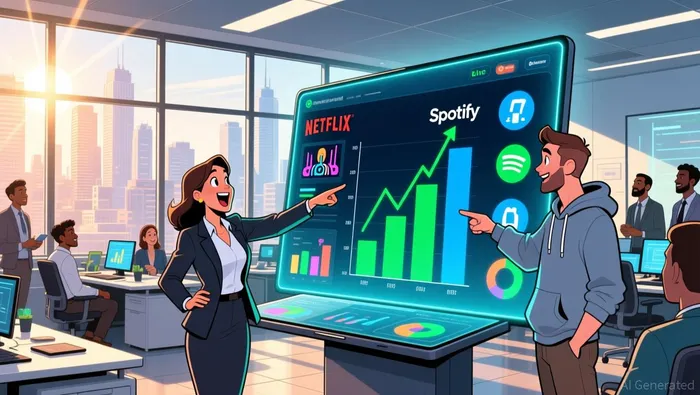
Netflix's collaboration with SpotifySPOT-- further underscores its ambition to diversify its content ecosystem. By co-creating music awards shows and concert series, Netflix aims to tap into Spotify's 281 million premium subscribers and attract younger demographics. This cross-platform synergy could prove invaluable in an era where user attention is fragmented across multiple services.
Spotify: Pricing Power and the Super-App Vision
Spotify's 2026 strategy is anchored in aggressive pricing and product innovation. The company reported a 12% year-over-year increase in premium subscribers, reaching 281 million as of Q3 2025. This growth has been driven by strategic price hikes in over 150 markets, including the UK, Switzerland, and Australia, where subscriber churn remained stable post-increase. Now, Spotify plans to extend this model to the U.S., raising Premium subscription prices in Q1 2026-a move that signals confidence in its ability to maintain user loyalty despite inflationary pressures.
Beyond pricing, Spotify is doubling down on its "audio super-app" vision. Investments in podcasts, audiobooks, and AI-driven personalization-such as the AI DJ and Daylist features-aim to position the platform as a one-stop hub for all audio content. These innovations are not just about user retention; they also open new revenue avenues, such as premium tiers in emerging markets like India and the UAE, where higher-priced subscriptions with exclusive perks are being tested.
Retention in a Saturated Market: Stability vs. Disruption
Both companies have demonstrated resilience in retaining users. Netflix's retention rates remain robust, with its content library and live events acting as moats against churn. However, its reliance on price increases and ad-supported tiers raises questions about long-term subscriber satisfaction.
Spotify, meanwhile, has outperformed expectations. Despite its global price hikes, the platform reported no slowdown in subscriber growth, with Premium users rising to 281 million in Q3 2025. This success is partly attributable to its enhanced free tier, which drives engagement and primes users for premium upgrades.
Strategic Implications for Investors
For investors, the key takeaway is that both Netflix and Spotify are adapting to market saturation through complementary strategies. Netflix's focus on live content and cross-industry partnerships reflects a defensive posture, aiming to protect its core audience while expanding into adjacent markets. Spotify, by contrast, is adopting an offensive approach, leveraging pricing power and product diversification to cement its dominance in audio consumption.
However, risks persist. Netflix's collaboration with Spotify could backfire if it cannibalizes its own content investments, while Spotify's reliance on price hikes may eventually erode user trust. Both companies must balance innovation with affordability to sustain growth.
Conclusion
The 2026 landscape for streaming services is defined by a delicate equilibrium between revenue diversification and subscriber retention. Netflix and Spotify have each carved out unique paths to navigate this terrain, but their success will ultimately depend on their ability to evolve without alienating their user bases. For investors, the streaming wars are far from over-what's next is a battle for adaptability in an era where every subscriber is a prize worth fighting for.







Comentarios
Aún no hay comentarios