
Streaming Platform Revenue Model Sustainability and Content Negotiation Risks: YouTube’s Strategic Maneuvering in the Fox Dispute
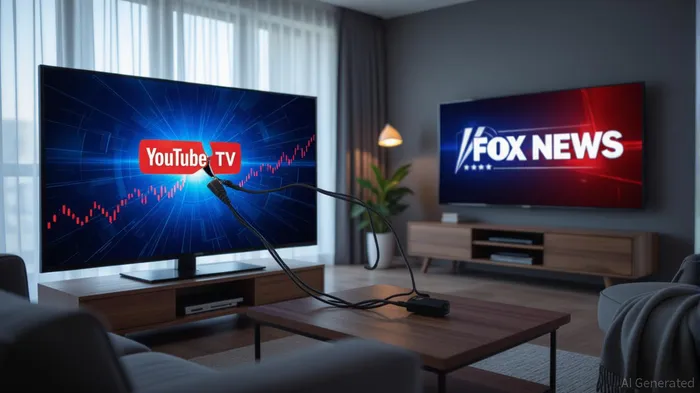
The recent short-term extension between YouTube TV and Fox to avoid a blackout of Fox’s channels underscores the fragility of streaming platform revenue models and the escalating risks of content negotiation. As the industry shifts from traditional cable to digital ecosystems, platforms like YouTube face a dual challenge: securing premium content at sustainable costs while maintaining subscriber affordability. The Fox dispute, which centers on carriage fees for sports and news programming, reveals how these pressures are reshaping the competitive landscape and investor expectations.
The Fox Dispute: A Microcosm of Industry Strains
Fox’s demand for higher carriage fees reflects a broader trend where content providers seek to monetize their assets in a streaming-first world. Fox argues that its sports and news programming—particularly college football and NFL games—command “market-aligned” rates, while YouTube TV contends that such fees exceed industry standards and risk burdening subscribers [1]. This standoff mirrors traditional cable-era disputes but with amplified stakes: a blackout could alienate millions of viewers and erode trust in YouTube’s ability to deliver reliable access to live content [2].
YouTube’s response—offering a $10 credit to affected users and promoting Fox’s direct-to-consumer (DTC) alternative, Fox One—highlights its strategic balancing act. By positioning itself as a neutral arbiter, YouTube aims to mitigate subscriber churn while signaling its commitment to affordability. However, this approach risks diluting its leverage in future negotiations, as content providers increasingly prioritize DTC platforms to capture higher margins [3].
Financial Pressures and Pricing Volatility
The dispute also exposes the financial fragility of streaming platforms. YouTube TV’s recent price hike to $82.99/month in January 2025—a 15% increase—reflects the cost of securing exclusive content and competing with rivals like NetflixNFLX-- and Disney+ [4]. Yet, such hikes risk subscriber attrition, particularly among price-sensitive users. A 2023 Charter-Disney blackout, which led to $5 billion in revenue losses for DisneySCHL-- and a 3% stock decline, illustrates the reputational and financial risks of unresolved carriage conflicts [5]. For YouTube, which lacks the subscriber base of traditional pay-TV providers, prolonged content gaps could prove catastrophic.
The rise of DTC platforms further complicates the equation. Fox One, priced at $19.99/month, offers a direct channel to cord-cutters, reducing Fox’s reliance on third-party platforms. This shift toward DTC monetization is accelerating, with experts noting that it allows content providers to bypass intermediaries and capture higher margins [6]. However, DTC strategies require significant marketing spend and user acquisition costs, which could strain Fox’s profitability if adoption lags expectations.
Strategic Implications for YouTube’s Revenue Model
YouTube’s ability to sustain its revenue model hinges on its capacity to balance affordability with content quality. The platform’s expansion into the living room—streaming over 1 billion hours of content daily on TV sets in 2024—has bolstered its market power, enabling price increases and differentiation from traditional TV [7]. Yet, this growth is contingent on maintaining access to premium content like Fox’s sports and news offerings.
Investors must also consider the broader industry dynamics. Legacy media companies, such as Paramount and Warner BrosWBD--. Discovery, are grappling with declining linear TV revenue and rising streaming costs, forcing them to adopt ad-supported tiers and bundled offerings [8]. Netflix’s aggressive content spending ($18 billion in 2025) has intensified competition, pushing rivals to prioritize profitability over subscriber growth [9]. For YouTube, the challenge lies in navigating these shifts without alienating its core audience or ceding ground to DTC competitors.
Conclusion: A Tipping Point for Streaming
The Fox-Youtube dispute is a harbinger of a new era in media valuation, where content negotiation risks and pricing volatility dominate investor concerns. Platforms must innovate to sustain revenue models—whether through tiered pricing, ad-supported tiers, or strategic partnerships—while managing the fallout from content fragmentation. For YouTube, the short-term extension with Fox buys time but does not resolve the underlying tension between content costs and affordability. As the streaming wars intensify, the ability to adapt to these pressures will determine not just survival, but leadership in the digital age.
Source:
[1] The Fox-YouTube TV Carriage Dispute: Implications for Media Consolidation and Streaming Valuations [https://www.ainvest.com/news/fox-youtube-tv-carriage-dispute-implications-media-consolidation-streaming-valuations-2508/]
[2] Streaming Carriage Disputes: A New Frontier in Media Valuations and Investment Risk [https://www.ainvest.com/news/streaming-carriage-disputes-frontier-media-valuations-investment-risk-2508/]
[3] YouTube TV viewers could lose access to Fox channels [https://www.cbsnews.com/news/youtube-tv-fox-dispute-carriage-fees/]
[4] YouTube TV price hike follows platform's massive living room growth [https://www.emarketer.com/content/youtube-tv-price-hike-follows-platform-s-massive-living-room-growth]
[5] The Future of Streaming Platforms: Key Trends and Outlook [https://www.alpha-sense.com/blog/trends/streaming-platforms-key-trends-and-outlook/]
[6] Bad News For Hollywood: Netflix Content Spending To Rise [https://www.forbes.com/sites/dbloom/2025/03/06/bad-news-hollywood-and--investors-netflix-content-spending-to-rise-11/]
[7] The State of the Streaming Industry in 2025: Triumphs, Turmoil, and Transformation [https://wingding.tv/the-state-of-the-streaming-industry-in-2025-triumphs-turmoil-and-transformation/]
[8] Top 3 trends from our 2025 Annual Streaming Study [https://www.simon-kucher.com/en/insights/top-3-trends-our-2025-annual-streaming-study]
[9] Streaming services profitability | Deloitte Insights [https://www.deloitte.com/us/en/insights/industry/technology/technology-media-and-telecom-predictions/2024/tmt-predictions-streaming-video-services-profitability-must-increase-in-2024.html]







Comentarios
Aún no hay comentarios