
Strathcona Energy’s Bold Pivot: A Strategic Play for Sustainable Growth and Undervalued Value
In a market increasingly demanding operational precision and capital discipline, Strathcona Resources Ltd. (TSX: SCR) has executed a masterstroke: a $2.84 billion divestiture of its Montney shale assets coupled with a $45 million acquisition of the Hardisty Rail Terminal (HRT). This strategic reallocation—shifting from high-cost, gas-heavy operations to a streamlined, heavy oil-focused model while seizing control of critical logistics infrastructure—positions the company to reduce costs, amplify free cash flow, and capitalize on underappreciated value. For investors, this is a rare opportunity to capitalize on a rebalanced portfolio and a countercyclical infrastructure play.
Portfolio Optimization: From Complexity to Clarity
The Montney asset sales mark a decisive shift toward simplicity. These assets, while profitable, contributed only 12% of Strathcona’s 2024 operating earnings and 15% of its proved reserves, yet required significant capital to maintain. By divesting them, Strathcona reduces operational complexity, repays $2.58 billion in debt, and transitions to a “pure-play heavy oil company”. Post-sale, 95% of production will come from thermal and conventional heavy oil assets, with a 50-year 2P reserve life index—a metric underscoring long-term stability.
The move also unlocks $5.5 billion in tax pools, shielding the company from cash tax liabilities and bolstering its net cash position. This financial flexibility is critical as Strathcona pivots to a capital-light growth model, with 2025 capital spending reduced to $1.2 billion and a focus on sustaining 120–125 Mbbls/d of oil production by late 2025.
The Hardisty Terminal: A Countercyclical Hedge and Cash Flow Machine
The $45 million acquisition of the HRT—North America’s largest crude-by-rail terminal—represents a visionary infrastructure play. With 262 Mbbls/d capacity and $12 million annual free cash flow (80% under long-term contracts), this asset is a strategic linchpin:
- Risk Mitigation: The terminal provides a hedge against pipeline bottlenecks, which have historically constrained oil exports. At peak utilization, it can handle 82% of its capacity, ensuring Strathcona retains egress options even in tight markets.
- Operational Synergy: Directly connected to the Hardisty Diluent Recovery Unit, the HRT improves netbacks by separating diluent from raw bitumen, a critical process for Strathcona’s thermal-heavy production mix.
- Scale and Stability: Combined with Strathcona’s Hamlin Terminal, the acquisition controls 80% of Western Canada’s crude-by-rail volumes, leveraging economies of scale and enhancing pricing power.
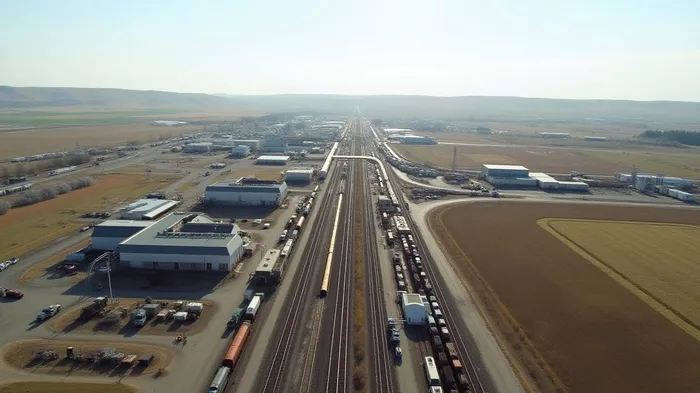
The terminal’s $200 million replacement cost underscores its undervalued price tag, while its low utilization rate (19% at acquisition) leaves room to scale during periods of rising demand. This asset alone justifies a reevaluation of Strathcona’s valuation multiple.
The Path to Sustainable Growth: Free Cash Flow and Valuation
Strathcona’s moves set the stage for a self-funding growth model, with free cash flow expected to grow steadily. Key catalysts include:
1. Production Growth: Targeting 195 Mbbls/d by 2031 (8% CAGR) via thermal projects in Cold Lake and Lloydminster, with minimal capital requirements post-2025.
2. Cost Discipline: Capital expenditures will average $0.9–1.2 billion annually through 2029, declining to $0.85 billion by 2031, as sustaining costs shrink with mature assets.
3. Debt Reduction: Post-sale net debt is projected to drop to $5.78 billion, with a positive net cash position by year-end .
At current prices, Strathcona trades at a discount to its peers, with a price-to-EBITDA multiple of 4.5x versus the sector average of 6.2x. This undervaluation is stark when considering its $12 million annual terminal cash flow, tax-advantaged position, and low-risk thermal assets.
Why Act Now?
The market has yet to fully price in Strathcona’s transformation. Investors should act on three compelling signals:
1. Operational Focus: A streamlined portfolio reduces execution risk and aligns with the long-term viability of thermal oil, a niche with stable demand.
2. Infrastructure Control: The HRT acquisition adds a cash-generating asset with asymmetric upside during supply chain disruptions.
3. Valuation Inversion: The stock’s current price reflects old risks (Montney complexity) but not new opportunities (HRT synergies, tax efficiency).
Conclusion: A Long Position in a Reborn Energy Giant
Strathcona’s strategic reallocation is not merely a defensive move—it’s a calculated shift toward sustainable, capital-efficient growth. By shedding non-core assets and acquiring a crown jewel in logistics, the company has positioned itself to thrive in both stable and stressed market conditions. With a debt-reduced balance sheet, low-cost thermal reserves, and an infrastructure asset primed for scalability, Strathcona represents a compelling buy at current levels. Investors who act now can capitalize on a stock undervalued by the market’s short-term focus, unlocking value as the company’s long-range plan unfolds.
The time to position for this rebalancing is now.







Comentarios
Aún no hay comentarios