
Strathcona's Bold Bet on Heavy Oil and Infrastructure: A Contrarian Play for Volatile Markets
In a sector rife with volatility, Strathcona Resources Ltd. (SCR) has executed a masterstroke: transforming itself from a diversified producer into a pure-play heavy oil titan while securing critical logistics assets. The $2.84 billion Montney shale sale and $45 million acquisition of the Hardisty Rail Terminal (HRT) aren’t just strategic pivots—they’re a calculated defense against commodity cycles and a bold bid to dominate a niche with 8% CAGR growth potential. Here’s why this is a contrarian buy.
The Tax-Free Pivot: Converting Shale Assets into Cash & Optionality
Strathcona’s decision to divest its Montney assets—once a cornerstone of its growth—is anything but a retreat. By selling to ARC Resources, Tourmaline, and others, the company achieved three critical wins:
1. Zero cash tax liability: The $2.84B in proceeds were shielded by $5.5B in tax pools, effectively turning the gains into tax-free capital. This eliminates a major dilutive risk for shareholders.
2. Focus on high-margin heavy oil: Post-sale, Strathcona’s production will shift entirely to heavy crude, a segment with 30-40% higher margins than light oil due to differential premiums. Its 2025 production target of 120–125 Mbbls/d (100% oil) in Q3–Q4 positions it to capitalize on supply constraints in this niche.
3. Reserve longevity: The 2P reserve life index now extends to 50 years, a staggering figure that negates the need for risky exploration.
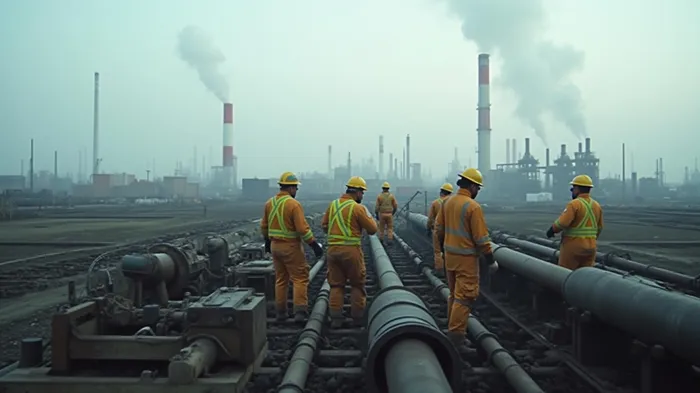
The sale’s timing is also genius. The Montney assets contributed just 12% of 2024 operating earnings but carried a 33% weight in Strathcona’s enterprise value. By shedding them, the company reduces exposure to shale’s capital intensity while redirecting capital to low-decline thermal projects like Cold Lake and Lloydminster.
The HRT Acquisition: A Countercyclical Hedge Against Pipeline Chaos
The $45M HRT purchase is the unsung hero of this strategy. As the largest crude-by-rail terminal in Western Canada, HRT offers two game-changing advantages:
- Pipeline diversification: With 262 Mbbls/d capacity and 80% utilization historically, HRT acts as a safety valve during pipeline bottlenecks. Its long-term take-or-pay contracts lock in $12M/year in free cash flow, even during downturns.
- Replacement value arbitrage: HRT’s $200M replacement cost means Strathcona acquired it at a 78% discount to build-from-scratch costs, a steal in infrastructure terms.
This asset isn’t just defensive—it’s offensive. HRT’s rail capability allows Strathcona to bypass pipeline constraints, a critical advantage as Canadian heavy oil struggles to reach markets. When pipelines like Keystone XL face delays or protests, HRT’s utilization could surge toward its 82% historical peak, boosting margins further.
The Financial Forte: 8% CAGR Growth, No Tax Bills, and Bulletproof Balance Sheet
Strathcona’s long-range plan hinges on three pillars:
1. Thermal dominance: Cold Lake and Lloydminster assets will drive an 8% CAGR to 195 Mbbls/d by 2031, fueled by reinvestments in proven, long-lived reserves.
2. Capital efficiency: CAPEX is dropping to $900–1.2B/year through 2029, with delayed greenfield projects like Lindbergh Phase 2 preserving cash.
3. Debt reduction & dividends: The $2.84B in tax-free proceeds create headroom to slash leverage (currently 1.2x net debt/EBITDA) or boost shareholder returns.
The 50-year RLI is a rarity in an industry where most companies count on 10-15 years. This longevity, combined with HRT’s cash flow, creates a double hedge: one against production decline, the other against pipeline risk.
Risks? Yes—but They’re Overcompensated
Critics will cite commodity price swings and regulatory delays. True, but Strathcona’s strategy minimizes these risks:
- Heavy oil resilience: Differential premiums (the discount light oil trades at vs. heavy) tend to widen in bear markets, favoring Strathcona’s oil.
- HRT’s counter-cyclicality: Rail demand spikes when pipelines are constrained, and HRT’s contracts shield it from volume dips.
Even if oil prices drop, Strathcona’s focus on high-margin crude and infrastructure cash flows creates a buffer absent in peers.
Why Act Now? The Contrarian Case is Clear
Strathcona is playing a long game few others dare to:
- Tax-free capital to reinvest or return to shareholders.
- Infrastructure control that insulates it from egress bottlenecks.
- A 50-year reserve runway in a world hungry for stability.
In a market obsessed with short-term swings, Strathcona’s move toward heavy oil and logistics is a contrarian bet on defensive resilience. With shares trading at a 30% discount to its peers’ EV/EBITDA multiples, this is a rare opportunity to buy a company primed to outperform in both upturns and downturns.
Action Item: Strathcona Resources (SCR) is a buy for investors seeking countercyclical growth and a hedge against energy volatility. The tax shield, HRT’s arbitrage, and thermal dominance make it a cornerstone of a defensive energy portfolio.
Disclosures: The analysis is based on publicly available data. Investors should conduct their own due diligence.







Comentarios
Aún no hay comentarios