
Strategic Utility Investments: Powering Regional Economic Growth Through Energy Reliability
In the evolving landscape of global energy and economic development, strategic utility infrastructure investments have emerged as a linchpin for regional competitiveness. From 2003 to 2023, U.S. utility spending on electricity transmission and distribution infrastructure nearly tripled and increased by 160%, respectively, driven by aging systems and the integration of renewable energy, according to EIA Today in Energy. These figures underscore a critical shift: modernizing energy grids is no longer just about reliability-it is a catalyst for economic transformation.
The Infrastructure-Driven Growth Engine
Federal and state-level policies are amplifying this trend. The CHIPS and Science Act, for instance, has catalyzed regional economic growth through targeted investments. A $100 billion semiconductor facility in Syracuse, New York, exemplifies how federal incentives can spur job creation and long-term industrial competitiveness, according to a Brookings analysis. Similarly, international case studies-such as Germany's Autobahn network and Singapore's transit systems-demonstrate that infrastructure investments enhance trade, attract businesses, and elevate property values, as shown in a Sparkmoor review.
The economic ripple effects of utility investments are particularly pronounced in regions adapting to surging electricity demand. Data centers, which now consume 6% to 8% of U.S. annual electricity generation, are projected to account for 11% to 15% by 2030, according to EIA data. To meet this demand, utilities are deploying advanced technologies like grid-enhancing conductors and smart grid systems. For example, reconductoring U.S. power lines could quadruple transmission capacity by 2035, enabling the integration of renewables while supporting data-driven industries, EIA finds.
Financing the Future: Public-Private Partnerships and Policy Innovation
The scale of these investments requires innovative financing. Public-private partnerships (P3s) have enabled states like Pennsylvania to accelerate infrastructure delivery, while value capture methods allow communities to monetize the economic value generated by new projects, according to the ASCE report. In rural areas, community banks are playing a pivotal role in financing renewable energy projects, fostering local energy security and job creation, as noted in a ResearchGate study.
Federal policies like the Infrastructure Investment and Jobs Act (IIJA) and the Inflation Reduction Act (IRA) are further reshaping the landscape. The ASCE 2025 Infrastructure Report highlights that transmission capacity must double to accommodate renewable energy integration and ensure grid resilience. However, utilities face challenges, including workforce shortages and balancing cost recovery with affordability for ratepayers, as Brookings notes.
Global Megatrends and Regional Opportunities
Internationally, the strategic importance of utility infrastructure is intensifying. Institutional investors and corporations are competing to control the grid and digital backbones of the economy, with integrated financing models spanning clean energy, digital infrastructure, and advanced grid systems, according to the ResearchGate paper. For instance, the Tennessee Valley Authority's partnership with Origis Energy to develop power plants for Google's data centers illustrates how regional utilities can leverage tech-sector growth to drive economic development, per EIA reporting.
Meanwhile, nuclear energy is re-emerging as a key component of the energy transition. Utilities are extending the operational lives of nuclear reactors and repurposing coal plant sites for new facilities, balancing reliability with sustainability goals, as the Brookings analysis explains. Circular economy initiatives are also gaining traction, addressing resource constraints and environmental impacts in infrastructure development, the ResearchGate study observes.
Conclusion: A Blueprint for Investors
For investors, the interplay between utility infrastructure and regional economic growth presents compelling opportunities. Regions with robust grid modernization programs-such as Georgia, where utilities are building new gas plants to meet energy demands-offer a glimpse into the future of infrastructure-driven growth, according to EIA. However, success hinges on collaboration between public and private sectors, as well as adaptive policy frameworks.
As the global energy transition accelerates, strategic utility investments will remain central to achieving both energy reliability and economic resilience. The data is clear: infrastructure is not just a foundation for growth-it is the engine.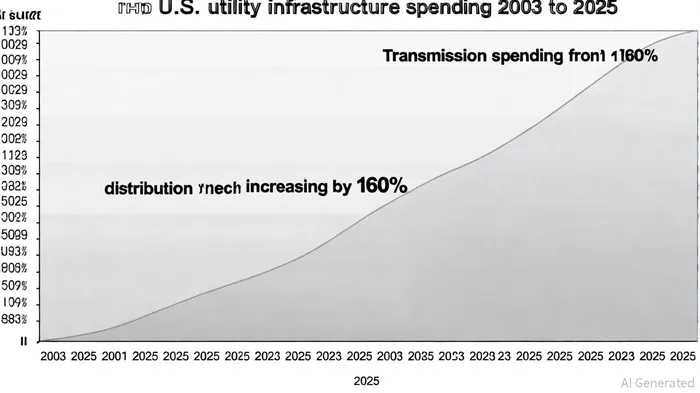







Comentarios
Aún no hay comentarios