
The Strategic Value of Trezor in Long-Term Crypto Portfolio Security
In an era where crypto assets face escalating threats from cyberattacks and market volatility, hardware wallets have emerged as a cornerstone of risk mitigation for both institutional and retail investors. Among these solutions, Trezor, developed by SatoshiLabs, stands out as a market leader, combining cutting-edge security, custodial independence, and ecosystem integration to address the evolving needs of the crypto landscape. This analysis evaluates Trezor's strategic value in 2025, emphasizing its role as an essential infrastructure asset for securing long-term crypto portfolios.
Market-Leading Security: A Foundation for Trust
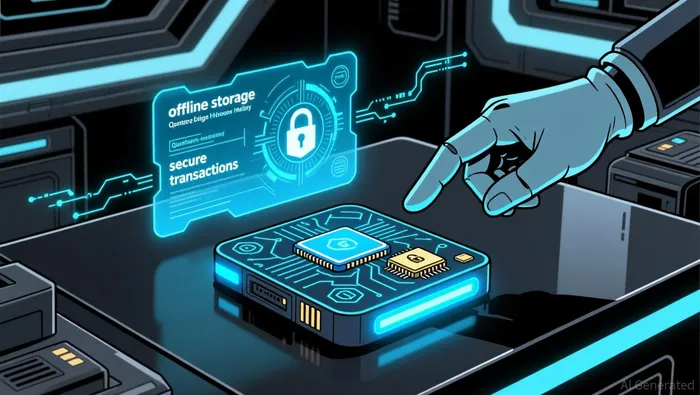
Trezor's security architecture is underpinned by rigorous certifications and innovative design. The Trezor Safe 3, for instance, features an EAL6+ certified chip, a benchmark in hardware security that ensures robust protection against physical and logical attacks according to BitDegree. This certification, coupled with the Tropic01 Secure Element in the Trezor Safe 7, introduces the first auditable secure element in the industry, allowing users to verify the integrity of their hardware as reported by SatoshiLabs. The Safe 7 also incorporates quantum-ready architecture, future-proofing assets against potential threats from quantum computing as detailed in the official announcement.
Trezor's open-source model further strengthens its security claims. By making firmware, hardware design files, and wallet-management software publicly accessible, the company invites global scrutiny from developers and auditors according to CoinPaper. This transparency fosters trust, as vulnerabilities can be identified and patched collaboratively. For institutional investors, this aligns with risk management frameworks that prioritize auditability and third-party validation.
Custodial Independence: Mitigating Counterparty Risk
Self-custody remains a critical priority for investors seeking to avoid reliance on third-party custodians, which are vulnerable to insolvency or regulatory scrutiny. Trezor's hardware wallets enable users to store private keys offline, eliminating exposure to exchange hacks or custodial failures. The Trezor Safe 7, for example, supports multi-signature transactions and customizable transaction fees, empowering users with granular control over their assets according to MEXC.
This custodial independence is further reinforced by Trezor's integration with over 40 third-party wallet apps, including MetaMask, Rabby, and Exodus. These integrations allow users to interact with decentralized finance (DeFi) platforms and decentralized applications (dApps) while maintaining offline key storage. For institutional investors, this flexibility supports portfolio diversification across blockchain networks like EthereumETH--, SolanaSOL--, and BitcoinBTC-- without compromising security as reported by Intellectia.
Ecosystem Integration: Expanding Utility and Accessibility
Trezor's ecosystem has expanded significantly in 2025, enhancing its utility for both novice and advanced users. The Trezor Safe 5 is tailored for beginners, offering an intuitive interface and support for thousands of cryptocurrencies according to MEXC, while the Safe 7 caters to power users with advanced features like a larger display and quantum-ready bootloader as detailed in the official announcement.
Partnerships with crypto exchanges such as GODEX and Changelly further streamline user experience by enabling secure transactions without exposing private keys as reported by Intellectia. Additionally, Trezor's support for the Virtuals Protocol-a platform for AI-driven blockchain interactions-demonstrates its adaptability to emerging use cases as described on the official site. These integrations position Trezor as a bridge between traditional crypto management and next-generation applications.
Operational Transparency and Financial Resilience
Trezor's operational model is defined by transparency and financial independence. As a pioneer in the hardware wallet industry, the company has grown from a two-person startup in 2021 to a team of 175 employees in 2025, scaling operations without significant external funding as detailed in the official announcement. Annual revenue surged to $47.2 million in 2025, a stark contrast to its $52,500 revenue in 2021 as reported in the same announcement. This growth trajectory underscores Trezor's ability to monetize its product-driven strategy while avoiding the pressures of investor-driven expansion.
The company's open-source philosophy extends to its financial practices. By maintaining minimal external funding and prioritizing product innovation, Trezor aligns with institutional investors' preferences for sustainable, audit-ready business models as detailed in the official announcement. This financial resilience, combined with a transparent codebase, reduces operational risks and enhances long-term viability.
Customer Support and User Satisfaction: Indirect Metrics of Success
While Trezor does not publish explicit customer support metrics like response times, its user satisfaction is evident in platform performance data. For instance, the conversion rate on Trezor's swap functionality increased by 55% from 2019 to 2023, and the average order value (AOV) grew by 182% from 2020 to 2024 as reported by Changelly. These metrics reflect a maturing user base confident in the platform's reliability.
Additionally, the funnel completion rate for confirmed swap transactions improved by 29% between November 2024 and March 2025, indicating optimized user experience during high-demand periods as reported by Changelly. While direct support channels like live chat are absent, Trezor's community forum and email support provide accessible alternatives as listed on the official site. For institutional investors, these indirect indicators suggest a robust user base and a product that meets evolving market demands.
Conclusion: A Strategic Investment in Crypto Security
Trezor's strategic value lies in its ability to address the core challenges of crypto portfolio management: security, custodial independence, and ecosystem integration. With EAL6+ certifications, quantum-ready hardware, and an open-source model, Trezor sets a new standard for hardware wallet security. Its custodial independence and expanding ecosystem integrations cater to both institutional and retail investors, while financial resilience and operational transparency reinforce its long-term viability.
As the crypto market matures, hardware wallets will remain a critical infrastructure asset. Trezor's innovations in 2025-ranging from auditable secure elements to quantum-resistant architecture-position it as a leader in this space. For investors prioritizing risk mitigation and long-term portfolio security, Trezor represents not just a tool, but a foundational component of a robust crypto strategy.






Comentarios
Aún no hay comentarios