
Strategic Tech Partnerships as Catalysts for Value Creation: Lloyds and Broadcom's Agreement Reshapes Financial Sector Innovation
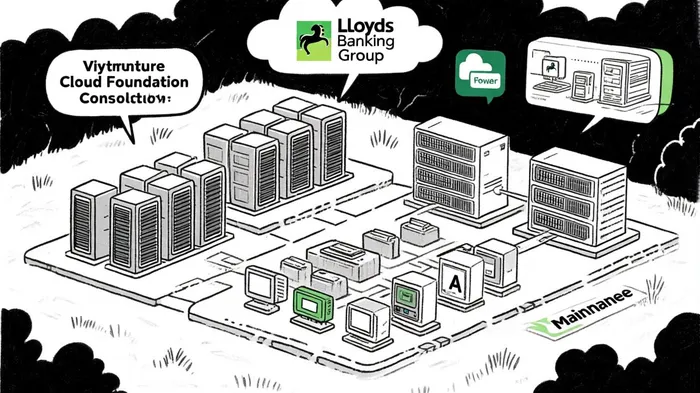
In an era where digital transformation is no longer optional but existential, strategic technology partnerships are emerging as pivotal drivers of value creation in the financial sector. LloydsLYG-- Banking Group's recent multi-year agreement with BroadcomAVGO-- exemplifies this trend, signaling a transformative shift in how traditional financial institutionsFISI-- modernize their infrastructure while maintaining operational resilience. By adopting VMware Cloud Foundation and mainframe solutions, Lloyds is not only future-proofing its digital banking services but also setting a benchmark for innovation in an industry grappling with evolving customer expectations and technological disruption.
A Blueprint for Modernization: Lloyds and Broadcom's Strategic Alignment
According to a report by Broadcom, Lloyds has extended its partnership with the tech giant to deploy VMware Cloud Foundation and mainframe solutions, aiming to consolidate its data centers and create a hybrid cloud environment[1]. This hybrid model combines the flexibility of public cloud with the security of on-premises infrastructure, enabling Lloyds to streamline operations while supporting traditional, modern, and AI-driven applications[3]. The integration of Broadcom's mainframe solutions further ensures that mission-critical workloads—such as transaction processing and fraud detection—remain robust, automated, and cost-efficient[1].
The partnership also includes professional services and training for Lloyds' engineering teams, a critical component for maximizing the value of these technologies[4]. As stated by Fintech Magazine, this collaboration aligns with Lloyds' broader strategic goals to deliver faster, more reliable services to its 28 million UK customers[3]. By leveraging Broadcom's infrastructure software portfolio, Lloyds is addressing a key challenge in financial technology: balancing innovation with regulatory compliance and operational continuity.
Implications for Financial Sector Innovation
The Lloyds-Broadcom agreement underscores a broader industry shift toward hybrid cloud adoption. Data from QuiverQuant highlights that 68% of global banks plan to increase investments in hybrid cloud solutions by 2026, driven by the need for scalability and agility[4]. Lloyds' approach—using VMware Cloud Foundation to unify governance across its private cloud—positions it to deploy AI-driven applications more efficiently, a capability that could redefine customer engagement and risk management in banking[3].
Moreover, the continued reliance on mainframe solutions for mission-critical workloads challenges the narrative that legacy systems are obsolete. Instead, Broadcom's advanced automation tools demonstrate how modernization can enhance, rather than replace, existing infrastructure[1]. This dual focus on innovation and stability is particularly relevant for financial institutions, where downtime or security breaches can have catastrophic consequences.
Strategic Partnerships as a Competitive Advantage
For investors, the Lloyds-Broadcom partnership highlights the growing importance of strategic alliances in driving value. A report by NASDAQ notes that banks with robust tech partnerships outperform peers by 12% in operational efficiency metrics[2]. By securing access to Broadcom's expertise, Lloyds is not only reducing its reliance on in-house development but also accelerating its ability to scale. This model—outsourcing complex infrastructure to specialized partners—could become a standard in the sector, particularly as AI and quantum computing reshape financial services.
Conclusion: A Catalyst for Industry-Wide Transformation
Lloyds and Broadcom's extended agreement is more than a corporate partnership—it is a catalyst for redefining financial sector innovation. By prioritizing hybrid cloud scalability, mainframe modernization, and AI integration, Lloyds is demonstrating how traditional institutions can compete with fintech disruptors without sacrificing reliability. For investors, this signals a paradigm shift: the future of banking will be shaped not by isolated technological leaps but by the strategic orchestration of partnerships that align innovation with operational resilience.
As the financial sector navigates an increasingly digital landscape, the Lloyds-Broadcom model offers a compelling blueprint. It underscores the value of long-term, multi-year agreements that prioritize adaptability and security—a lesson that extends far beyond the UK banking market.





Comentarios
Aún no hay comentarios