
The Strategic Takeover: US Firms Securing Europe's Rare Earths Amid China's Supply Constraints
The global race to secure rare earth elements (REEs) has intensified as the United States and Europe pivot away from China's stranglehold on processing and supply chains. With China controlling over 90% of global rare earth processing, geopolitical tensions and supply risks have driven a strategic realignment. U.S. firms are now capitalizing on Europe's industrial expertise and the U.S. government's financial incentives to build a resilient, diversified supply chain. This shift is not merely a response to China's dominance but a calculated investment in the future of clean energy, defense, and advanced manufacturing.
The US-Europe Synergy: A New Supply Chain Paradigm
Europe's rare earth industry, long overshadowed by Chinese dominance, has emerged as a critical partner for U.S. firms. Solvay, a European chemical giant and one of the few non-Chinese companies capable of rare earth separation, has become a linchpin in this collaboration. According to a report by Reuters, Solvay is open to building a rare earth processing plant in the 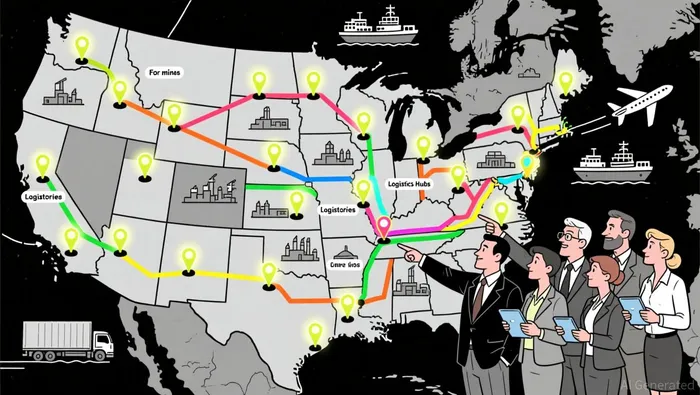 where financial support is stronger. This move aligns with broader U.S. efforts to localize processing capabilities, which are essential for producing high-performance magnets used in electric vehicles (EVs), wind turbines, and defense systems.
Solvay's European operations are equally strategic. The company has partnered with U.S. firms Noveon Magnetics and Permag to supply rare earth oxides like neodymium and dysprosium. These materials are critical for next-generation magnets, which are in high demand as EV adoption accelerates. Meanwhile, Solvay's collaboration with Less Common Metals in the UK underscores a shared goal: securing a reliable, non-Chinese supply of rare earths.
Europe's Industrial Ambitions: From Estonia to France
Europe is not merely a passive partner in this realignment. Neo Performance Materials is constructing a magnet plant in Estonia to localize production. Similarly, the Lacq facility in France, set to produce 600 metric tons of heavy rare earths annually, represents a major step toward European self-sufficiency. These projects are part of a broader strategy to reduce reliance on Chinese processing, which has long been a bottleneck for global supply chains.
The U.S. government has amplified this momentum. MP Materials has received substantial support from the Department of Defense, which now holds a significant stake in the company. This partnership aims to create a fully integrated rare earth magnet supply chain in the U.S., from mining to processing. Energy Fuels is expanding operations in the U.S. and internationally, including in Australia and Madagascar, to diversify feedstock sources.
Investment Implications: The New Frontier of Supply Chain Resilience
For investors, the convergence of U.S. policy, European industrial capacity, and strategic partnerships presents a compelling opportunity. The rare earth sector is no longer a niche market; it is a cornerstone of global economic and national security. According to data from Investing News Network, companies like Solvay, MP MaterialsMP--, and Energy Fuels are at the forefront of a supply chain revolution.
The key to long-term value lies in firms that can bridge the gap between raw material extraction and high-value processing. Solvay's dual focus on U.S. and European markets, for instance, positions it as a critical node in a decentralized supply chain. Similarly, MP Materials' integration with the DoD ensures a stable demand stream, while Energy Fuels' global footprint mitigates geopolitical risks.
Conclusion: A Geopolitical and Economic Imperative
The U.S.-Europe collaboration in rare earths is more than a supply chain adjustment-it is a strategic reordering of global industrial power. As China's dominance faces pushback, the ability to secure and process rare earths will determine which economies lead the clean energy and defense revolutions. For investors, the lesson is clear: resilience and diversification are no longer optional; they are existential. The companies that master this transition-through innovation, partnerships, and policy alignment-will define the next era of industrial leadership.





Comentarios
Aún no hay comentarios