
Strategic Synergy: How Temasek's Institutional Expertise Fuels Zegna's Premium Luxury Ambitions
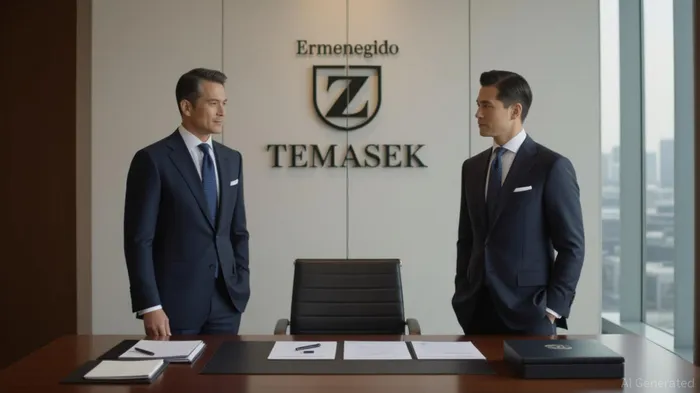
The luxury sector, long characterized by its resilience and exclusivity, is undergoing a quiet revolution driven by institutional capital. In 2025, Ermenegildo ZegnaZGN-- Group's strategic partnership with Temasek Holdings exemplifies how deep-pocketed investors with operational expertise can catalyze growth in premium brands. This $126.4 million investment—purchasing 10% of Zegna's shares—goes beyond a financial transaction; it signals a recalibration of how luxury brands navigate global expansion, sustainability, and digital transformation.
The Temasek Playbook: Long-Term Vision Meets On-the-Ground Execution
Temasek's approach to the luxury sector is rooted in a blend of patience and pragmatism. The firm's 2016 investment in Moncler, followed by a calculated partial divestment in 2025, underscores its ability to balance long-term value creation with strategic reallocation. By embedding local expertise in key markets—such as its physical presence in London, Brussels, and Paris—Temasek builds trust with family-owned European luxury houses, a demographic critical to the sector's DNA. Vincent Lee, Temasek's Director for Technology & Consumer Investments, emphasizes that “face-to-face engagement with CEOs and advisors unlocks insights that algorithms cannot replicate.”
This on-the-ground strategy is now being applied to Zegna. The firm's decision to appoint Nagi Hamiyeh, Head of EMEA, to Zegna's Board of Directors by June 2026, reflects its hands-on governance model. Hamiyeh's experience in managing cross-border luxury brands will likely focus on optimizing Zegna's Asian market penetration, where Temasek's regional infrastructure and consumer insights provide a distinct advantage.
Institutional Capital as a Catalyst for Organic Growth
The $126.4 million infusion into Zegna's balance sheet is not merely a liquidity boost—it's a strategic lever. By reducing debt and freeing up capital, the firm can accelerate investments in digital infrastructure, sustainability initiatives, and brand storytelling. Temasek's emphasis on ESG (Environmental, Social, and Governance) frameworks will likely pressure Zegna to adopt greener supply chains, a critical differentiator in a sector where 65% of Gen Z consumers prioritize sustainability, per McKinsey's 2024 report.
Moreover, Temasek's track record in co-investment partnerships—such as its ventures into luxury cruises and premium outlets—suggests it may explore similar synergies for Zegna. Imagine a Zegna-branded luxury cruise line or a curated e-commerce platform targeting high-net-worth Asian consumers. These ventures align with Temasek's broader “Future of Consumption” thesis, which prioritizes experiences and digital-first engagement.
The Bigger Picture: Institutional Capital's Role in Shaping the Luxury Sector
Temasek's Zegna investment is part of a larger trend. Over the past decade, institutional ownership in luxury conglomerates like LVMH and Kering has surged, driven by their ability to compound earnings at 12%+ CAGR. These firms have mastered the art of balancing brand equity with financial discipline—expanding store counts judiciously while maintaining pricing power. For example, LVMH's 2023 acquisition of Belmond, a luxury hospitality brand, expanded its ecosystem into high-margin experiences, a move likely supported by institutional capital.
However, the Zegna-Temasek partnership introduces a new dynamic. Unlike private equity-backed buyouts, which often prioritize short-term financial engineering, Temasek's long-term horizon aligns with Zegna's heritage of artisanal craftsmanship. This reduces the risk of brand dilution while enabling strategic experimentation. For instance, Zegna's recent pivot to direct-to-consumer digital sales—mirroring Patek Philippe's cautious foray into e-commerce—could be scaled with Temasek's infrastructure support.
Risks and Rewards: A Balanced Perspective
While the partnership offers clear upside, challenges remain. Temasek's Asian market expertise may face hurdles in Europe, where luxury consumers demand hyper-localized branding. Additionally, the firm's 2025 partial divestment of Moncler highlights its willingness to exit non-core assets—a reminder that patience has limits. Investors should monitor Zegna's ability to maintain its creative vision while meeting institutional KPIs.
For now, the Zegna-Temasek alliance appears well-positioned to capitalize on structural trends: the rise of Asian affluence, the digitalization of luxury consumption, and the premiumization of everyday goods. As the S&P Global Luxury Index outperforms broader markets (up 8.7% YTD in 2025), institutional capital's role in curating these trends becomes increasingly vital.
Investment Takeaway
The Ermenegildo Zegna-Temasek partnership is a masterclass in strategic alignment. For investors, the key takeaway is that institutional capital, when paired with operational expertise, can unlock value in even the most traditional sectors. Zegna's 2025 stock price, currently trading at $8.95 per share (in line with its treasury stock purchase price), offers a compelling entry point for those betting on its organic growth trajectory. Meanwhile, broader luxury indices like the S&P Global Luxury Index remain a benchmark for sector performance.
In an era where luxury is no longer a discretionary splurge but a symbol of aspirational identity, the Zegna-Temasek model proves that institutional capital can be both a guardian of tradition and a driver of innovation. For investors, the lesson is clear: align with institutions that understand the sector's soul as much as its numbers.





Comentarios
Aún no hay comentarios