
The Strategic Synergy of Sky's Potential ITV M&E Acquisition: A Catalyst for Growth in the U.K. Media Landscape
Strategic Goals and Market Position
Sky's interest in ITV's M&E division aligns with its broader strategy to expand its content library and streaming capabilities. By acquiring ITV's free-to-air channels and the ITVX platform-which boasts 40 million registered users, according to Sky News-Sky would gain access to a vast audience base and a complementary distribution network. This move also complements Sky's existing production arm, Sky Studios, which has produced critically acclaimed series such as Mary & George and The Day of the Jackal. The acquisition would allow Sky to integrate ITV's established programming slate with its own original content, creating a more diversified portfolio capable of appealing to both traditional and streaming audiences, as noted in the Hollywood Reporter.
However, the deal excludes ITV Studios, the production arm responsible for hit shows like Love Island and Fool Me Once. This omission suggests that Sky's focus is on distribution and existing content rather than production, a distinction that could limit long-term synergies if ITV Studios remains independent, as reported in Financial Express.
Content Diversification and Audience Reach
The acquisition would significantly enhance Sky's content diversification. ITV's M&E division offers a broad range of programming, including sports, news, and entertainment, which aligns with Sky's existing strengths in sports broadcasting (e.g., Sky Sports). The ITVX platform, in particular, provides a scalable streaming infrastructure that Sky could leverage to expand its digital footprint, as detailed in Sky News.
A visual representation of this synergy could depict a modern media ecosystem where Sky's pay-TV services and ITV's free-to-air channels converge with the ITVX streaming platform, symbolizing the integration of traditional and digital audiences.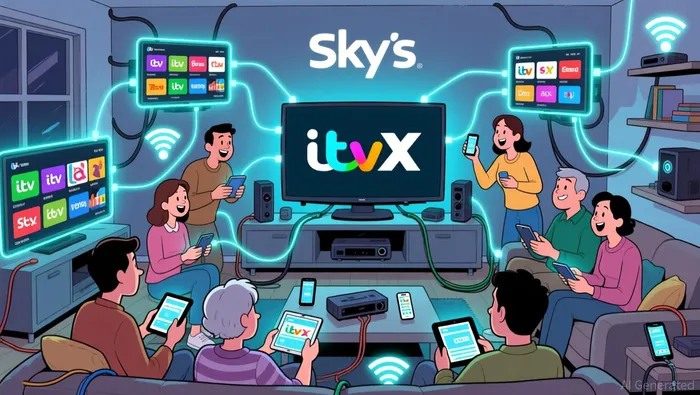
Financially, the M&E division reported £1.45 billion in revenue for the first nine months of 2025, though it faces a projected 9% decline in Q4 due to a weak ad market, as reported in CNBC. Despite this, the combined entity's expanded content library could stabilize revenue streams by reducing reliance on volatile advertising income. Analysts suggest that Sky's ability to cross-promote ITVX content across its pay-TV platforms could drive subscriber growth and retention, as noted in RTÉ.
Advertising Revenue Potential and Regulatory Risks
The deal's impact on advertising revenue is a double-edged sword. ITV's M&E division has seen a 5% year-to-date decline in ad revenue, reflecting broader industry challenges, as reported in CNBC. However, the combined entity would control up to 70% of the U.K. TV advertising market, potentially enabling price-setting power and greater ad inventory, as reported in Financial Express. This scale could attract advertisers seeking a single platform to reach a broad audience, particularly as competition from Google and Meta intensifies, as noted in Sky News.
A data query to visualize this dynamic could track the stock performance of ITV and Sky's parent company, ComcastCMCSA-- (CMCSA), to gauge investor sentiment.
Regulatory scrutiny remains a critical hurdle. The UK's Competition and Markets Authority (CMA) and Ofcom are likely to investigate concerns about market concentration, particularly in the TV advertising sector, as reported in LinkedIn. While the combined entity's ad sales would still lag behind Google and Meta's £9 billion annual U.K. ad revenue, regulators may impose conditions to preserve media plurality, as noted in ScreenDaily.
Conclusion
Sky's potential acquisition of ITV's M&E division is a calculated bet on the future of U.K. media. By combining Sky's production capabilities with ITV's distribution and streaming infrastructure, the deal could catalyze growth in content diversification and advertising revenue. However, regulatory challenges and the ad market's fragility pose significant risks. If approved, the merger would reshape the competitive landscape, positioning Sky as a dominant force in an increasingly fragmented media environment.







Comentarios
Aún no hay comentarios