
The Strategic Synergy of Ripple's $1B GTreasury Acquisition and Crypto Expansion Opportunities
Strategic Synergy: Bridging Legacy and Blockchain
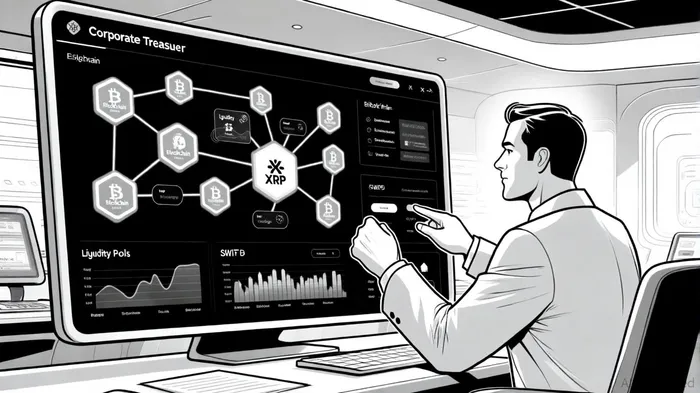
Ripple's acquisition of GTreasury is more than a financial transaction-it's a calculated integration of decades-old treasury management tools with cutting-edge blockchain infrastructure. GTreasury's platform, which processes $12.5 trillion in payments annually for clients like American Airlines and Volvo, now becomes a conduit for XRP-based liquidity solutions, according to a Ledger Insights report. By embedding XRP into workflows for cash forecasting, risk management, and compliance, Ripple is addressing the core pain points of corporate treasurers: slow settlement times, high transaction costs, and fragmented systems, a Coinotag analysis found.
The strategic rationale is clear. Traditional systems like SWIFT, while ubiquitous, are archaic in their 1–5 business-day settlement cycles and opaque fee structures. Ripple's blockchain-based solution promises real-time, 24/7/365 transactions, with XRP acting as a bridging asset to unlock liquidity in global markets, as Coinotag noted. This is not theoretical: Ripple's prime broker, Hidden Road, already enables clients to earn overnight yields on stablecoins like RLUSD, demonstrating the practicality of tokenized finance, as the Ledger Insights report also described.
Market Potential: A $120 Trillion Opportunity
The corporate treasury market is a $120 trillion behemoth, and Ripple's acquisition targets its most inefficient segments. By integrating GTreasury's tools with its own infrastructure-including previous acquisitions like Metaco (custody), Rail (payments), and Hidden Road (stablecoin issuance)-Ripple is constructing an end-to-end financial stack, according to a Coinotag report. This vertical integration allows it to offer a unified platform where treasurers can manage fiat, stablecoins, and XRP in real time, optimizing capital deployment and reducing operational overhead, Coinotag argued.
Data from Bloomberg-summarized in Blockchain Magazine-indicates that corporations are increasingly receptive to blockchain solutions, with 68% of surveyed treasurers expressing interest in tokenized assets for liquidity management. Ripple's move aligns perfectly with this trend. For example, a multinational corporation using GTreasury's platform could now route payments through XRP's decentralized exchange (DEX) to access lower fees and faster settlements, while leveraging Hidden Road's repo market to generate returns on idle cash, as the Ledger Insights report described.
Competitive Positioning: Challenging SWIFT and Legacy Banks
Ripple's DAT system is not just a technological upgrade-it's a direct challenge to SWIFT and legacy banks. By enabling real-time cross-border payments at a fraction of the cost, Ripple is positioning itself as the infrastructure layer for a new financial ecosystem, Coinotag argued. The acquisition of GTreasury, which already has deep relationships with enterprise clients, accelerates this transition.
SWIFT's dominance has been built on its network effect, but Ripple's blockchain-based model offers a compelling alternative. For instance, a company transferring funds from Singapore to Mexico via SWIFT might face 3–5 business days and 6–8% in fees. With Ripple's system, the same transaction could settle in seconds with fees under 1%, using XRP as an intermediary. This efficiency is not just a theoretical advantage-it's a tangible value proposition for corporations seeking to cut costs and improve cash flow.
Investment Implications: ROI and Regulatory Risks
While the market potential is vast, investors must weigh the risks. The acquisition is contingent on regulatory approvals, and Ripple's ongoing legal battles with U.S. regulators cast a shadow over its long-term strategy. However, the company's aggressive use of XRP to fund the deal-valued at $1.25 billion in its native token-signals confidence in its utility and price trajectory.
From a ROI perspective, the integration of GTreasury into Ripple's ecosystem could unlock new revenue streams. If even 10% of the $120 trillion corporate treasury market adopts blockchain-based solutions, Ripple's DAT system could generate billions in annual fees from liquidity management, cross-border payments, and stablecoin services, a Coinotag piece suggested. For XRP holders, this could translate to increased demand for the token as a liquidity engine, potentially driving price appreciation.
Conclusion: A New Era for Corporate Finance
Ripple's acquisition of GTreasury is a masterstroke in the ongoing battle to digitize global finance. By combining legacy treasury tools with blockchain innovation, the company is creating a platform that addresses the inefficiencies of traditional systems while capitalizing on the growth of tokenized assets. For investors, this represents a unique opportunity to bet on the convergence of corporate finance and decentralized technology-a space that is poised for explosive growth in the coming years.






Comentarios
Aún no hay comentarios