
The Strategic Synergy Between Enterprise Software and Defense Technology
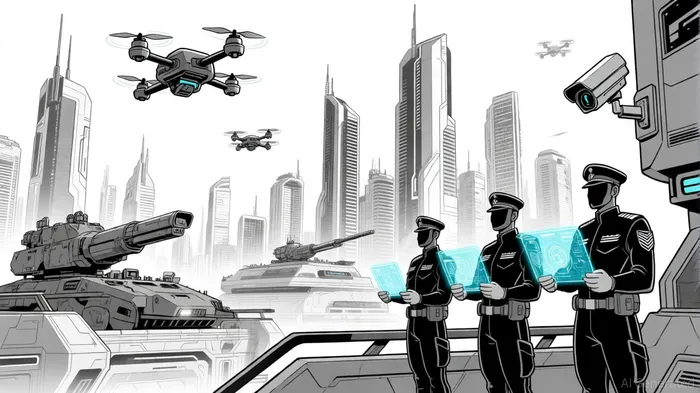
The intersection of enterprise software, (AI), and national security has emerged as one of the most dynamic and strategically vital investment arenas in 2025. As the U.S. (DoD) accelerates its shift toward software-centric solutions and AI-driven decision-making, companies at the forefront of this transformation are capturing market share and reshaping the defense landscape. From startups like Anduril Industries and Saronic Technologies to traditional giants like Lockheed MartinLMT--, the race to dominate this space is heating up. Let's dissect the investment case for these firms and the broader market trends driving their growth.
The AI-Defense Convergence: A $200 Billion Opportunity
, . , driven by the need for decision superiority against strategic competitors like China[2]. The DoD's (CDAO) is spearheading this effort, with initiatives like the $15 billion Advancing Artificial Intelligence Multiple Award Contract (AAMAC) signaling a long-term commitment to outsourcing AI development[3].
Meanwhile, , fueled by automation, supply chain optimization, and tools[4]. This growth is not confined to traditional defense contractors; cloud providers like AWS and GoogleGOOGL-- Cloud are also capitalizing on AI-as-a-Service platforms, enabling mid-tier firms to access cutting-edge technology without massive upfront costs[5].
Anduril Industries: The Disruptor with a $30.5 Billion Valuation
Anduril Industries, the standout name in this space, has become a poster child for software-driven defense innovation. The company's Lattice OS, which powers autonomous systems like the Barracuda cruise missile and its AI-driven anti-drone solutions, . , .
Anduril's success lies in its ability to integrate AI, autonomy, and real-time data analytics into a cohesive platform. For instance, its collaboration with Lockheed Martin during the U.S. Central Command Desert Guardian exercise demonstrated how Lattice's command-and-control system could enhance radar and sensor data processing, enabling faster threat detection[8]. However, its high valuation raises questions about sustainability. Unlike established defense contractors, Anduril lacks a diversified revenue base and relies heavily on government contracts, which are subject to political and budgetary shifts.
Saronic Technologies: Scaling Maritime Autonomy
Saronic Technologies, a 2022 startup, , . The company's autonomous surface vessels (ASVs), including the Spyglass and Cutlass models, are designed for maritime security, domain awareness, and . Saronic's vertical integration strategy—designing hardware, software, and AI in-house—has allowed it to iterate quickly and secure contracts with the U.S. Navy and international allies[10].
A key differentiator is Saronic's Port Alpha shipyard, . This move positions the company to meet growing demand for maritime autonomy, particularly as the DoD prioritizes . However, Saronic's aggressive expansion introduces risks. Its reliance on U.S. government contracts and the nascent state of maritime AI regulation could expose it to operational and geopolitical volatility.
Traditional Giants: Adapting or Dying
Lockheed Martin, Northrop GrummanNOC--, and Raytheon Technologies remain dominant players, but their dominance is being challenged by agile startups. . Yet, the Air Force's decision to award (CCA) prototypes to Anduril and General Atomics over established firms like BoeingBA-- and Northrop Grumman highlights a shift toward cost efficiency and innovation[13].
Northrop Grumman and Raytheon are also pivoting to AI, . However, their higher valuation multiples (compared to startups) and slower R&D cycles may hinder their ability to compete in the long term.
Risks and Rewards: A Balancing Act
Investing in this sector requires a nuanced understanding of risk. For startups like Anduril and Saronic, scalability and regulatory hurdles are critical concerns. , while justified by its contract pipeline, may not hold if it fails to diversify revenue streams. Saronic's Port Alpha project, while ambitious, could strain its balance sheet if demand for ASVs lags expectations.
On the other hand, traditional defense firms face their own challenges. Their reliance on legacy systems and bureaucratic procurement processes may slow their AI adoption. However, their established relationships with the DoD and diversified portfolios offer stability.
The Bottom Line: Where to Allocate Capital
For investors, the key is to balance high-growth startups with established players. Anduril and Saronic represent the future of defense tech, with AI and autonomy at their core. However, their valuations demand rigorous due diligence. Meanwhile, Lockheed Martin and Raytheon offer a safer bet for those seeking steady returns amid geopolitical uncertainty.
As the DoD's AI budget stabilizes and private-sector partnerships expand, the companies that can bridge the gap between enterprise software and national security will dominate this decade. The question isn't whether to invest—it's how to position your portfolio for the next phase of this revolution.







Comentarios
Aún no hay comentarios