
The Strategic Synergy of AI Hardware and Cybersecurity Innovation: Investing in the Future of Digital Trust
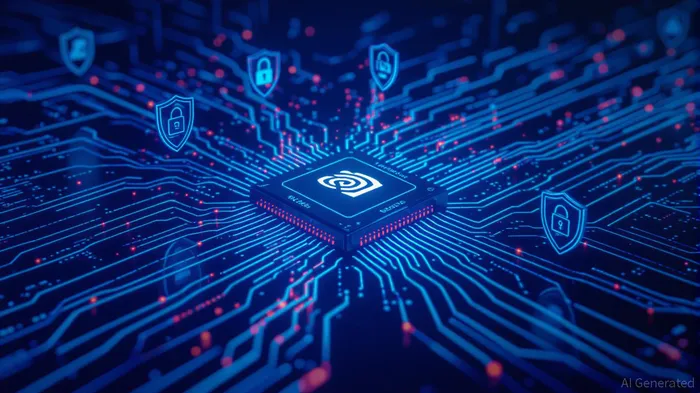
The convergence of AI hardware and cybersecurity software is no longer a speculative concept but a market-driven reality reshaping digital trust. By 2025, the AI hardware cybersecurity market is valued at USD 34.10 billion, with projections to surge to USD 234.64 billion by 2032 at a compound annual growth rate (CAGR) of 31.70%[1]. This exponential growth is fueled by the escalating sophistication of cyber threats and the computational demands of real-time AI processing, particularly in edge environments. Investors are now prioritizing firms that demonstrate strategic integration of AI-optimized hardware and software, creating a new paradigm where digital trust is not just maintained but actively engineered.
Hardware-Software Convergence: The New Frontier
The synergy between AI hardware and cybersecurity software lies in their ability to address two critical challenges: speed and accuracy. Traditional cybersecurity systems struggle to keep pace with polymorphic malware, deepfake-based social engineering, and AI-driven reconnaissance attacks[2]. However, AI-optimized hardware—such as Nvidia's A100 GPUs, Intel's Xeon Scalable processors, and AMD's Instinct MI300 series—enables real-time threat detection by accelerating machine learning (ML) and deep learning (DL) workloads[3]. For instance, CrowdStrike's Falcon platform leverages AI for endpoint protection, reducing false positives by 70% while automating incident prioritization[4]. Similarly, Darktrace's ActiveAI Security Platform integrates with third-party tools to detect anomalies in milliseconds, a feat made possible by GPU-accelerated computing[5].
The ROI of this integration is staggering. A logistics company reduced phishing-related risks by 90% through a €500,000 investment in email security and staff training, achieving a Return on Security Investment (ROSI) of 2.6[6]. Meanwhile, an AI-driven threat detection system costing $200,000 cut breach probabilities from 40% to 12%, delivering a ROSI of 250%[6]. These metrics underscore the tangible value of hardware-software convergence in mitigating financial and reputational risks.
Case Studies: From Theory to Practice
Technical case studies further validate this synergy. In a 2025 IEEE study, a genetic algorithm (GA) was used to generate secure pseudo-random noise (PN) sequences for IEEE 802.15.4 networks, maintaining throughput while enhancing anonymity and hardware-level security[7]. This approach demonstrated that AI-driven security does not compromise performance—a critical consideration for resource-constrained IoT ecosystems.
Another example comes from Palo Alto Networks' Precision AI, which unifies data security platforms to streamline threat response[8]. By integrating AI-optimized processors with cloud-native software, the system reduces mean time to detect (MTTD) by 50% compared to legacy solutions[8]. Similarly, Zscaler's cloud-based architecture leverages AI accelerators to secure internet access for enterprises, achieving 99.99% uptime in 2025[9].
Strategic Implications for Investors
The hardware-software convergence is not without challenges. Model bias, zero-day vulnerabilities, and ethical concerns around data privacy remain unresolved[10]. However, leading firms are addressing these risks through quantum-resistant frameworks and agentic AI. For example, Apple's integration of post-quantum encryption into iMessage safeguards against future quantum computing threats[11], while Microsoft's multi-factor authentication systems reduce data breach risks by 80%[11].
Investors should focus on companies that:
1. Prioritize hardware-software integration (e.g., Nvidia's BlueField-3 DPUs for infrastructure protection[12]).
2. Demonstrate measurable ROI through ROSI metrics and reduced MTTD[6].
3. Adopt proactive strategies like Deloitte's 2025 forecasts, which emphasize AI in governance and policy-making[13].
Conclusion: The AI Arms Race and Digital Trust
The cybersecurity landscape is evolving into an “AI versus AI” arms race, where defenders must match attackers' computational power and adaptability[14]. Hardware-software convergence is the linchpin of this evolution, enabling real-time threat detection, behavioral analytics, and predictive intelligence. As the market grows, investors who align with pioneers like CrowdStrikeCRWD--, NvidiaNVDA--, and Palo Alto NetworksPANW-- will not only capitalize on a $236.80 billion opportunity but also shape the future of digital trust.







Comentarios
Aún no hay comentarios