
The Strategic Synergy of AI and Energy Infrastructure: How OpenAI and SoftBank's $1 Billion SB Energy Bet Signals the Future of Tech Growth
The convergence of artificial intelligence (AI) and energy infrastructure is reshaping the global tech landscape, with OpenAI and SoftBank's $1 billion investment in SB Energy serving as a pivotal case study. This partnership, part of the broader $500 billion Stargate initiative, underscores a strategic shift toward scalable, AI-driven infrastructure that balances computational demand with energy efficiency. By dissecting the technical, economic, and regulatory dimensions of this investment, we uncover why this move is a harbinger of the next phase in tech growth.
The Stargate Initiative: A Blueprint for AI Infrastructure at Scale
OpenAI, OracleORCL--, and SoftBank's Stargate initiative is not merely a capital play-it's a calculated effort to dominate the AI infrastructure race. The $1 billion joint investment in SB Energy, split evenly between OpenAI and SoftBank, funds the development of a 1.2-gigawatt data center in Milam County, Texas, which will power OpenAI's AI workloads. This facility is part of a larger plan to deploy 10 gigawatts of AI infrastructure across the U.S. by 2025, with Texas as a central hub.
The strategic rationale is clear: AI training and inference require exorbitant computational power, which in turn demands energy infrastructure that is both reliable and scalable. Stargate's focus on Texas-a state with abundant energy resources, a deregulated grid, and favorable regulatory policies-positions it to address these challenges. For instance, the initiative leverages Texas's "ERCOT connect and manage" process, which accelerates grid interconnection for large-scale projects. This agility is critical for AI firms racing to deploy next-generation models like GPT-5 and beyond.
SB Energy's Role: Bridging Renewable Energy and AI Demand
SB Energy, a SoftBank-backed energy infrastructure firm, is central to this equation. Its Orion Solar Belt-a 900 MWdc solar project in Milam County- powers Google's data centers and will soon support OpenAI's operations. This integration of renewable energy into AI infrastructure is not just environmentally prudent but economically necessary. As AI workloads grow, so does their energy footprint: a single large data center can consume as much electricity as 50,000 homes.
SB Energy's approach combines on-site solar generation with grid-connected power to ensure reliability. For example, the Milam County data center will feature on-site backup generation to comply with Texas's Senate Bill 6 (SB-6), which mandates cost-sharing for transmission infrastructure and backup power for large-load customers. This regulatory alignment ensures that AI-driven energy systems do not destabilize the grid-a concern that has plagued earlier data center expansions in energy-constrained regions.
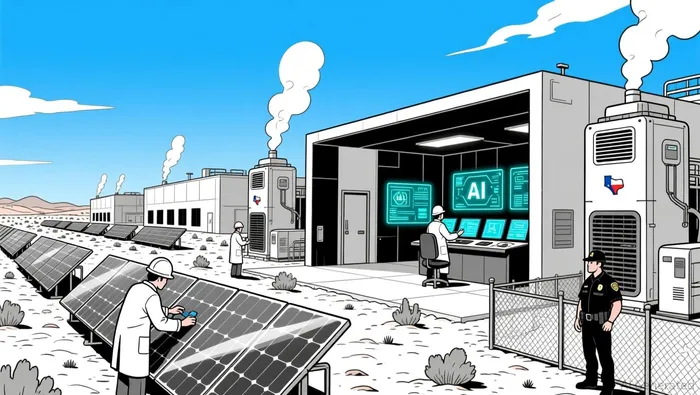
AI-Driven Energy Management: The Hidden Engine of Scalability
While technical details on SB Energy's AI-driven energy management systems remain sparse, the broader industry trends suggest their importance. AI algorithms optimize energy distribution, predict demand fluctuations, and manage cooling systems-critical for data centers where heat dissipation alone can account for 40% of energy use. For instance, the University of Texas at Arlington's DOE-backed project is developing liquid cooling technologies to reduce energy waste in AI data centers. Such innovations, when integrated with SB Energy's infrastructure, could amplify efficiency gains.
Moreover, AI's role extends beyond energy management. OpenAI's decision to use SB Energy's infrastructure for its own AI models-via APIs and ChatGPT deployment-creates a feedback loop where energy data informs AI training, and AI models refine energy optimization. This symbiosis between AI and energy infrastructure is a key differentiator for Stargate, enabling dynamic resource allocation and cost reduction.
Regulatory and Environmental Considerations
Texas's regulatory environment is both a catalyst and a constraint. SB-6, while ensuring grid reliability, imposes cost-sharing obligations on large-load customers like Stargate. This could drive up capital expenditures but also incentivizes innovation in energy storage and grid resilience. Additionally, the reliance on natural gas for backup power at some Stargate sites has sparked environmental debates, with critics highlighting health risks from emissions from the Abilene plant. However, SB Energy's commitment to U.S.-made solar panels and battery storage projects-such as ACCIONA Energía's Quinlan facility- demonstrates a hybrid approach that balances scalability with sustainability.
The Long-Term Investment Thesis
For investors, the Stargate-SB Energy partnership represents a multi-decade play on AI's energy demands. By 2027, SB Energy aims to deliver multi-gigawatts of data center capacity, with Milam and Borden County campuses operational by 2026. This timeline aligns with the projected 19–22% annual growth in AI computing demand from 2023 to 2030. The economic multiplier effects-25,000+ jobs, $400 billion in U.S. investment- further solidify the case for long-term value creation.
However, risks persist. Grid constraints in Texas, water scarcity for cooling, and regulatory shifts could disrupt timelines. Yet, the Stargate model-combining renewable energy, AI optimization, and regulatory agility-positions it to mitigate these challenges. For instance, the use of AI-driven demand forecasting could preemptively address grid instability, while partnerships with local communities ensure social license to operate.
Conclusion: A New Era of Tech-Infrastructure Convergence
OpenAI and SoftBank's bet on SB Energy is more than a capital allocation-it's a strategic redefinition of how AI and energy infrastructure co-evolve. By embedding AI into energy systems and vice versa, Stargate is building a scalable, self-reinforcing ecosystem that addresses both computational and environmental challenges. For investors, this represents a rare intersection of technological innovation, regulatory tailwinds, and long-term demand growth. As AI's energy footprint expands, the winners will be those who, like Stargate, master the art of infrastructure at scale.





Comentarios
Aún no hay comentarios