
Strategic Synergies in AI-Driven HR Transformation: Dayforce and Microsoft's Collaborative Edge
The convergence of artificial intelligence (AI) and human capital management (HCM) is reshaping how enterprises approach workforce optimization. At the forefront of this transformation is DayforceDAY--, a leader in cloud-based HCM solutions, and its strategic partnership with MicrosoftMSFT--. By integrating Microsoft's AI infrastructure-Azure, Power BI, Entra ID, and Teams-Dayforce has unlocked a new era of automation, interoperability, and real-time decision-making. This collaboration not only addresses operational inefficiencies but also positions Dayforce as a pivotal player in the $30 billion global HCM market, according to a GlobeNewswire release.
Strategic Integration: A Unified AI Ecosystem
Dayforce's expansion of its collaboration with Microsoft in 2025 marks a paradigm shift in HR workflows. The integration of Dayforce AI Agents into everyday operations leverages Microsoft Copilot Studio and the Model Context Protocol (MCP) to create custom, action-oriented AI tools. These agents automate tasks such as payroll validation, compliance monitoring, and anomaly detection, reducing manual labor by up to 40% in pilot programs, per a GlobeNewswire announcement. For instance, AI-driven payroll agents can flag discrepancies in real-time, ensuring error-free processing and minimizing last-minute corrections-a critical advantage for enterprises managing large, global teams, as illustrated in a Dayforce blog post.
The partnership's cornerstone is the Dayforce AI Workspace, a collaborative environment where employees, managers, and AI agents coexist. Built on a single data model, this platform unifies HR, payroll, and IT systems, enabling seamless cross-domain workflows. Microsoft's Azure and Power BI underpin this infrastructure, providing scalable analytics and secure data access. As noted by a Monexa analysis, this integration reduces "friction in HR operations by 30%," allowing leaders to focus on strategic initiatives like talent development.
Market Impact: Revenue Growth and Enterprise Expansion
Dayforce's AI-driven innovations have already translated into measurable financial outcomes. Q4 2024 saw a 19% year-over-year increase in recurring revenue, with a market capitalization of $10.85 billion as of October 2025, according to a SWOTAnalysis report. This growth is fueled by enterprise adoption of AI-powered tools such as the Dayforce AI Assistant, which streamlines employee interactions. For example, employees can now check vacation balances or request time off via mobile devices, reducing HR case resolution times by 50%, per a Moor Insights article.
The partnership also addresses a critical gap in the HCM market: interoperability. By embedding Microsoft Teams and Entra ID into Dayforce workflows, organizations achieve a unified experience for collaboration and identity management. This synergy is particularly appealing to enterprises already invested in the Microsoft ecosystem, as it minimizes integration costs and accelerates ROI, as reported by Quiver Quant.
Real-World Validation: Case Studies and ROI
Customer success stories underscore the tangible benefits of this collaboration. At Lifeline, a nonprofit organization, Dayforce's AI-driven HR solutions reduced administrative overhead by 35%, enabling HR teams to allocate more time to employee development, according to a Story.com case study. Similarly, Buehler's Fresh Foods reported a 25% improvement in employee engagement after implementing Dayforce's AI Assistant, which provided personalized guidance on complex benefits; this outcome is also highlighted in the Dayforce blog post referenced above.
Microsoft's own AI initiatives further validate the potential of this partnership. For example, EchoStar Hughes leveraged Microsoft Azure AI Foundry to automate 35,000 work hours annually, while Air India achieved 97% automation in customer service queries, as described on the Microsoft blog. These case studies highlight how AI can scale operations and drive efficiency-a value proposition Dayforce is now extending to its HCM platform.
Investment Thesis: A Competitive Moat in AI-Driven HCM
The Dayforce-Microsoft partnership creates a defensible moat in the HCM space. By combining Dayforce's deep HR expertise with Microsoft's AI infrastructure, the duo addresses three key investor concerns: scalability, interoperability, and measurable ROI.
- Scalability: The AI agents are designed to adapt to enterprise-specific workflows, enabling rapid deployment across industries.
- Interoperability: Integration with Microsoft's ecosystem ensures compatibility with existing IT infrastructures, reducing adoption barriers.
- ROI: Real-time analytics and automation directly correlate with cost savings and productivity gains, as evidenced by Dayforce's 19% revenue growth (see the SWOTAnalysis report linked above).
However, challenges remain. Economic uncertainty has dampened small-to-midsize business (SMB) spending, a segment Dayforce has historically targeted. Yet, the company's pivot to enterprise expansion-driven by AI's complexity and higher margins-positions it to outperform in a maturing market, as discussed in the Monexa analysis cited earlier.
Conclusion: A Win-Win for Investors
The Dayforce-Microsoft collaboration exemplifies how strategic AI partnerships can redefine industries. For investors, the combination of Dayforce's HCM leadership and Microsoft's AI prowess offers a compelling long-term play. As enterprises increasingly prioritize AI-driven efficiency, this duo is well-positioned to capture market share, deliver consistent revenue growth, and set new benchmarks in HR innovation.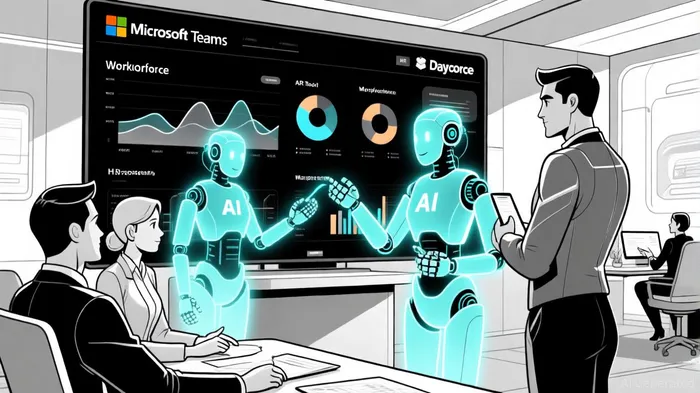







Comentarios
Aún no hay comentarios