
The Strategic Surge: How Web3 Agency Capital Flows Are Reshaping ORDER Token Value in 2025
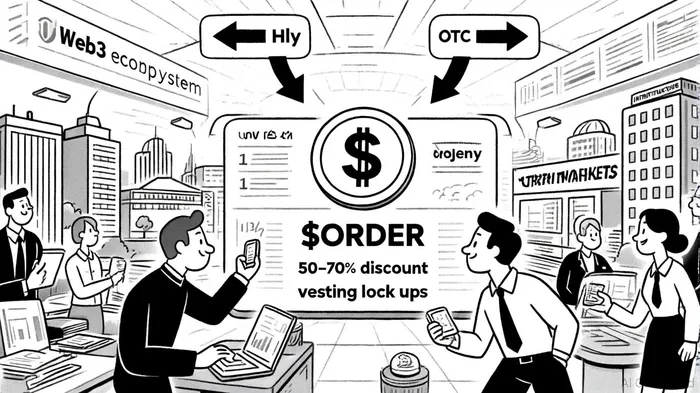
In 2025, Web3's capital flows are undergoing a seismic shift. Founders and institutional players are no longer chasing speculative hype but instead deploying capital with surgical precision—targeting infrastructure, utility-driven tokens, and secondary markets like OTC trading. At the center of this evolution lies the ORDER token, a case study in how strategic agency capital allocation is reshaping token value dynamics.
Capital Concentration and the Infrastructure Playbook
Web3 fundraising in Q1 2025 totaled $7.7 billion across 603 deals, a 34% drop in deal count from Q4 2024 but a 25% increase in capital deployed [1]. This shift reflects a broader trend: capital concentration. Projects like Binance's $2 billion raise (accounting for 25% of Q1 capital) and infrastructure-focused rounds averaging $112 million signal a market prioritizing foundational value over broad exposure [1].
For agency founders, this means strategic token purchases are no longer optional—they're a necessity. By acquiring tokens in infrastructure projects (e.g., modular blockspace, AI-aligned consensus systems), founders align with long-term utility and institutional-grade tokenomics [5]. The ORDER token, for instance, has seen significant agency interest due to its role in onchain ecosystems like Orderly, where Kraken's recent listing added liquidity and credibility [6].
OTC Markets: The New Frontier of Liquidity Management
The rise of OTC trading is a critical enabler of this strategy. In 2024, OTC volumes surged 106% year-over-year, driven by macroeconomic shifts, institutional demand, and the Trump administration's regulatory clarity [9]. By Q3 2025, OTC trading now accounts for 29% of altcoin volume—up from 13% in 2023 [6].
Founders are leveraging OTC channels to execute strategic token purchases at discounts of 50–70% off public prices, often with vesting schedules and lockups to stabilize supply [6]. These deals serve dual purposes:
1. Liquidity management: Preventing large unlocks from flooding public markets.
2. Price stabilization: Reducing sell-pressure by transferring tokens to long-term holders [8].
For example, a $29.3 million private ORDER token sale in Q2 2025 included a 12-month vesting period, ensuring buyers were incentivized to hold and align with the project's growth trajectory [2]. Such structures mirror the “circular token economies” outlined in the Tokenomics Playbook, which emphasize anti-inflationary models and utility-driven value [3].
Signaling Effect: From Token Purchases to Market Confidence
The signaling effect of these purchases is profound. When agencies allocate capital to tokens like ORDER via OTC, they send a clear message: This token has utility, governance weight, and institutional backing. This is particularly impactful in a market where public token sales have declined, and private rounds dominate [4].
Consider the broader implications:
- Institutional validation: OTC buyers (e.g., sovereign funds, ecosystem treasuries) act as “liquidity anchors,” reducing volatility and attracting retail investors [1].
- Regulatory alignment: The Trump administration's 2025 digital asset strategy has made OTC deals more palatable to risk-averse investors, further legitimizing agency capital flows [5].
- AI integration: Projects like Orderly, which combine OTC liquidity with AI-driven automation, are seeing disproportionate traction—ORDER's token utility in algorithmic trading and validator networks is a prime example [5].
The Road Ahead: From Hype to Traction
By 2025, Web3's focus has shifted from speculative narratives to product-led growth and real-world utility. Founders who prioritize strategic token purchases—especially in infrastructure and OTC channels—are better positioned to navigate this transition. The ORDER token's trajectory underscores this: its integration with Kraken's exchange and OTC liquidity mechanisms has already driven a 42% CAGR in its ecosystem's valuation [6].
However, risks remain. Over-reliance on OTC discounts could create arbitrage opportunities, and regulatory shifts (e.g., G20 stablecoin rules) may alter capital flows. For now, though, the data is clear: strategic agency capital is the new alpha in Web3.







Comentarios
Aún no hay comentarios