
Strategic Shifts in the Military-Industrial Complex: Defense Stock Opportunities in 2025
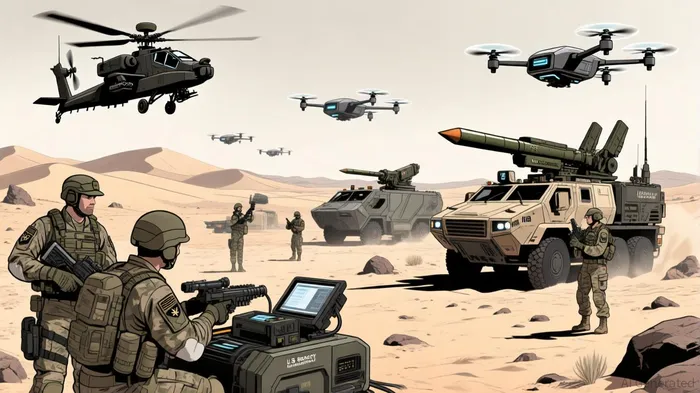
The U.S. military-industrial sector is undergoing a seismic transformation in 2025, driven by leadership changes, policy realignments, and a strategic pivot toward high-end peer conflict readiness. Defense Secretary Pete Hegseth's emphasis on “warrior ethos,” streamlined procurement, and industrial base revitalization has catalyzed a wave of reforms across the Department of Defense (DoD) and the Army. These shifts are not merely bureaucratic—they signal a fundamental reorientation of national security priorities, creating both risks and opportunities for defense contractors and investors.
Leadership and Policy: A New Era of Modernization
Hegseth's February 2025 town hall speech laid the groundwork for a defense strategy centered on readiness, accountability, and technological overmatch[1]. His priorities align with President Trump's April 2025 Executive Order, which mandates faster acquisition cycles, commercial solution integration, and workforce restructuring to prioritize innovation[2]. This policy framework has already triggered a cascade of changes: the Army's cancellation of legacy programs like the Robotic Combat Vehicle (RCV) and Stryker Combat Vehicle, and its accelerated investment in precision fires (e.g., PrSM, MRBMs) and drone warfare[3].
The Army's 2025 Restructuring Plan further underscores this shift. By merging Army Futures Command and TRADOC, reducing general officer ranks, and prioritizing AI-driven command systems, the service is streamlining decision-making for distributed, high-intensity operations[4]. These moves reflect a recognition that future conflicts will demand speed, adaptability, and technological superiority—qualities that legacy systems cannot deliver.
Defense Contractors: Aligning with the New Strategic Imperatives
The modernization agenda has created a clear divide among defense contractors. Companies aligned with the DoD's focus on precision fires, autonomy, and AI are poised to benefit, while those reliant on outdated platforms face declining relevance.
Precision Fires and Missile Systems:
Lockheed MartinLMT-- (LMT) and Raytheon Technologies (RTX) are leading the charge in long-range missile production. The Army's PrSM program, which replaces the aging ATACMS, is a $12 billion opportunity for LMT, while Raytheon's AIM-260 Joint Aerial Target Missile (JATM) is central to air defense modernization[3]. Similarly, Northrop Grumman's RQ-4 Global Hawk and Boeing's hypersonic test platforms remain critical for reconnaissance and strike capabilities[5].Drone Warfare and Autonomy:
The Pentagon's $50 million contract to Auterion for AI-powered “strike kits” (Skynode systems) highlights the growing demand for autonomous drone technology[2]. AeroVironmentAVAV-- (AVAV) and Kratos Defense (KRTOS) are also beneficiaries, with AVAV's Switchblade series and Kratos' Valkyrie drone platform securing key roles in tactical operations. Meanwhile, XTEND's Scorpio 500 AI-powered sUAS, capable of indoor-outdoor strikes, represents a new frontier in urban warfare[1].Industrial Base and Additive Manufacturing:
The DoD's push for rapid production and supply chain resilience has elevated companies like Ursa Major and Anduril Industries. Ursa Major's microreactors and Anduril's Barracuda autonomous air vehicles are emblematic of the shift toward low-cost, high-volume systems[6]. Honeywell Aerospace's 14% year-over-year revenue growth, driven by defense backlogs, further illustrates the sector's momentum[3].
Financial Performance and Market Trends
The defense market's trajectory is equally compelling. According to the May 2025 Defense Market Quarterly Review, the U.S. defense industry is projected to grow from $314 billion in 2024 to $447.31 billion by 2033, driven by modernization contracts and geopolitical tensions[3]. Q1 2025 saw standout performances:
- Kratos Defense: 9.2% revenue growth to $302.6 million, fueled by hypersonic systems and drone platforms[3].
- Rocket Lab: 32% year-over-year revenue increase to $122.6 million, supported by space launch contracts[3].
- Rheinmetall AG: 33% defense sales surge to €1.795 billion, reflecting global demand for air defense systems[3].
Risks and Challenges
While the sector's outlook is bullish, risks persist. The Government Accountability Office (GAO) has flagged oversight gaps in contractor-acquired property management, which could delay programs[2]. Additionally, the Army's aggressive modernization timelines—such as fielding drones in every division by 2026—require flawless execution. Companies like General Atomics and AM General, tied to canceled programs (e.g., MQ-1C Grey Eagle, JLTV), face headwinds[3].
Investment Thesis
For investors, the key is to prioritize contractors with deep alignment to the DoD's 2025 priorities. This includes:
- High-conviction plays: Lockheed Martin (PrSM), Raytheon (missile defense), Kratos (autonomous drones).
- Emerging innovators: Anduril (autonomy), XTEND (indoor sUAS), Ursa Major (additive manufacturing).
- Industrial enablers: Honeywell (aerospace tech), Teledyne FLIR (sensors).
Conversely, firms with exposure to legacy systems or bureaucratic inefficiencies should be approached cautiously. The DoD's emphasis on speed and cost-effectiveness favors agile, technology-driven firms over traditional heavyweights.
Conclusion
The U.S. military's 2025 modernization push is not a temporary trend but a strategic reorientation toward peer conflict and technological dominance. As leadership and policy converge on precision fires, autonomy, and industrial agility, the defense sector offers compelling long-term investment opportunities. For those who can navigate the risks and identify the right partners, this is a pivotal moment to capitalize on the next era of national security innovation.







Comentarios
Aún no hay comentarios