
Strategic Shifts in Fincraft Group's Tethys Petroleum Holdings and Implications for Takeover Potential
The recent maneuvers by Fincraft Group LLP in its Tethys Petroleum Limited (TPL) holdings signal a pivotal moment in the company's corporate trajectory. By restructuring its equity stake and escalating its takeover bid, Fincraft has positioned itself to potentially catalyze a transformative corporate action-one that could redefine Tethys's ownership structure, market presence, and strategic direction. For investors, the interplay of these moves with Tethys's operational performance and valuation metrics demands a nuanced assessment of timing and positioning.
Fincraft's Strategic Overhaul and Escalating Bid
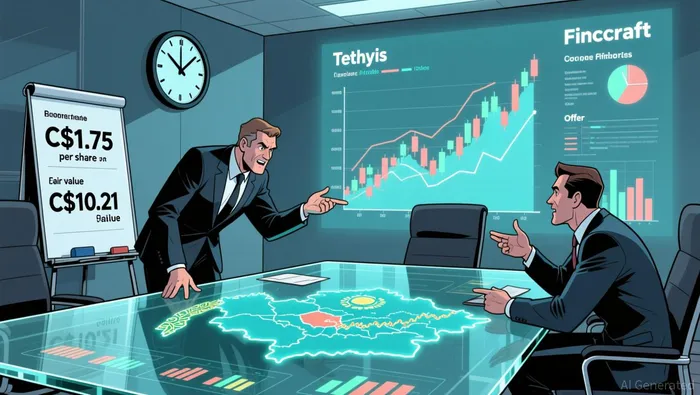
Fincraft's latest actions reflect a calculated effort to consolidate control. The firm has terminated prior agreements to purchase 6.7 million shares of Tethys and replaced them with a new deal to acquire 1.666 million shares at C$1.45 per share, a price significantly above the recent trading range. Simultaneously, Fincraft plans to transfer its existing 30.96 million shares to its wholly-owned subsidiary, FG Limited, a move likely aimed at streamlining governance. Most notably, Fincraft has raised its takeover offer from C$1.38 to C$1.75 per share-a 106% premium over Tethys's closing price of C$0.85 on September 12, 2025. This revised offer, now under review by Tethys's Special Committee, could culminate in a court-approved scheme of arrangement or delisting from the TSX Venture Exchange and Kazakhstan Stock Exchange according to market analysis.
The escalation in Fincraft's bid underscores its confidence in Tethys's long-term potential. As a major shareholder (owning 26.95% of shares), Fincraft argues that privatization would free Tethys from public market constraints, enabling more aggressive strategic initiatives in Kazakhstan's oil and gas sector. However, the proposal remains non-binding, contingent on due diligence, negotiations and regulatory approvals-a process that could span months.
Valuation Divergence and Operational Gains
Tethys's valuation profile presents a paradox. On one hand, the stock trades at a Price-to-Sales (PS) ratio of 6.1x, far exceeding the Canadian oil and gas industry average of 2.7x and peer averages of 1.3x. This suggests the market is pricing in optimism about future growth, despite Tethys's recent revenue contraction of 58% year-over-year as of December 2024. On the other hand, the stock is trading at CA$1.49, well below its estimated fair value of CA$10.21, indicating a potential undervaluation of over 20%.
This divergence highlights the tension between Tethys's operational improvements and its financial underperformance. The company reported a Q3 2025 profit of $1.4 million, reversing a loss in the same period in 2024, and has stabilized its debt profile. Yet, its return on equity remains negative, and earnings are still in the red. For Fincraft, the premium offer may reflect a belief that Tethys's operational turnaround can be accelerated under private ownership, while public investors remain skeptical.
Investor Positioning and Market Implications
The path forward hinges on Tethys's Special Committee and broader shareholder sentiment. While Fincraft's offer is compelling, Tethys's board has emphasized its progress since 2015-transforming from a near-bankrupt entity to a debt-free, production-growing company. This history of resilience could delay or even reject a takeover, particularly if the committee believes the offer undervalues Tethys's future potential.
For investors, the key question is timing. If Fincraft's proposal gains traction, Tethys's shares could trade closer to the C$1.75 offer price, especially if the Special Committee endorses the deal or initiates a competitive bidding process. However, risks remain: regulatory hurdles, shareholder resistance, or operational setbacks could derail the transaction. A more conservative approach might involve hedging against volatility through options or waiting for clarity on the Special Committee's review.
Conversely, if the takeover fails, Tethys's stock could remain range-bound, constrained by its weak earnings and high PS ratio. In this scenario, investors might focus on the company's operational metrics-such as production growth or cost reductions-as proxies for value.
Conclusion
Fincraft's strategic shifts in Tethys Petroleum holdings represent a high-stakes gamble with significant implications. The firm's escalating bid and restructuring efforts signal a belief in Tethys's long-term potential, but the path to a transformative corporate action is fraught with uncertainty. For investors, the decision to position in Tethys hinges on balancing optimism about privatization with skepticism about the company's current financial health. As the Special Committee deliberates, market participants must monitor both the progress of Fincraft's proposal and Tethys's operational performance-a duality that will ultimately determine whether this corporate drama culminates in a successful takeover or a prolonged standoff.







Comentarios
Aún no hay comentarios