
The Strategic Shift in U.S. Space Defense: Implications for Tech and Aerospace Stocks
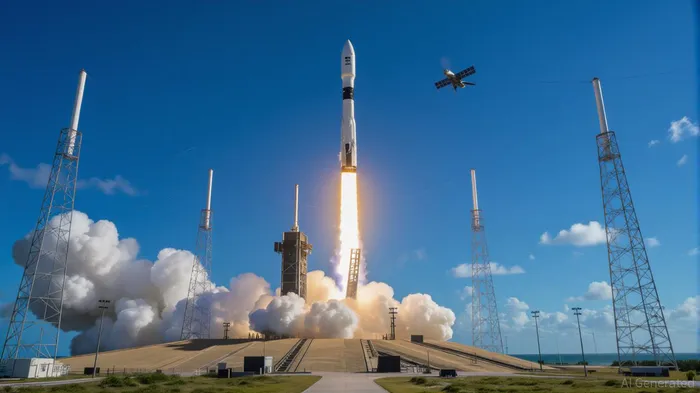
The U.S. space defense landscape has undergone a quiet but profound transformation in recent years, driven by technological innovation, geopolitical pressures, and shifting government priorities. At the heart of this evolution lies a pivotal question for investors: How will the Trump administration's scrutiny of SpaceX—coupled with its broader push to diversify aerospace partnerships—reshape the competitive dynamics between emerging space firms and traditional defense contractors?
The Trump Era and the SpaceX Paradox
During the Trump administration (2017–2021), SpaceX emerged as a linchpin of U.S. space and defense policy. The company secured over $5.9 billion in Department of Defense contracts, including 28 national-security launches, and became the sole provider of crewed missions to the International Space Station via its Crew Dragon spacecraft. The administration's emphasis on commercialization, epitomized by the creation of the U.S. Space Force in 2019, aligned perfectly with SpaceX's reusable rocket technology and cost efficiencies.
However, this dominance was not without friction. In 2021, tensions between Elon Musk and Donald Trump—sparked by Musk's criticism of the latter's policies—led to a formal review of SpaceX's federal contracts. The General Services Administration (GSA) initiated a probe to assess whether the government could reduce reliance on SpaceX by redirecting contracts to other providers. While the review ultimately concluded that SpaceX's services were “indispensable” to national security, it signaled a strategic imperative: diversify the aerospace supply chain to mitigate risks tied to over-reliance on a single entity.
Emerging Aerospace Firms: Capitalizing on the Pivot
The scrutiny of SpaceX created a window of opportunity for emerging aerospace firms. Amazon's Project Kuiper, for example, was approached by the Pentagon to participate in the administration's Golden Dome missile defense system—a $175 billion initiative aimed at deploying space-based interceptors. While Project Kuiper has yet to match SpaceX's launch pace (78 satellites deployed vs. Starlink's 4,000+), its involvement in defense applications underscores the administration's interest in leveraging commercial satellite capabilities.
Smaller rocket companiesRKT-- like Rocket LabRKLB-- (RKLB) and Stoke Space also saw renewed attention. The Pentagon's plan to open individual launch contracts for the Golden Dome system to competition could create a bidding arena where these firms, with their agile business models, gain traction. For investors, this represents a high-risk, high-reward proposition: early-stage aerospace startups with niche capabilities but limited track records in defense contracts.
Traditional Defense Contractors: Adapting to a New Paradigm
Legacy defense giants like Lockheed MartinLMT-- (LMT), Northrop GrummanNOC-- (NOC), and L3HarrisLHX-- Technologies (LHX) have long dominated the aerospace sector. Under the Trump administration, they faced a dual challenge: competing with SpaceX's cost efficiencies while adapting to a government that increasingly valued commercial innovation.
The administration's Golden Dome initiative, however, offered a lifeline. These traditional firms were tapped to develop components like space-based interceptors and missile warning systems, leveraging their experience in complex defense projects. For example, Northrop Grumman's expertise in satellite manufacturing and Lockheed's history with missile defense systems positioned them as key players in the administration's space-based security strategy.
The increased funding for the U.S. Space Force—$13 billion in 2023 alone—further bolstered traditional contractors. This investment, aimed at accelerating satellite production and space infrastructure, provided a buffer against the encroachment of commercial players. For investors, these companies represent a more stable, albeit less dynamic, segment of the sector.
The Investment Outlook: Balancing Innovation and Stability
The Trump-era shift in space defense policy offers a nuanced playbook for investors. On one hand, the administration's push for commercialization and competition has elevated the profile of emerging aerospace firms. On the other, the strategic necessity of SpaceX's capabilities ensures its dominance in the near term, limiting the upside for alternatives.
For a diversified portfolio, consider the following:
1. Emerging Firms with Defense Ties: Companies like AmazonAMZN-- (AMZN) and Rocket Lab (RKLB) could benefit from long-term government contracts if the administration continues to prioritize diversification. However, their valuations remain speculative.
2. Traditional Contractors with Space Expertise: LockheedLMT-- Martin (LMT) and Northrop Grumman (NOC) are well-positioned to capitalize on the Space Force's growth and the Golden Dome initiative. Their established relationships with the DoD provide a buffer against market volatility.
3. Space Infrastructure Providers: Firms involved in satellite manufacturing, launch services, and ground systems (e.g., L3Harris Technologies) stand to gain from the administration's $13 billion satellite funding push.
Conclusion: A Sector in Flux
The U.S. space defense sector is at a crossroads, shaped by the interplay of technological disruption and strategic necessity. While the Trump administration's scrutiny of SpaceX highlighted the risks of over-reliance on a single provider, it also accelerated the integration of commercial capabilities into national security. For investors, this means a sector ripe for both innovation and caution.
The key takeaway: Diversify across emerging and traditional players. Emerging firms offer growth potential tied to government innovation, while legacy contractors provide stability in an unpredictable geopolitical climate. As the administration's Golden Dome initiative and the Space Force's expansion unfold, the aerospace sector will remain a critical arena for strategic investment.





Comentarios
Aún no hay comentarios