
The Strategic Shift in DeFi Yield: Spark's $100M Move into Superstate's Crypto Carry Fund
The Treasury Yield Dilemma and DeFi's Response
The compression of U.S. Treasury yields has long been a thorn in the side of institutional investors and DeFi protocols alike. As central banks normalize rate cuts, the "risk-free floor" for returns-once anchored by Treasurys-has eroded. For DeFi platforms like Spark, which previously relied on tokenized U.S. Treasury bonds (USTB) to generate stable returns, this creates a critical inflection point. According to The Block, Spark's decision to reallocate $100 million into Superstate's fund reflects a broader industry trend: the pursuit of market-neutral strategies that thrive in low-interest environments.
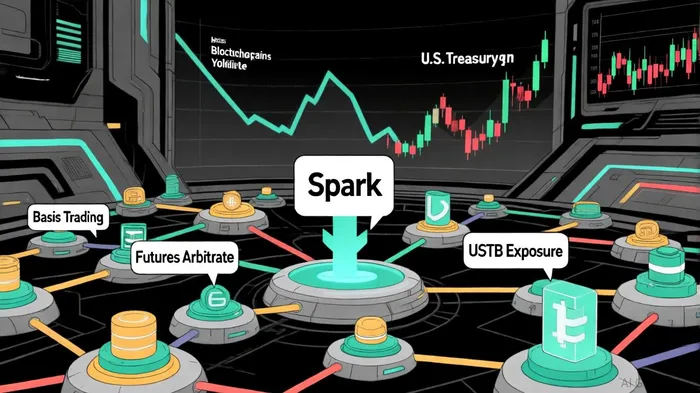
Superstate's USCC fund, which targets a 30-day yield of 8.35%, operates by arbitraging price gaps between spot and futures markets for major digital assets. This approach is inherently uncorrelated with Federal Reserve policy, offering a hedge against the volatility of traditional fixed-income markets, as Coinotag reports. For Spark, the move notNOT-- only diversifies its revenue streams but also aligns with its mission to integrate regulated, transparent infrastructure into DeFi's yield ecosystem, according to Cointelegraph.
The Mechanics of Crypto Carry Strategies
The USCC fund's strategy hinges on basis trading-a practice where traders profit from the difference between spot and futures prices. In a low-interest world, this becomes particularly attractive. As noted by Galaxy Digital, DeFi yield strategies have evolved beyond simple interest generation to include complex derivatives trading and restaking mechanisms. By leveraging institutional-grade compliance and crypto-native tools, Superstate's fund offers a bridge between traditional finance (TradFi) and DeFi, enabling protocols to access high-yield opportunities without sacrificing regulatory clarity.
Spark's allocation also underscores the growing importance of liquidity management in DeFi. Unlike passive yield mechanisms, basis trading requires dynamic capital deployment, which aligns with Spark's broader efforts to optimize its stablecoin reserves. This shift is not without risks-market volatility and liquidity crunches can amplify losses-but the potential rewards are significant in an environment where traditional benchmarks are faltering, as previously reported by Cointelegraph.
Broader Implications for DeFi Yield Innovation
Spark's move signals a maturation of DeFi's yield landscape. Protocols are no longer content with mimicking TradFi's playbook; instead, they are innovating with strategies tailored to crypto's unique properties. The integration of regulated funds like USCC into DeFi's infrastructure also addresses a long-standing criticism: the lack of institutional-grade safeguards. By partnering with Superstate, Spark demonstrates that DeFi can coexist with compliance, offering returns that rival-or even surpass-those of traditional markets, as The Block observed.
However, this transition is not without challenges. As DeFi protocols venture into complex derivatives and arbitrage strategies, they must balance innovation with risk management. The recent collapse of several leveraged yield farms highlights the fragility of untested models. Yet, for platforms like Spark, the alternative-stagnating returns from Treasurys-is equally untenable.
Conclusion
The $100 million allocation to Superstate's USCC fund is more than a tactical maneuver; it is a strategic repositioning for DeFi in a low-yield world. By embracing crypto-native strategies like basis trading, Spark and its peers are redefining what it means to generate value in decentralized ecosystems. As traditional benchmarks lose relevance, the ability to diversify across uncorrelated, market-neutral strategies will become a key differentiator for DeFi protocols seeking to thrive in the next phase of the crypto cycle.







Comentarios
Aún no hay comentarios