
The Strategic Shift in Asian Crude Sourcing: Nigerian Oil as a High-Yield Alternative to U.S. Grades
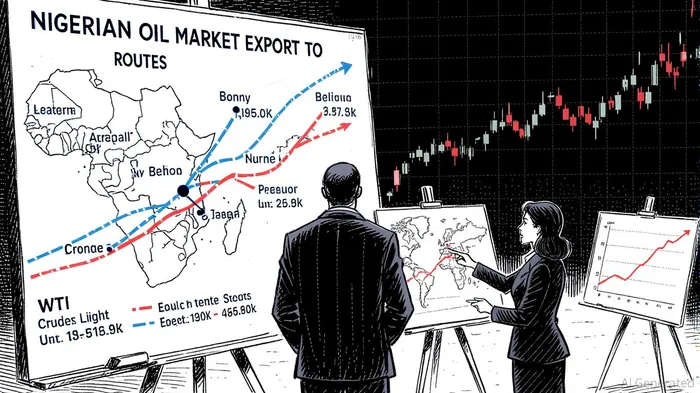
The global crude oil market in 2025 is witnessing a seismic shift in sourcing strategies, driven by a confluence of geopolitical arbitrage, supply diversification imperatives, and the inherent quality advantages of Nigerian crude. Asian refiners, long accustomed to balancing cost, quality, and geopolitical risk, are increasingly favoring Nigerian grades like Bonny Light over U.S. counterparts such as West Texas Intermediate (WTI). This trend is not merely a short-term fluctuation but a recalibration of energy trade dynamics shaped by structural factors.
Quality Premiums and Refining Efficiency
Nigerian crude’s technical attributes position it as a superior feedstock for Asian refineries. Bonny Light, with its low sulfur content (0.21%) and high API gravityGRVY-- (32.5°), commands a price premium of $11.37 per barrel over WTIWTI-- as of July 2025 [2]. This premium reflects its compatibility with modern refining infrastructure, which prioritizes low-sulfur crude to meet stringent emissions standards. In contrast, U.S. grades, while still desirable, face logistical headwinds and regional discounts. For instance, WTI traded at $67.25 per barrel in July 2025, lagging behind Bonny Light’s $78.62 and the OPEC basket’s $68.06 [2]. Asian refiners, particularly in India and South Korea, are capitalizing on these differentials to optimize yields of high-value products like gasoline and diesel [4].
Geopolitical Arbitrage and Diversification Imperatives
The shift toward Nigerian crude is amplified by geopolitical tensions that have eroded confidence in U.S. energy security. The Iran-Israel conflict and U.S. sanctions on Iranian oil have introduced a “geopolitical premium” into global crude pricing, with Brent crude surging to $81 per barrel in June 2025 [5]. These disruptions have pushed Asian buyers to diversify away from politically volatile regions. India, Nigeria’s largest crude buyer in Q1 2025 (importing $1.41 trillion worth of oil), has pivoted from U.S. crude to Nigerian and Middle Eastern grades, leveraging favorable pricing windows [1]. Similarly, Pakistan’s first-ever purchase of Bonny Light from Vitol underscores Nigeria’s role as a stable alternative to Middle Eastern suppliers [3].
U.S. trade policies under the Trump administration have further complicated the landscape. Tariff adjustments and export restrictions have created pricing asymmetries, with U.S. crude facing a $4-per-barrel landed cost disadvantage compared to Nigerian oil [1]. This has opened arbitrage opportunities for Asian refiners, who now source Nigerian crude at lower risk-adjusted costs. For example, Indian Oil Corporation (IOC) recently tendered for Nigerian Agbami and Usan grades instead of WTI, a move analysts attribute to both economic and strategic considerations [4].
Supply Chain Resilience and Market Adaptability
Nigeria’s production resilience has bolstered its appeal. Despite challenges in the Niger Delta, output rebounded to 1.7 million barrels per day in July 2025, driven by improved security and increased rig activity [4]. This stability contrasts with U.S. supply chains, which face bottlenecks from infrastructure constraints and regional price discounts. Meanwhile, Nigeria’s Dangote Refinery has emerged as an unexpected player in U.S. markets, exporting jet fuel during maintenance shutdowns of American refineries—a short-term arbitrage that highlights the growing interdependence between Nigerian and U.S. energy systems [3].
The strategic calculus for Asian buyers also includes long-term infrastructure investments. China’s expanding influence in Africa, coupled with Nigeria’s planned IPO of the Nigerian National Petroleum Company Limited (NNPC Ltd), signals a shift toward institutionalized partnerships that prioritize supply continuity [1]. These developments align with broader Asian efforts to hedge against Middle East-centric supply risks, a trend accelerated by Red Sea shipping disruptions [2].
Conclusion: A New Equilibrium in Global Oil Trade
The strategic shift in Asian crude sourcing underscores a broader realignment of global energy markets. Nigerian oil, with its quality advantages and geopolitical resilience, is emerging as a high-yield alternative to U.S. grades in a landscape defined by arbitrage and diversification. For investors, this trend highlights the importance of monitoring not just price movements but also the interplay of technical, geopolitical, and infrastructural factors that shape energy trade flows. As OPEC+ contemplates further production adjustments and U.S. policies remain volatile, Nigeria’s position in Asian markets is likely to solidify—a testament to the enduring power of supply-side adaptability in an era of uncertainty.
Source:
[1] Indian Oil skips US crude, buys Nigerian, Mideast oil via tender, say sources [https://www.reuters.com/business/energy/indian-oil-skips-us-crude-buys-nigerian-mideast-oil-via-tender-say-sources-2025-09-05/]
[2] Crude Oil Prices Today: Market Trends and Global Factors [https://discoveryalert.com.au/news/crude-oil-prices-dynamics-influences-2025/]
[3] US jet fuel imports surge as Nigeria's Dangote refinery pushes barrels [https://www.reuters.com/business/energy/us-jet-fuel-imports-surge-nigerias-dangote-refinery-pushes-barrels-west-2025-03-24/]
[4] India Shifts from US Crude, Buys Nigerian Oil Amid Trade Tensions [https://www.arise.tv/india-shifts-from-us-crude-buys-nigerian-and-middle-eastern-oil-amid-trade-tensions/]
[5] Geostrategic Analysis: July 2025 edition [https://www.ey.com/en_gl/insights/geostrategy/geostrategic-analysis]





Comentarios
Aún no hay comentarios