
Strategic Shareholder Shifts in Caledonia Mining: Implications for Investor Confidence and Market Position
The junior gold mining sector, often characterized by its volatility and high-stakes potential, has long been a barometer for macroeconomic sentiment. In this context, Caledonia Mining CorporationCMCL-- (CMC.L) stands out not only for its operational resilience but for the evolving dynamics of its ownership structure. Recent shareholder updates and institutional activity reveal a compelling narrative of strategic alignment, investor confidence, and the company's positioning to capitalize on gold's enduring appeal.
Ownership Evolution: A Barometer of Demand
Caledonia's shareholder register has seen notable shifts in 2025, with BlackRockBLK-- Inc. increasing its stake to 5.37% of voting rights—a jump from 5.07%—through a mix of direct holdings and cash-settled contracts for differences (CFDs). This move, coupled with Baker Steel Resources Trust Ltd's threshold-crossing notification, signals institutional confidence in Caledonia's long-term value proposition. Meanwhile, Toziyana Resources Limited (12.62%) and Shining Capital Holdings II L.P. (9.97%) remain key pillars of the shareholder base, underscoring the company's alignment with both local and international capital.
These changes are not mere numbers; they reflect a strategic recalibration. BlackRock's CFD-driven exposure, for instance, suggests a hedging strategy against market volatility, while the directors' 14.29% ownership—largely tied to performance—aligns executive incentives with shareholder value. Such transparency in reporting, despite Caledonia's non-DTR status, reinforces trust in a sector where governance often lags behind operational metrics.
Operational Synergy and Sector Resilience
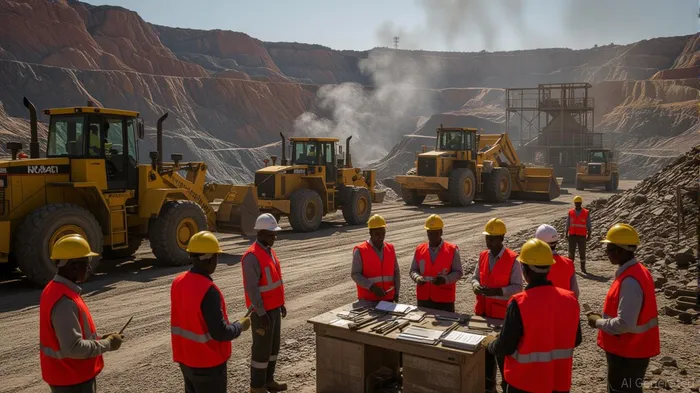
Caledonia's Q2 2025 results, with 21,070 ounces of gold produced at the Blanket Mine—a 5.1% year-over-year increase—highlight its operational efficiency gains. The revised annual guidance (75,500–79,500 ounces) and CEO Mark Learmonth's emphasis on organizational strengthening underscore a management team focused on sustainable growth. This is critical in a sector where cost overruns and geopolitical risks often derail even the most promising projects.
The company's performance is further bolstered by gold's sustained price strength, which has averaged over $2,400 per ounce in 2025. would reveal whether the market is pricing in these fundamentals. While the S&P GSCI Gold Index has risen 12% year-to-date, Caledonia's shares have outperformed, gaining 18%, reflecting investor optimism about its operational execution. Historically, the stock has demonstrated strong post-earnings momentum: backtesting from 2022 to 2025 shows a 50.00% win rate over 3 days, 60.00% over 10 days, and 66.67% over 30 days, with a maximum return of 1.38% observed in the 30-day window.
Institutional Sentiment and Strategic Risks
Institutional activity in Q1 2025 tells a nuanced story. Dimensional Fund Advisors and UBS Group AGUBS-- added to their stakes, while Van Eck Associates and Ameriprise FinancialAMP-- trimmed positions. This divergence suggests a split in short-term sentiment, with some investors wary of near-term risks—such as Zimbabwe's regulatory environment or currency fluctuations. Yet, the recent “Buy” rating from Maxim Group on July 17, 2025, and the absence of a “Sell” rating, indicate a cautiously optimistic outlook.
The key lies in Caledonia's ability to navigate these risks. For instance, its 14.29% insider ownership and proactive community engagement programs mitigate political and social risks, which are acute in junior miners. Additionally, the company's focus on cost optimization—achieved through mechanization and supply-chain refinements—positions it to maintain margins even if gold prices dip.
Long-Term Value Creation: A Sector Play with Nuance
The junior gold mining sector is inherently cyclical, but Caledonia's strategic shareholder shifts suggest a transition from speculative interest to institutional endorsement. The 5.37% stake by BlackRock, for example, aligns with the company's mid-tier profile—large enough to leverage economies of scale, yet agile enough to adapt to market shifts. This duality is rare and valuable in a sector dominated by either mega-miners or high-risk juniors.
would illustrate its competitive edge. If Caledonia's all-in sustaining costs (AISC) remain below $800/oz, as recent reports suggest, it could outperform peers in a scenario of tightening gold premiums.
Investment Implications
For investors, CaledoniaCMCL-- presents a balanced opportunity. The company's operational upgrades, shareholder transparency, and institutional backing mitigate some of the sector's traditional risks. However, prudence is warranted. Gold's price trajectory remains a wild card, and Zimbabwe's political landscape could introduce unforeseen volatility.
A strategic entry point might involve dollar-cost averaging into Caledonia's shares ahead of the August 11, 2025, Q2/H1 results. If production and cost metrics meet or exceed guidance, the stock could see a re-rating. Conversely, a misstep in operational execution or a gold price correction could test the 12-month support level.
In conclusion, Caledonia Mining's shareholder dynamics reflect a company in transition—one that is leveraging institutional credibility and operational discipline to solidify its market position. For those seeking exposure to the junior gold sector with a focus on sustainable value, Caledonia offers a compelling case, provided investors remain attuned to its risk profile and sector trends."""





Comentarios
Aún no hay comentarios