
Strategic Share Buybacks: A Capital Allocation Lens on Royal Unibrew, DFDS, and Aegon
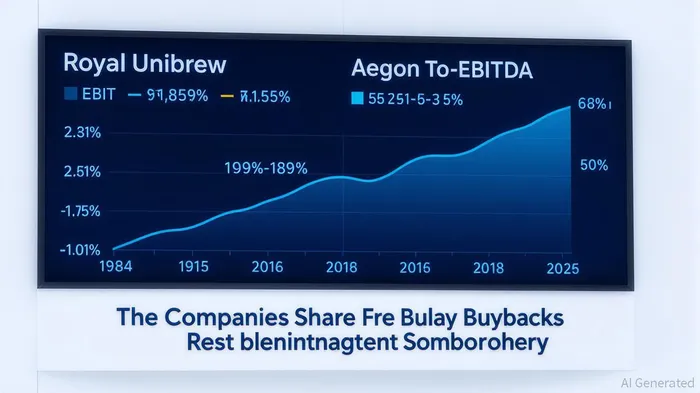
In the realm of corporate finance, share buybacks have evolved from a mere accounting maneuver to a strategic tool for value creation. For investors, the timing, scale, and rationale behind these programs can reveal critical insights into a company's financial health, management priorities, and long-term vision. This article examines the buyback strategies of three European firms—Royal Unibrew, DFDS, and Aegon—to assess how disciplined capital allocation through share repurchases can signal strength and shareholder-centric governance.
Royal Unibrew: Precision and Regulatory Compliance
Royal Unibrew's recent DKK 250 million buyback program, executed between February and August 2025, exemplifies a company leveraging its strong cash flow and regulatory expertise to optimize capital structure. The program, conducted under EU Market Abuse Regulation (MAR) and Safe Harbour rules, reduced the company's share count by 1.2%, enhancing earnings per share (EPS) and signaling confidence in its multi-beverage model.
The rationale is rooted in Royal Unibrew's decade-long track record of 9% CAGR EBIT growth, driven by organic expansion and strategic acquisitions. By returning surplus cash to shareholders during periods of low leverage (net debt-to-EBITDA of 2.2x in 2024), the company demonstrates a balance between reinvestment and capital return. For investors, this aligns with the principle that buybacks are most effective when executed at a discount to intrinsic value—a metric Royal Unibrew appears to meet, given its robust ROIC and asset-light operating model.
DFDS: Prudence in the Face of Leverage
DFDS's 2024 DKK 431 million buyback, conducted under Safe Harbour rules, contrasts sharply with its decision to halt distributions in 2025. The 2024 program, which reduced share capital by DKK 13.2 million, was justified by a 15% EBIT margin expansion and a net debt-to-EBITDA ratio of 3.9x—a level the board deemed temporarily acceptable. However, the 2025 pause underscores the company's prioritization of deleveraging over shareholder returns, a move that reflects disciplined execution in volatile markets.
DFDS's approach highlights a key nuance: buybacks are not inherently value-creating if they exacerbate leverage. The company's 2024 buyback was paired with a DKK 168 million dividend, totaling DKK 599 million in shareholder returns. Yet, with earnings underperformance in logistics and ferry operations, the board's 2025 decision to focus on operational efficiency and debt reduction signals a long-term orientation. For investors, this duality—rewarding shareholders when metrics are favorable while pausing during stress—reinforces the importance of aligning buybacks with a company's financial flexibility.
Aegon: A Legacy of Large-Scale Buybacks
Aegon's history of aggressive buybacks—culminating in a EUR 1.535 billion program in 2023—demonstrates a commitment to capital discipline and shareholder value. The company's buybacks are often tied to specific triggers: neutralizing dilutive dividends, fulfilling share-based compensation, or executing capital reductions. For instance, the 2023 EUR 1.535 billion program, expanded by EUR 35 million to address executive compensation, reduced the share count by over 100 million shares, directly boosting EPS.
Aegon's approach is notable for its consistency. From 2020 to 2025, the company has executed buybacks totaling over EUR 2.5 billion, often at a discount to intrinsic value. This reflects a management team that views equity as a flexible capital source, particularly in a sector where regulatory capital requirements are stringent. For investors, Aegon's buybacks are a testament to its ability to generate surplus cash while maintaining solvency—a rare combination in the insurance industry.
Implications for Investors
The contrasting strategies of Royal Unibrew, DFDS, and AegonAEG-- illustrate that effective buybacks are not one-size-fits-all. Key takeaways for investors include:
1. Alignment with Financial Metrics: Buybacks should be evaluated in the context of leverage, free cash flow, and growth prospects. Royal Unibrew's low debt and high ROIC make its buybacks a compelling use of capital, while DFDS's 2025 pause shows prudence.
2. Execution Discipline: Aegon's adherence to regulatory frameworks and its ability to time buybacks during undervaluation periods (e.g., 2023) highlight the importance of management's execution quality.
3. Strategic Rationale: Buybacks tied to specific triggers (e.g., dividend neutralization, compensation) often reflect a more disciplined approach than opportunistic repurchases.
For investors considering these firms post-buyback, the focus should shift to how these programs impact future earnings and valuation. Royal Unibrew's reduced share count could amplify EPS growth in 2026, while DFDS's deleveraging may unlock buybacks once leverage improves. Aegon's sustained buybacks, meanwhile, position it to outperform peers in a low-growth insurance sector.
In conclusion, strategic share buybacks are a powerful tool for value creation when executed with discipline, transparency, and alignment to long-term goals. Royal Unibrew, DFDS, and Aegon each offer lessons in how companies can balance capital return with operational resilience—a critical consideration for investors navigating today's dynamic markets.







Comentarios
Aún no hay comentarios