
Strategic Sector Rotation in a Tariff-Driven World: Navigating Trump's Trade Policies
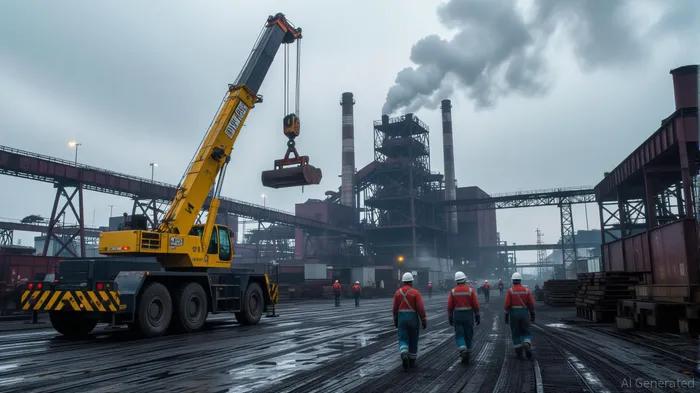
The U.S. trade landscape in 2025 is defined by a seismic shift under President Trump's aggressive tariff regime. Steel, autos, and critical minerals have become focal points of a strategy aimed at reshaping global supply chains, but the ripple effects are far-reaching. For investors, this environment demands a sharp focus on sector rotation and risk mitigation. Let's dissect the opportunities and pitfalls.
The Tariff-Driven Reconfiguration of Global Supply Chains
Trump's tariffs have rewritten the rules of engagement for industries reliant on imported materials. Steel and aluminum tariffs, now at 50% for most countries (25% for the UK), have forced manufacturers to reevaluate sourcing strategies. The auto sector, hit by a 25% import tariff, faces a 0.1% GDP drag and 109,000 job losses, yet domestic automakers with USMCA-compliant supply chains may gain a competitive edge. Meanwhile, critical minerals tariffs—spiking to 100% on semiconductors and 250% on pharmaceuticals—threaten to disrupt energy and tech sectors, which depend on global supply chains for rare earth elements and components.
The economic modeling is clear: while these policies aim to protect domestic industries, they also inflate production costs, trigger retaliatory tariffs, and reduce GDP. For example, the steel and aluminum tariffs alone could shrink U.S. GDP by 0.2% and cost 141,000 jobs. Yet, for investors, the asymmetry lies in identifying which sectors can adapt and which will crumble under the weight of these policies.
Strategic Rotation: Where to Play and Where to Hedge
1. Capitalize on Resilient Sectors
- Steel and Aluminum Producers: Domestic manufacturers like NucorNUE-- (NUE) and U.S. Steel (X) are direct beneficiaries of elevated tariffs. With import costs soaring, these firms are seeing increased demand for their products. However, investors must monitor input costs and capacity constraints.
- Auto Supply Chains with USMCA Compliance: Companies like Magna InternationalMGA-- (MGA) and Lear CorporationLEA-- (LEA) are restructuring to meet U.S. content requirements, positioning themselves to thrive in a tariff-protected market.
- Critical Minerals and Tech Reshoring: Firms securing domestic sources of rare earth elements or investing in alternative materials (e.g., Tesla's [TSLA] battery innovations) could outperform peers. The Biden administration's Inflation Reduction Credit (IRC) also offers a tailwind for U.S. energy tech.
2. Hedge Against Exposed Sectors
- Auto Manufacturers and Appliance Makers: Companies like FordF-- (F) and WhirlpoolWHR-- (WHR) face margin compression due to higher steel and aluminum costs. Investors should consider short-term hedging via options or ETFs like the iShares U.S. Auto Manufacturers ETF (IYM).
- Pharmaceuticals and Consumer Goods: Tariffs on imported drugs and textiles could lead to price spikes and supply chain bottlenecks. Diversifying into companies with strong domestic sourcing (e.g., PerrigoPRGO-- [PRGO]) or using sector-specific inverse ETFs may mitigate risk.
Risk Mitigation in a Volatile Trade Environment
The key to navigating this landscape is agility. Here's how to build a resilient portfolio:
- Diversify Geographically: Overexposure to U.S.-centric policies can be offset by investing in countries less impacted by retaliatory tariffs. For example, India's manufacturing sector is gaining traction as a trade alternative.
- Leverage Derivatives: Use futures and options to hedge against sector-specific volatility. For instance, long-dated call options on steel producers could lock in gains if tariffs persist.
- Focus on Innovation: Companies pivoting to domestic production or alternative materials (e.g., solid-state batteries) are better positioned to withstand trade shocks.
The Bottom Line: Agility Over Complacency
Trump's tariffs are not just a short-term disruption—they're a catalyst for long-term structural shifts in global trade. Investors must act with precision: rotate into sectors that benefit from protectionism, hedge against those that are vulnerable, and stay attuned to geopolitical developments. The market's next phase will reward those who adapt swiftly to a world where trade wars redefine supply chains and sector dynamics.
In this high-stakes environment, the mantra is simple: rotate strategically, hedge ruthlessly, and stay ahead of the curve. The future belongs to investors who see volatility not as a threat, but as an opportunity to rebalance their portfolios for the new economic reality.





Comentarios
Aún no hay comentarios