
Strategic Sector Positioning in the Wake of the U.S.-Japan Trade Agreement: Navigating Tariffs and Opportunities
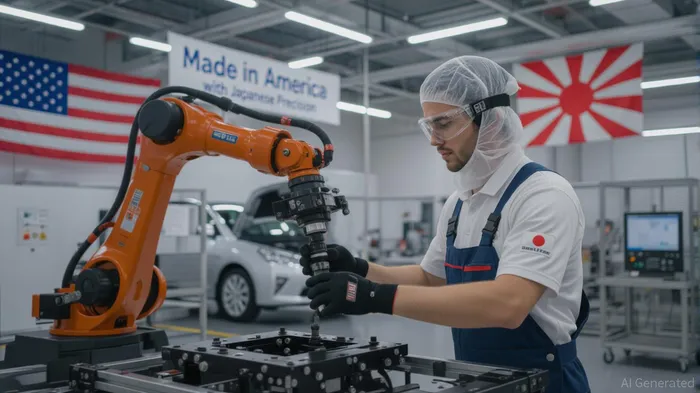
The U.S.-Japan Trade Agreement of July 2025 has rewritten the rules of global manufacturing and export dynamics. By reducing tariffs on Japanese goods from a threatened 25% to 15%, the deal has created a fragile equilibrium between protectionist ambitions and economic pragmatism. For investors, the agreement is not merely a tariff adjustment but a catalyst for strategic repositioning across sectors. This analysis explores how manufacturers and exporters can navigate this new landscape while mitigating risks and capitalizing on opportunities.
Automotive: Localization as a Lifeline
The automotive sector remains the epicenter of the agreement's impact. Japanese automakers, long reliant on cross-border exports, now face a 15% tariff that, while lower than initially feared, still erodes margins. ToyotaTM-- and HondaHMC--, for instance, have seen export values drop 26.7% year-over-year despite a 4.6% increase in shipment volumes. The solution? Accelerated localization. Toyota's plan to source 80% of U.S. sales from domestic plants by 2027 is projected to reduce tariff exposure by $1.8 billion annually.
Investors should monitor how quickly firms like Toyota and Honda ramp up U.S. production. Those with robust nearshoring strategies—such as Honda's $3.5 billion investment in a U.S. EV battery plant—stand to outperform. However, the transition is not without risks. Labor shortages and supply chain bottlenecks could delay timelines, creating volatility in valuations. For now, the sector's undervaluation (Toyota's P/E at 7.3x versus the industry average of 12.5x) suggests potential for long-term gains if execution aligns with plans.
Steel: A Green Transition with Geopolitical Leverage
Japan's steel exports to the U.S. have plummeted 29% under the 50% tariff, creating a vacuum for domestic producers like U.S. Steel and NucorNUE--. The latter has leveraged the Inflation Reduction Act (IRA) to pivot toward green steel, a move that aligns with U.S. decarbonization goals. U.S. Steel's recent acquisition by Nippon Steel for $14.1 billion exemplifies the fusion of Japanese capital and U.S. infrastructure ambitions.
For investors, the key lies in identifying firms that bridge green technology and geopolitical alignment. Nippon Steel's acquisition not only secures U.S. production capacity but also positions it to benefit from $550 billion in Japanese investments. Japanese steelmakers like JFE Steel could also gain if capital flows into U.S. infrastructure projects, though delays in implementation remain a risk.
Technology and Energy: The Asymmetric Opportunity
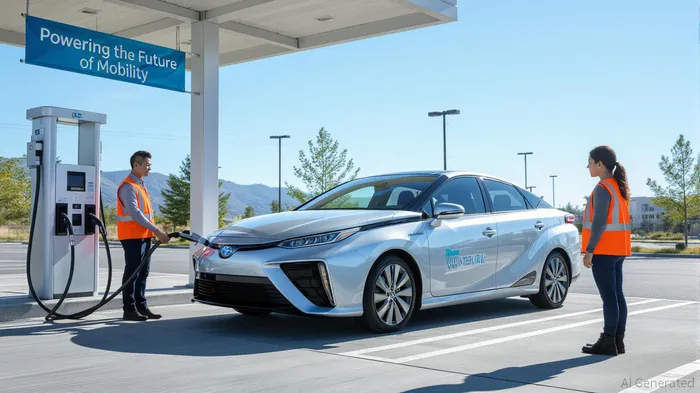
Japanese firms are pivoting toward green technologies to offset short-term pain. Toyota's hydrogen fuel cell partnerships and Honda's EV battery venture with LG Energy Solution highlight this shift. These moves position Japan as a leader in the next phase of the energy transition, despite current valuations that reflect near-term struggles.
The $550 billion investment pledge could further accelerate this transition. If directed toward U.S. infrastructure, companies like Komatsu and Hitachi Construction Machinery—suppliers of heavy equipment—could see demand surges. However, the lack of a clear implementation timeline introduces uncertainty. Investors should prioritize firms with diversified revenue streams and strong R&D pipelines.
Risk Mitigation in a Fragmented Trade Environment
The agreement underscores a broader shift toward bilateralism and protectionism. While the U.S. aims to reduce trade deficits, Japan's investment commitment offers a buffer against retaliatory tariffs. However, global fragmentation remains a risk. Investors must balance exposure to U.S. protectionist policies (e.g., 100% Chinese EV tariffs) with the potential for retaliatory measures from other trade partners.
Diversification is key. For example, Tesla's dominance in the U.S. EV market (Model Y sales up 50% in Q2 2025) is a testament to the benefits of leveraging protectionist policies. Yet, overreliance on a single market exposes firms to regulatory shifts. Cross-border collaborations—such as Toyota's Mississippi EV plant—offer a hedge against such risks.
Conclusion: Positioning for the New Normal
The U.S.-Japan Trade Agreement signals a paradigm shift in global manufacturing. For investors, the path forward lies in strategic sector positioning:
1. Automotive: Prioritize firms accelerating localization and EV innovation.
2. Steel: Target U.S. producers aligned with green energy and infrastructure goals.
3. Technology: Bet on Japanese firms pivoting to hydrogen and EV ecosystems.
4. Diversification: Hedge against geopolitical risks through cross-border partnerships.
While the immediate focus is on tariff adjustments, the long-term narrative is about resilience and adaptation. Companies that embrace this duality—localizing production while expanding green innovation—will define the next era of global trade. For investors, the challenge is to balance short-term volatility with long-term structural change, ensuring portfolios are both agile and aligned with the new economic realities.





Comentarios
Aún no hay comentarios