
Strategic M&A in SaaS and the Rise of Tokenized Assets: Investment Implications for 2026
The intersection of strategic mergers and acquisitions (M&A) in the SaaS sector and the rapid evolution of tokenized assets is reshaping the investment landscape in 2026. Two pivotal developments-ServiceNow's potential $7 billion acquisition of cybersecurity firm Armis and JPMorgan's launch of a tokenized money market fund-highlight divergent yet complementary approaches to value creation. This analysis evaluates their long-term implications for investors, contextualizing their strategic rationales, market risks, and alignment with macroeconomic trends.
ServiceNow's Armis Acquisition: A Strategic Bet on Cybersecurity Consolidation
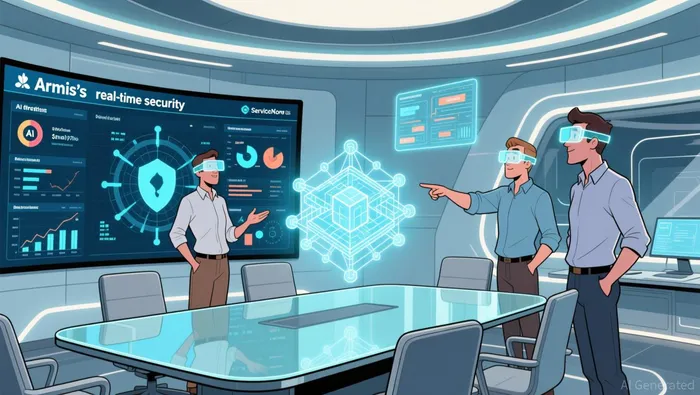
ServiceNow's rumored acquisition of Armis, a cybersecurity firm specializing in asset intelligence and real-time device protection, represents a bold expansion into a sector projected to grow at a 12% CAGR through 2030. Armis's technology, which provides visibility across IT, IoT, and OT environments, aligns with ServiceNow's vision of embedding security into digital workflows. The deal, if finalized, would mark ServiceNow's largest acquisition to date and signal a shift from its core IT service management offerings to a broader enterprise security platform.
The strategic rationale is compelling. Armis's $300 million in annual recurring revenue (ARR) and its client base of 40% of the Fortune 100 underscore its market relevance. For ServiceNowNOW--, integrating Armis's capabilities could accelerate its transition into an "AI operating system for enterprises," a narrative already bolstered by prior acquisitions like Moveworks and Veza. Analysts at RBC Capital argue that the deal reflects a broader trend of software consolidation in an AI-driven world, positioning ServiceNow as a consolidator in the cybersecurity space.
However, the $7 billion valuation has sparked skepticism. Armis had recently raised $435 million at a $6.1 billion valuation in anticipation of an IPO, raising questions about whether the acquisition premium justifies the strategic upside. Short-term market reactions including a pre-market stock dip for ServiceNow highlight investor concerns over overpayment. Yet, long-term value creation hinges on successful integration: Armis's agentless security model could enhance ServiceNow's platform, enabling real-time threat detection and reducing operational friction for clients.
JPMorgan's Tokenized Money Market Fund: A Blockchain-Driven Financial Innovation
JPMorgan's launch of the My OnChain Net Yield Fund (MONY) on the EthereumETH-- blockchain represents a paradigm shift in asset tokenization. Seeded with $100 million of the bank's capital and targeting qualified investors with a $1 million minimum, MONY offers daily interest payouts and redemptions in cash or USDCUSDC-- stablecoin. The fund's focus on U.S. Treasury securities and fully collateralized repurchase agreements ensures stability while leveraging blockchain's advantages-faster settlement, real-time transparency, and 24/7 trading.
This move aligns with JPMorgan's broader strategy to navigate macroeconomic volatility. As global trade dynamics and U.S. tariff policies create uncertainty, the bank is prioritizing resilient, liquid offerings for institutional clients. Tokenized money market funds like MONY address a critical gap: they enable investors to earn yield on blockchain-based assets without sacrificing the safety of traditional fixed-income instruments. By joining peers like BlackRock and Franklin Templeton in this space, JPMorganJPM-- is positioning itself as a leader in the tokenization of real-world assets (RWAs), a market expected to reach $16 trillion by 2030.
The fund's success, however, depends on regulatory clarity and market adoption. While the GENIUS Act has facilitated stablecoin use in such products, broader acceptance will require overcoming institutional inertia and demonstrating scalability. For JPMorgan, MONY serves as a test case for future onchain offerings, with potential to expand into tokenized bonds, commercial real estate, and more.
Comparative Analysis: SaaS Consolidation vs. Blockchain-Driven Finance
ServiceNow and JPMorgan's strategies reflect distinct but overlapping themes. ServiceNow's acquisition of Armis is a vertical integration into a high-growth sector, leveraging cybersecurity's critical role in digital transformation. In contrast, JPMorgan's tokenized fund is a horizontal expansion into blockchain-based financial infrastructure, capitalizing on the efficiency gains of decentralized systems.
From an investment perspective, both moves carry risks and rewards. ServiceNow's Armis deal faces execution risks-integrating a cybersecurity firm into a SaaS platform requires technical and cultural alignment. Yet, the potential to dominate enterprise security workflows, especially as AI-driven threats escalate, is substantial. JPMorgan's MONY fund, meanwhile, benefits from JPMorgan's institutional credibility but must prove its utility in a market still grappling with regulatory and technological hurdles.
2026 Investment Implications
For investors, the key takeaway is diversification across strategic innovation. ServiceNow's Armis acquisition offers exposure to the cybersecurity-SaaS convergence, a sector with strong tailwinds from AI adoption and regulatory pressures. RBC Capital's "Outperform" rating for ServiceNow, despite short-term volatility, underscores confidence in its long-term positioning.
JPMorgan's tokenized fund, on the other hand, provides a hedge against macroeconomic uncertainty while tapping into the blockchain revolution. As institutional demand for tokenized assets grows, MONY could become a cornerstone of diversified portfolios, particularly for investors seeking liquidity and yield in a low-interest-rate environment.
Conclusion
The 2026 investment landscape is defined by two megatrends: the consolidation of SaaS platforms through strategic M&A and the tokenization of traditional assets. ServiceNow's Armis acquisition and JPMorgan's MONY fund exemplify these trends, each addressing distinct but interconnected challenges in enterprise security and financial innovation. While risks remain, both initiatives are well-positioned to create long-term value-provided they execute their visions with agility and foresight.





Comentarios
Aún no hay comentarios