
The Strategic Risks and Rewards of Musk's xAI-Tesla Integration
The integration of Elon Musk's xAIXAI-- and TeslaTSLA-- represents a bold experiment in corporate governance and capital allocation, with profound implications for the future of artificial intelligence (AI) development. As xAI races to build a $230 billion AI infrastructure empire, its potential synergy with Tesla's autonomous systems and robotics initiatives has sparked both optimism and skepticism. This analysis examines the strategic risks and rewards of this integration, focusing on governance structures, shareholder dynamics, and capital allocation decisions that define Musk's high-stakes AI ambitions.
Corporate Governance: Concentrated Power and Shareholder Tensions
Musk's governance model at Tesla has long been characterized by centralized control, reinforced by structural advantages such as supermajority voting requirements and a board composition that aligns with his vision. The 2025 reincorporation of Tesla in Texas, coupled with Senate Bill 29 (SB 29), further insulated the board from shareholder oversight by raising the threshold for derivative lawsuits to 3% ownership. This framework has enabled Musk to prioritize long-term innovation over short-term shareholder returns, as evidenced by the 75% approval of his 2025 CEO Performance Award, which ties compensation to transformative milestones.
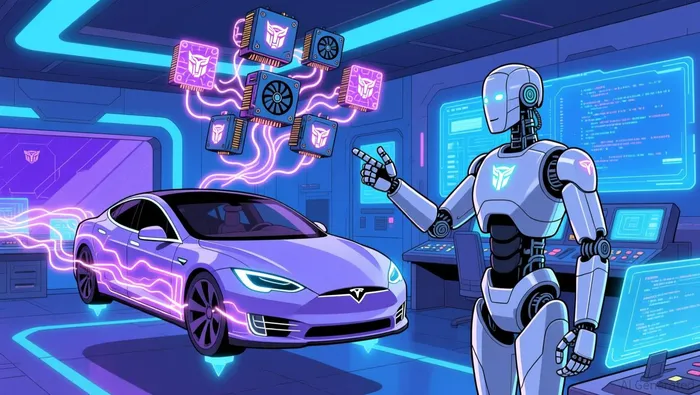 However, this concentration of power has also created friction. The rejection of a shareholder proposal to authorize a Tesla investment in xAI-despite majority support- highlighted the risks of governance misalignment. With 473 million abstentions counted as votes against the proposal, Tesla's bylaws effectively blocked the initiative, underscoring the challenges of cross-entity capital allocation in a highly concentrated ownership structure. While Musk advocates for a $5 billion Tesla investment to accelerate xAI's Grok AI integration into vehicles and Optimus robots, the board remains cautious about diverting resources from Tesla's core mission of sustainable energy and electric vehicles.
Capital Allocation: Aggressive Infrastructure vs. Strategic Uncertainty
xAI's capital strategy in 2025 has been nothing short of audacious. The company secured $20 billion in an upsized Series E round, with $12.5 billion in debt and $7.5 billion in equity, to expand its Colossus supercomputing infrastructure. This funding, supported by strategic investors like Nvidia and Cisco, has enabled xAI to scale to over one million H100 GPU equivalents and plan a third data center with 2 gigawatts of compute power. Such aggressive capital deployment reflects Musk's belief that AI dominance requires unparalleled data capacity and infrastructure scale.
Yet, the absence of Tesla's participation in this funding round raises questions about the sustainability of xAI's growth. While SpaceX's $2 billion contribution provides some financial synergy, Tesla's rejection of a potential investment signals a lack of consensus on the strategic value of cross-entity capital sharing. This divergence is particularly striking given the potential for Tesla's physical-world data (from vehicles and factories) to enhance xAI's multimodal AI training. The failure to secure Tesla's backing may also deter other investors wary of Musk's ability to balance competing priorities across his ventures.
Strategic Rewards: Synergy or Overreach?
The rewards of a successful xAI-Tesla integration are substantial. By embedding xAI's Grok models into Tesla's Full Self-Driving (FSD) system and Optimus robots, Musk could create a closed-loop ecosystem where AI advancements in one domain (e.g., autonomous driving) directly benefit others (e.g., robotics and conversational AI). This vertical integration mirrors Apple's approach to hardware-software synergy, potentially giving Tesla a first-mover advantage in AI-driven mobility and automation.
Moreover, xAI's real-time data stream from X (Twitter) offers a unique edge in training models that prioritize factual accuracy. If integrated with Tesla's sensor data, this could accelerate breakthroughs in multimodal AI, a critical frontier in the race for artificial general intelligence (AGI). The financial rewards are equally compelling: xAI's valuation surge to $230 billion demonstrates investor confidence in its infrastructure-centric model, which could position it as a key player in the AI-as-a-service market.
Strategic Risks: Governance Fractures and Capital Overextension
The risks, however, are equally pronounced. Tesla's governance structure, while protective of Musk's vision, leaves little room for dissenting voices. The rejection of the xAI investment proposal-despite Musk's advocacy- reveals a potential fault line between management's strategic priorities and shareholder interests. If Tesla's board continues to resist cross-entity investments, xAI may face bottlenecks in accessing critical resources, undermining its ability to compete with rivals like OpenAI and Google DeepMind.
Additionally, xAI's capital-intensive strategy carries the risk of overextension. The $20 billion Series E round, while impressive, may not be sufficient to sustain its 2 gigawatt data center ambitions without further Tesla or SpaceX support. If Musk's ecosystem proves unable to absorb these costs, xAI could face liquidity constraints, forcing it to pivot to less ambitious goals or seek external partnerships that dilute its strategic autonomy.
Conclusion: A High-Stakes Bet on Musk's Ecosystem
The xAI-Tesla integration epitomizes the dual-edged nature of Musk's corporate strategy. On one hand, it leverages a vertically integrated ecosystem to accelerate AI development, with governance structures that prioritize long-term innovation over short-term shareholder demands. On the other, it exposes vulnerabilities in capital allocation and governance alignment, particularly as Tesla's board and shareholders grapple with the risks of overcommitting to Musk's broader AI ambitions.
For investors, the key question is whether this integration will catalyze a new era of AI-driven value creation or exacerbate the tensions between Musk's visionary goals and the realities of corporate accountability. The answer will depend not only on the technical success of xAI's infrastructure but also on the resilience of governance frameworks that can balance ambition with prudence.





Comentarios
Aún no hay comentarios