
The Strategic Risks and Opportunities in U.S.-Taiwan Semiconductor Reshoring
The global semiconductor industry stands at a crossroads, shaped by geopolitical tensions, technological innovation, and shifting economic priorities. For investors, the interplay between U.S. and Taiwanese semiconductor production-particularly the contentious idea of a 50-50 split-offers both risks and opportunities. This analysis examines the implications of such a shift, focusing on supply chain resilience, investment dynamics, and the broader strategic competition between the U.S. and China.
The Current Imbalance: Taiwan's Dominance and U.S. Reshoring Efforts
Taiwan Semiconductor Manufacturing Company (TSMC) remains the linchpin of global semiconductor production, controlling 92 percent of the world's most advanced logic chip capacity in 2023. Its dominance extends to 70 percent of smartphone chipsets and 35 percent of automotive microcontrollers, cementing its role as the industry's "foundry of choice". Meanwhile, the U.S. has sought to reduce its reliance on Taiwanese manufacturing through the CHIPS and Science Act, which has spurred over $450 billion in private investment in domestic production. However, the U.S. still lags behind Taiwan in cutting-edge sub-5nm process technology, the standard for next-generation computing.
This imbalance has prompted U.S. officials to propose a 50-50 production split, a move aimed at diversifying supply chains and mitigating risks from geopolitical volatility. Yet, as of late 2025, Taiwan has firmly rejected such proposals. Vice Premier Cheng Li-chiun explicitly denied any commitment to the idea, emphasizing Taiwan's desire to maintain its strategic edge in semiconductor manufacturing. TSMCTSM--, while investing $165 billion in U.S. facilities, continues to concentrate the bulk of its advanced production in Taiwan, raising concerns about the fragility of its ecosystem.
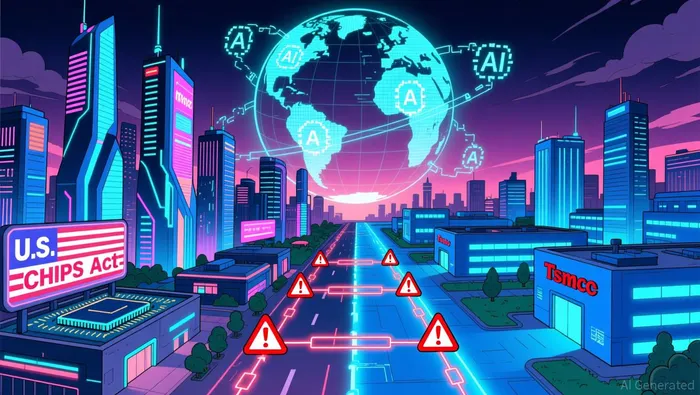
Geopolitical Risks: A Fragile Partnership
The U.S.-Taiwan semiconductor relationship is inherently fraught with geopolitical risks. Taiwan's location at the heart of U.S.-China strategic competition means any disruption-whether through a Chinese quarantine or military escalation-could cripple global supply chains. According to a 2025 study, quarantine measures are identified as the most likely immediate threat, given their low mobilization costs and high disruption potential. Such scenarios are not hypothetical; they are part of strategic contingency planning by both governments and industry stakeholders.
The U.S. has adopted a "small yard, high fence" strategy to protect its technological edge, including export controls on high-bandwidth memory (HBM) chips and AI-related hardware. These measures aim to restrict China's access to advanced technologies, while preserving U.S. dominance in critical sectors. However, this approach has also created friction with Taiwan, which views its semiconductor industry as a sovereign asset. TSMC's compliance with U.S. policies-such as halting advanced chip sales to Chinese entities-has further strained relations, highlighting the tension between economic interdependence and strategic autonomy.
Economic Implications: Investment Flows and Supply Chain Resilience
A 50-50 production split would require massive capital reallocation and reconfiguration of global supply chains. While the U.S. has made strides in reshoring, its efforts face significant hurdles. The CHIPS Act's $52 billion investment aims to reduce dependency on Asian suppliers, but domestic fabrication capabilities remain limited by talent shortages and high operational costs. In contrast, Taiwan's ecosystem-anchored by TSMC's R&D infrastructure and skilled labor force-offers unmatched efficiency in advanced manufacturing.
For investors, the key question is whether a forced rebalancing would enhance resilience or create new vulnerabilities. Diversification strategies, such as expanding fabrication footprints to the U.S., Europe, Vietnam, and Mexico, are gaining traction. However, these efforts introduce trade-offs, including increased complexity and costs. A 2025 report by Omdia notes that while diversification reduces concentration risk, it also weakens economies of scale, potentially slowing innovation cycles.
Meanwhile, AI-driven technologies are emerging as a critical tool for mitigating supply chain disruptions. Innovations in defect detection and yield optimization-such as those developed at Purdue University-are enhancing manufacturing resilience, even as geopolitical risks persist. These advancements underscore the importance of maintaining a flexible and adaptive production ecosystem.
Strategic Opportunities: Collaboration and Innovation
Despite the challenges, the U.S.-Taiwan partnership holds significant potential. Multilateral initiatives like Chip 4, the Quadrilateral Security Dialogue (QUAD), and the Government/Authorities Meeting on Semiconductors (GAMS) are fostering collaboration on crisis management and supply chain transparency. These platforms could help align U.S. and Taiwanese interests while addressing shared vulnerabilities.
For investors, opportunities lie in companies that bridge the gap between U.S. and Taiwanese capabilities. TSMC's U.S. expansion, for instance, represents a hybrid model that leverages American capital and regulatory support while retaining Taiwan's technical expertise. Similarly, U.S. firms specializing in advanced packaging and AI-driven supply chain analytics are well-positioned to benefit from the reshoring trend.
Conclusion: Balancing Risk and Reward
The push for a 50-50 U.S.-Taiwan semiconductor production split reflects a broader struggle to balance geopolitical risk with economic efficiency. While Taiwan's rejection of the proposal underscores its determination to maintain its technological edge, the U.S. remains committed to reducing its reliance on a single region for critical technologies. For investors, the path forward lies in hedging against volatility by supporting innovation, diversification, and strategic partnerships.
As the semiconductor industry evolves, the ability to navigate this complex landscape will determine not only the resilience of supply chains but also the future of global technological leadership.







Comentarios
Aún no hay comentarios