
Strategic Risk Assessment: V.F. Corporation's Securities Litigation and Retail Sector Implications
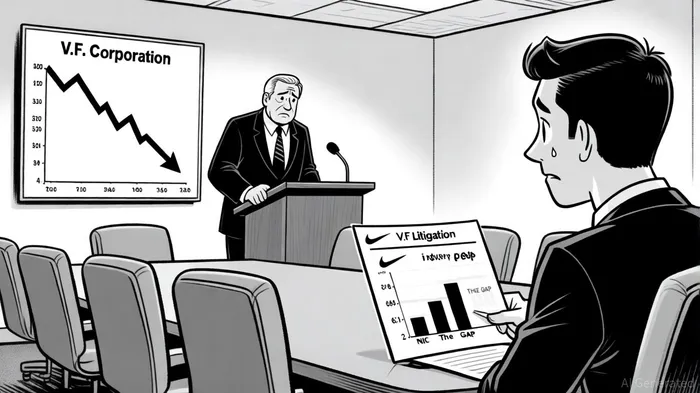
V.F. Corporation (VFC) has become a focal point in the retail sector's evolving legal and financial landscape, with multiple class-action lawsuits alleging securities fraud tied to its Vans brand turnaround strategy. Investors who purchased VFCVFC-- securities between October 30, 2023, and May 20, 2025, now face a critical reckoning as litigation unfolds, raising questions about corporate transparency, financial resilience, and long-term strategic risks. For long-term investors, understanding these dynamics requires a nuanced analysis of VFC's legal exposure, its financial position relative to peers, and broader retail sector trends.
The Litigation Landscape: Misrepresentation or Strategic Restructuring?
The lawsuits against VFC center on alleged misrepresentations regarding the Vans brand's performance. According to a report by Business Wire, VFC is accused of overstating the success of its turnaround plans and concealing the need for aggressive restructuring actions that led to a 20% revenue decline in Q4 2025[1]. The company attributed this downturn to deliberate efforts to eliminate unprofitable segments, but plaintiffs argue that even without these actions, Vans would have faced a high single-digit decline[2]. This discrepancy between corporate messaging and actual performance triggered a 15.8% stock price drop on May 21, 2025[3], erasing roughly $2.3 billion in market value.
The legal risks extend beyond reputational damage. With net debt of $5.46 billion as of May 2025[4], VFC's financial flexibility could be strained by potential settlements or legal fees. While the company's operating income exceeded guidance in Q4 2025[4], its equity base of $1.49 billion[5] suggests limited buffer against prolonged litigation costs. By contrast, industry peers like NikeNKE-- and The GapGAP-- have leveraged legal finance tools—such as third-party litigation funding—to mitigate costs, a strategy VFC has not publicly adopted[6].
Retail Sector Context: Litigation as a Systemic Risk
The VFC case reflects a broader trend in the retail sector, where litigation risks are rising due to heightened regulatory scrutiny and investor expectations. A 2025 report by TLTTLT-- LLP notes that 42% of retail sector legal teams anticipate increased lawsuits, driven by green claims enforcement, price transparency laws, and consumer protection regulations[7]. For example, non-food retailers faced EBITDA margins of just 7–8% in 2024, exacerbated by extended cash cycles and real estate challenges[8]. In this environment, companies with weaker balance sheets—like VFC, which has a debt-to-equity ratio of 4.39[5]—are particularly vulnerable to litigation-driven volatility.
VFC's situation contrasts with more resilient peers. Nike, for instance, maintained a debt-to-equity ratio of 1.2 in 2025 while achieving a 15% ROE[9], enabling it to absorb legal costs without jeopardizing core operations. Similarly, The Gap's 5% ROE and 2.1 debt-to-equity ratio[9] suggest a stronger capacity to navigate litigation compared to VFC's 7.83% ROE and 4.39 debt-to-equity ratio[5]. These disparities highlight the importance of financial discipline in mitigating strategic risks.
Long-Term Implications for Investors
For long-term investors, the VFC litigation underscores three key risks:
1. Earnings Volatility: The 16% stock price drop in May 2025 illustrates how litigation can amplify short-term volatility, potentially deterring institutional investors seeking stability[3].
2. Operational Distraction: Prolonged legal battles may divert management's focus from executing VFC's $500–600 million operating income improvement plan[4], jeopardizing its turnaround.
3. Reputational Damage: A 2025 Retail Law Resource Center analysis emphasizes that litigation, even if unsuccessful, can erode consumer and investor trust[10], compounding financial pressures.
However, VFC's strategic response—such as its deliberate restructuring of unprofitable segments—could also be viewed as a long-term value driver. By exiting low-margin businesses, the company aims to streamline operations and boost profitability. Yet, the timing and transparency of such actions remain under scrutiny, with plaintiffs arguing that delayed disclosures misled investors[2].
Conclusion: Balancing Risk and Resilience
V.F. Corporation's securities litigation serves as a cautionary tale for the retail sector. While the company has shown resilience through improved operating income and a stock price surge of 8.31% in recent months[5], its high leverage and litigation exposure pose significant headwinds. For long-term investors, the key lies in assessing whether VFC's strategic initiatives—such as its Reinvent program—can offset legal and financial risks. In a sector where litigation costs are rising and margins are thinning, VFC's ability to navigate this crisis will likely determine its competitive positioning in the years ahead.





Comentarios
Aún no hay comentarios