
The Strategic Rise of Samsung Heavy Industries in the Global LNG Carrier Market: A High-Conviction Play in the Energy Transition Era
Samsung Heavy Industries (SHI) is emerging as a linchpin in the global energy transition, leveraging its dominance in the liquefied natural gas (LNG) carrier sector to position itself at the intersection of decarbonization and energy security. As the world grapples with the dual imperatives of reducing emissions and ensuring stable energy supplies, SHI's strategic alignment with these trends—coupled with its technological innovation and robust order backlog—makes it a compelling long-term industrial play.
Order Momentum: A $19.1 Billion Backlog and Counting
SHI's 2025 order book for LNG carriers is a testament to its market leadership. With 84 LNG carriers valued at $19.1 billion, the company has secured a commanding share of the sector. This includes a $261.5 million contract for a vessel destined for Oceania, potentially for Denmark's Celsius Tankers, which now operates a fleet of 21 LNG carriers. These wins build on 2024's momentum, where SHI secured 22 LNG carrier orders worth $5.3 billion, including landmark deals with QatarEnergy, MISC, and Adnoc L&S.
The significance of this backlog extends beyond volume. SHI's 86% focus on eco-friendly vessels—such as ammonia and ethane carriers—aligns with the International Maritime Organization's (IMO) carbon tax and the EU's Carbon Border Adjustment Mechanism (CBAM). These regulatory tailwinds are not just compliance hurdles but catalysts for margin expansion, as green technology projects command premium pricing.
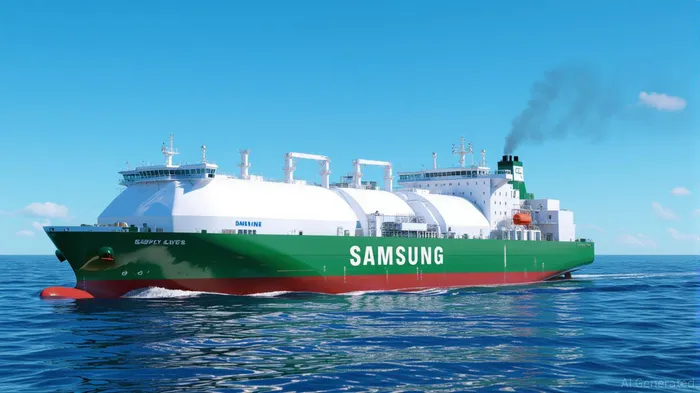
Technological Edge: Green Innovation as a Competitive Moat
SHI's technological prowess is a critical differentiator. The company has pioneered ammonia-powered vessel designs and its proprietary SENSE IV liquefaction technology, which enhances efficiency and reduces emissions. These innovations are not speculative—they are already being deployed in high-margin projects, such as the $637 million floating LNG (FLNG) project in Mozambique and a potential $2.5 billion expansion.
Moreover, SHI's expertise in floating liquefaction units, exemplified by its contract to build Cedar LNG's facility, diversifies its revenue streams beyond traditional shipbuilding. This adaptability is crucial in an industry where demand for LNG carriers is expected to grow by 40% over the next decade, driven by Asia's energy transition and Europe's need to replace Russian gas imports.
Strategic Alignment with Global LNG Demand Surges
The energy transition is not a zero-sum game. While renewables dominate headlines, LNG remains a critical bridge fuel, particularly in Asia and Europe. SHI's clients—QatarEnergy, Adnoc L&S, and MISC—are all investing heavily in LNG infrastructure to meet this demand. For example, QatarEnergy's 15-ship order with SHI underscores the Gulf state's ambition to become the world's largest LNG exporter by 2030.
Meanwhile, the EU's CBAM and IMO's carbon regulations are creating a “green premium” for LNG carriers that meet stringent environmental standards. SHI's focus on eco-friendly vessels positions it to capture this premium, with EBIT margins projected to rise to 6.71% in 2025—a stark contrast to the industry average of 3-4%.
Investment Thesis: A High-Conviction Industrial Play
For investors, SHI represents a rare combination of near-term visibility and long-term growth. Its $19.1 billion order backlog ensures steady cash flow through 2028, while its green technology projects offer margin expansion. The company's diversified client base—spanning energy majors and emerging markets—reduces geopolitical risk, and its strategic partnerships (e.g., with Celsius Shipping) provide recurring revenue opportunities.
However, risks remain. A slowdown in LNG demand due to a global economic downturn or a faster-than-expected shift to renewables could pressure margins. Yet, given the current trajectory of energy markets and regulatory frameworks, these risks appear manageable.
Conclusion: Positioning for the Energy Transition
Samsung Heavy Industries is not just building ships—it is engineering the future of global energy logistics. Its order momentum, technological leadership, and alignment with decarbonization mandates make it a high-conviction play for investors seeking exposure to the energy transition. As the world navigates the complex interplay of climate goals and energy security, SHI's strategic positioning offers a compelling case for long-term capital appreciation.
For those willing to bet on the next phase of industrial innovation, SHI's stock is a must-watch. The question is not whether the energy transition will accelerate—but who will profit most from it.







Comentarios
Aún no hay comentarios