
Strategic Retail Divestitures in a Shifting E-Commerce Landscape
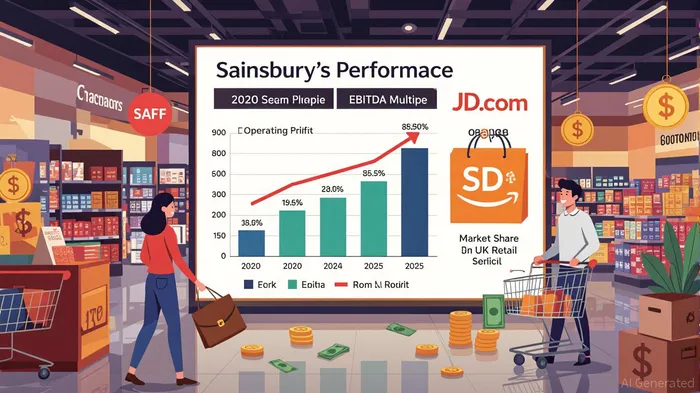
The recent termination of Sainsbury's and JDJD--.com's talks over the potential sale of Argos underscores the complexities of strategic retail divestitures in an era of rapid e-commerce evolution. For investors, this case offers critical insights into the financial and operational risks and opportunities inherent in restructuring retail portfolios. By analyzing the Sainsbury's/Argos/JD.com scenario alongside broader industry trends, we can better evaluate its implications for UK retail and global e-commerce players.
The Sainsbury's-Argos-JD.com Dilemma: A Strategic Crossroads
Sainsbury's decision to halt discussions with JD.com over the Argos sale was driven by the Chinese e-commerce giant's demand for “materially revised terms and commitments” that conflicted with Sainsbury's stakeholder interests [1]. This move aligns with Sainsbury's broader strategy to refocus on its core food retail operations under CEO Simon Roberts, who has prioritized divesting non-core assets like Argos [2]. Argos, acquired for £1.1 billion in 2016, has struggled with profitability, operating margins near 1%, and structural challenges, despite generating £4 billion in annual sales [3].
For Sainsbury's, the termination of the deal preserves its 2025–2026 financial guidance, including a retail underlying operating profit of £1 billion [4]. However, the company now faces the challenge of revitalizing Argos through digital enhancements and operational efficiency, a strategy that requires significant capital and execution risk. Meanwhile, JD.com's withdrawal signals potential limitations in its ability to integrate foreign retail assets, a setback for its European expansion ambitions [5].
Financial and Operational Implications for Investors
The Sainsbury's-Argos case reflects broader trends in retail divestitures, where companies seek to streamline operations amid shifting consumer behaviors and economic pressures. For instance, WH Smith's 2025 sale of its high-street retail division to Modella Capital allowed the company to focus on its more profitable travel retail segment [6]. Similarly, Stella McCartney's repurchase of a minority stake from LVMH provided creative autonomy while maintaining brand alignment with sustainability goals [6]. These examples highlight how divestitures can unlock value by reallocating resources to core competencies.
However, the financial outcomes of such moves are mixed. Argos's post-2016 acquisition initially boosted Sainsbury's profits by 20% [7], but its long-term performance has been lackluster, with the Argos Index® dropping to 9.5x EBITDA in Q1 2025 [8]. This decline mirrors challenges faced by other retailers, such as Superdry's struggle to clear 19 million garments in overstock [9], underscoring the risks of misaligned strategic bets.
JD.com's Global Ambitions and E-Commerce Realities
JD.com's failed Argos bid also reveals the hurdles of international expansion for e-commerce giants. The company's “10 Billion Growth Plan” aims to bring 1,000 global brands into China, leveraging its supply chain and digital infrastructure [10]. Yet, its inability to secure Argos—despite prior attempts to acquire Currys—suggests that cross-border retail integration remains fraught with regulatory, cultural, and operational complexities. For investors, this raises questions about JD.com's capacity to execute its global strategy without overpaying for assets or facing integration challenges.
Comparative cases, such as Brookfield's $9 billion acquisition of Colonial Pipeline [11], demonstrate that infrastructure and logistics expertise are critical for omnichannel success. JD.com's strength in logistics could have complemented Argos's UK retail network, but the deal's collapse highlights the importance of aligning strategic goals with partner capabilities.
Investor Reactions and Market Trends
The termination of the Sainsbury's-JD.com talks has elicited cautious optimism from analysts. RBC noted that divesting Argos could have unlocked value for Sainsbury's by refocusing on food retail [12], while the deal's collapse may stabilize investor confidence in the company's current strategy. Conversely, JD.com's setback could dampen enthusiasm for its European expansion, particularly as regulatory scrutiny of cross-border deals intensifies [13].
Globally, retail M&A activity in 2024–2025 has been characterized by high-value, strategic transactions, such as T-Mobile's $4.3 billion acquisition of U.S. Cellular [11]. These deals often prioritize operational synergies and market consolidation, reflecting a sector-wide shift toward efficiency over scale. For UK investors, the Sainsbury's-Argos case serves as a cautionary tale about the risks of overreliance on non-core assets in a volatile market.
Conclusion: Navigating the New Retail Landscape
As e-commerce continues to reshape retail, strategic divestitures will remain a key tool for companies to adapt to changing dynamics. The Sainsbury's-Argos-JD.com scenario illustrates the delicate balance between preserving core operations, pursuing growth through partnerships, and managing stakeholder expectations. For investors, the lessons are clear: prioritize companies with agile strategies, robust digital capabilities, and a clear focus on profitability. In an era of uncertainty, the ability to pivot quickly—whether through divestiture, acquisition, or internal transformation—will define long-term success in the retail sector.





Comentarios
Aún no hay comentarios