
Strategic Retail Alliances: How Rogers Communications Leverages Apple Device Access to Drive 5G Growth
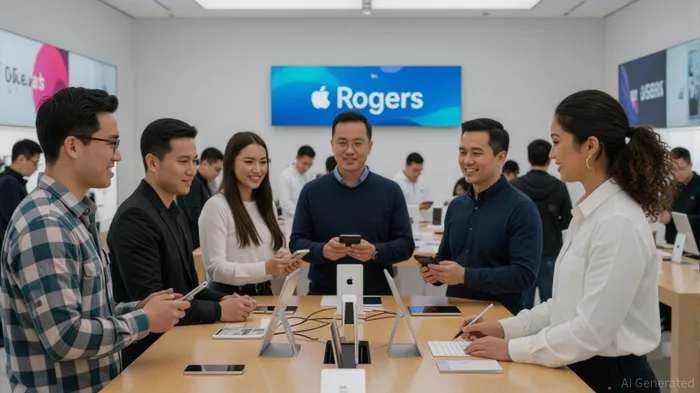
In the fiercely competitive telecommunications landscape, the intersection of device innovation and network infrastructure has become a critical battleground. Rogers CommunicationsRCI--, Canada's largest telecom provider, has long understood that customer retention and 5G adoption are inextricably linked to the devices consumers hold in their hands. While the company has not publicly announced a formal “strategic partnership” with AppleAAPL--, its aggressive availability of the latest Apple devices—coupled with its 5G-centric marketing—suggests a calculated approach to aligning retail access with network evolution. For investors, this strategy raises compelling questions about how indirect alliances can shape market leadership in an era where connectivity and consumer electronics are increasingly inseparable.
The Apple-Rogers Nexus: Device Availability as a Network Catalyst
Rogers Communications has positioned itself as a primary retail channel for Apple's flagship products, including the latest iPhones, iPads, and Apple Watches. This access is not merely transactional; it is a strategic lever to drive demand for 5G services. By offering cutting-edge Apple devices—many of which are optimized for 5G—Rogers creates a natural incentive for customers to upgrade both their hardware and their network plans. According to a 2024 report by Deloitte, 68% of smartphone users in North America upgrade their devices every two years, with carrier partnerships playing a pivotal role in accelerating adoption[1]. For RogersROG--, this means that every new iPhone sold becomes a potential gateway to 5G, as customers are more likely to activate advanced features like ultra-low latency or high-bandwidth streaming when paired with compatible devices.
The company's “Save & Return” program, which allows customers to test devices before committing, further underscores its focus on reducing friction in the upgrade cycle. This approach mirrors broader industry trends where carriers use flexible financing and trial periods to bridge the gap between device innovation and network readiness. While Rogers has not disclosed specific metrics on how Apple device sales correlate with 5G activations, the logic is straightforward: a customer purchasing an iPhone 16 Pro Max is statistically more likely to subscribe to a 5G plan to fully utilize features like 4K video calling or augmented reality apps.
5G Retention: Locking in Customers Through Ecosystem Integration
Customer retention in telecom has always hinged on pricing and service quality, but the rise of 5G has introduced a new variable: ecosystem loyalty. Rogers' emphasis on Apple device availability taps into this dynamic by embedding itself within the broader Apple ecosystem. A 2025 analysis by Bernstein Research found that Apple device owners are 30% less likely to switch carriers compared to users of non-Apple devices, largely due to the seamless integration of hardware, software, and cloud services[2]. For Rogers, this means that offering Apple products isn't just about selling phones—it's about creating a sticky relationship where customers are incentivized to stay with Rogers for both their device and network needs.
This strategy also aligns with Rogers' broader investments in 5G infrastructure. The company has committed CAD 30 billion to 5G expansion by 2027[3], a figure that gains strategic value when paired with the high data usage patterns of Apple device owners. Features like Apple's 5G-powered “Live Text” and “Siri enhancements” require robust network performance, which in turn drives demand for premium Rogers plans. The result is a virtuous cycle: better devices drive higher data consumption, which justifies network investments, which in turn justify premium pricing.
The Investment Implications: Indirect Alliances in a Post-Competition Era
For investors, the absence of a formal Apple-Rogers partnership does not diminish the significance of their implicit alignment. In fact, the lack of a public “strategic partnership” label may understate the depth of their mutual benefit. Apple gains a dominant retail channel in Canada, while Rogers secures a steady flow of 5G-optimized devices to differentiate its offerings. This dynamic is particularly relevant in a market where Rogers faces intense competition from TelusTU-- and Bell Canada. By prioritizing Apple's product roadmap—whether through early access or exclusive financing deals—the company can maintain its edge in a sector where differentiation is increasingly difficult.
Conclusion: The Unspoken Synergy
Rogers Communications may not have a press release touting a “strategic retail partnership” with Apple, but its business model already reflects the principles of such an alliance. By treating device availability as a catalyst for 5G adoption and customer retention, the company has positioned itself at the intersection of two of the most powerful forces in modern tech: Apple's ecosystem and the 5G revolution. For investors, this suggests that the value of Rogers' strategy lies not in explicit agreements but in its ability to align with the broader currents of consumer behavior and technological progress. In an industry where partnerships are often defined by more than contracts, Rogers' approach offers a blueprint for sustainable growth in the 5G era.







Comentarios
Aún no hay comentarios