
Strategic Resource Nationalism and the Global Copper Sector: Implications of the Anglo-Teck Merger and Codelco's Ascendancy
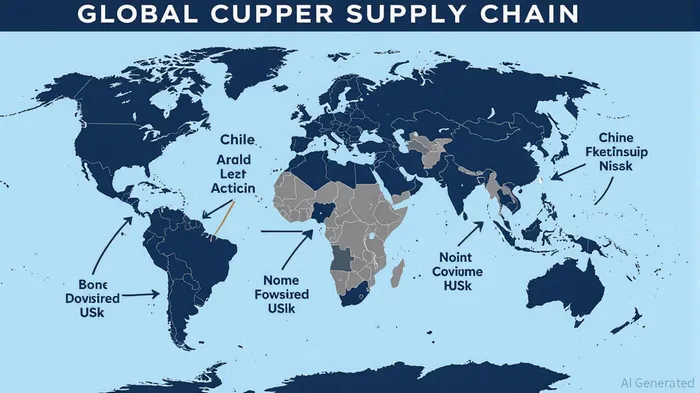
The global copper sector is undergoing a seismic shift driven by strategic resource nationalism and the urgent demands of the green energy transition. As nations vie for control over critical minerals, the recent Anglo American-Teck merger and Codelco's expanding influence underscore the evolving dynamics of supply chains, market concentration, and geopolitical risk. For investors, understanding these trends is essential to navigating a sector where policy, technology, and corporate strategy intersect.
The Anglo-Teck Merger: A Strategic Power Play
The $50 billion merger of Anglo American and Teck ResourcesTECK-- to form "Anglo Teck" represents a landmark consolidation in the copper industry. By combining six world-class copper assets and leveraging synergies worth $800 million annually, the new entity will become the fifth-largest copper producer globally, with over 70% exposure to the metal . This move is not merely about scale but about positioning for a future where copper demand is projected to triple by 2050 due to electrification and decarbonization efforts .
The merger's structure—Anglo American issuing 1.3301 shares for each Teck share and retaining 62.4% ownership—reflects a calculated balance of power. However, regulatory hurdles in Canada, the U.S., and China remain critical risks, as governments increasingly scrutinize cross-border deals in strategic sectors . The pre-merger $4.5 billion special dividend to Anglo American shareholders also signals a short-term focus on shareholder returns amid long-term strategic bets .
This consolidation aligns with broader trends of resource nationalism, where governments seek to secure domestic supply chains. For instance, the U.S. imposed a 50% tariff on copper imports in August 2025, creating a $2,000-per-tonne premium on U.S. prices compared to global benchmarks . Such policies incentivize domestic production but also heighten geopolitical tensions, complicating global trade flows.
Codelco's Dual Role: State Control and Innovation
Chile's Codelco, the world's largest state-owned copper producer, exemplifies the duality of resource nationalism and technological advancement. In 2025 Q3, Codelco achieved a 16.5% year-over-year production increase, driven by autonomous drilling systems and AI-driven efficiency gains at operations like Andina and El Teniente . Despite a temporary 33,000-tonne output reduction due to an accident at El Teniente, the company remains on track to reach 1.7 million tonnes of annual production by 2030 .
Codelco's influence extends beyond production. Its joint venture with Anglo American to boost output at Los Bronces and Andina by 120,000 tonnes of fine copper annually—without major new investments—highlights the value of strategic partnerships in a capital-constrained environment . Simultaneously, Codelco's collaboration with SQM to expand lithium production in the Atacama salt flats underscores Chile's ambition to dominate both copper and lithium markets, critical for electric vehicles and energy storage .
However, Codelco's success is not without challenges. Water shortages, environmental regulations, and geopolitical instability in Chile threaten operational continuity. These risks amplify the importance of Codelco's governance model, which aligns with global sustainability standards—a rare trait among state-owned enterprises .
Resource Nationalism: A Double-Edged Sword
Resource nationalism is reshaping the copper sector, with governments prioritizing supply chain security over free-market principles. The U.S. has accelerated deep-sea mining permits and streamlined permitting under Executive Order 14154, while China's dominance in processing and refining adds another layer of complexity . These policies create a fragmented global market, where access to resources is increasingly tied to political alignment.
For investors, the implications are twofold. On one hand, resource nationalism can protect domestic producers and stabilize supply chains. On the other, it raises operational costs for multinational firms through stricter regulations and renegotiated contracts . The Anglo-Teck merger, for example, must navigate these pressures while maintaining profitability in a sector with historically low margins.
Investment Implications and the Road Ahead
The convergence of resource nationalism and green energy demand creates a compelling but volatile investment landscape. Companies that can navigate regulatory hurdles, leverage technology, and secure long-term partnerships—like Anglo Teck and Codelco—are likely to outperform. However, investors must also hedge against geopolitical risks, such as U.S.-China tensions or Chilean water disputes.
Conclusion
The Anglo-Teck merger and Codelco's strategic initiatives reflect a sector in flux, where corporate ambition and state control are reshaping the copper landscape. As resource nationalism intensifies, the ability to adapt to regulatory, technological, and geopolitical shifts will determine long-term success. For investors, this means prioritizing resilience over short-term gains and recognizing that copper's role in the green transition is both a commodity and a geopolitical asset.





Comentarios
Aún no hay comentarios