
Strategic Resilience in the EV Transition: Analyzing General Motors' $1.6 Billion Financial Hit
The electric vehicle (EV) transition, once hailed as an inflection point for the automotive industry, is now testing the strategic resilience of even the most ambitious players. General MotorsGM-- (GM) has emerged as a case study in this evolving landscape, with its recent $1.6 billion financial hit underscoring the risks of navigating a rapidly shifting regulatory and market environment. This adjustment, driven by the expiration of U.S. federal EV tax credits and relaxed emissions standards, raises critical questions about the sustainability of EV strategies and the adaptability of legacy automakers.
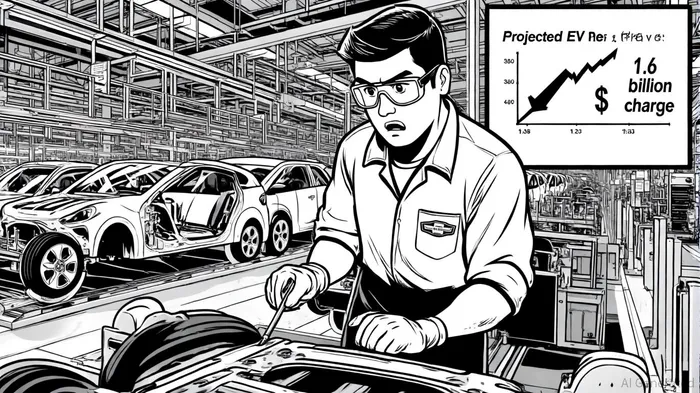
The Immediate Impact: A Reassessment of EV Capacity
According to a report by Fox Business, GMGM-- attributed the $1.6 billion charge to a reassessment of EV capacity, including $1.2 billion in non-cash impairment charges tied to manufacturing adjustments and $400 million in canceled supplier contracts and settlements [1]. This financial blow reflects a stark reality: the removal of the $7,500 federal tax credit for EV purchases and the rollback of emissions regulations have significantly dampened consumer demand and investor confidence. As stated by The New York Times, slowing EV sales have forced GM to scale back its aggressive production targets, which had previously aimed to make half of its North American and Chinese factories EV-capable by 2030 [2].
The company's decision to write down assets and renegotiate supplier agreements signals a recalibration of priorities. However, this move also highlights the fragility of strategies built on policy-driven incentives. As AP News notes, the absence of these subsidies has created a "regulatory headwind" that extends beyond GM, affecting the broader EV ecosystem [3].
Strategic Resilience: Flexibility vs. Long-Term Commitment
Strategic resilience in the EV transition requires a delicate balance between short-term adaptability and long-term vision. GM's current approach-retaining its retail EV portfolio while scaling back infrastructure investments-demonstrates a pragmatic response to uncertainty. Yet, this strategy risks undermining the very innovation it seeks to foster.
Data from Fortune indicates that GM's competitors, including Ford, are similarly reassessing their EV commitments, suggesting a broader industry recalibration rather than a company-specific failure [4]. However, the magnitude of GM's financial hit raises concerns about its ability to maintain momentum in a sector where sustained investment is critical. The $1.2 billion impairment charge, in particular, underscores the challenge of aligning capital expenditures with volatile market conditions.
Implications for Investors: Navigating Uncertainty
For investors, GM's experience offers a cautionary tale about the risks of over-reliance on policy-driven growth. While the company's EV models under Chevrolet, GMC, and Cadillac remain in production, the broader strategic realignment could lead to further charges as manufacturing plans are adjusted [1]. This volatility complicates valuation models, particularly for firms that have positioned themselves as EV pioneers.
Moreover, the expiration of tax credits and relaxed regulations signal a potential shift in the U.S. government's approach to decarbonization. If private-sector demand for EVs fails to offset the loss of subsidies, automakers may struggle to justify the high costs of transitioning production lines. For GM, this means its strategic resilience will be measured not just by its ability to adapt to current conditions, but by its capacity to anticipate and influence future policy and market dynamics.
Conclusion: A Test of Leadership
General Motors' $1.6 billion hit is a microcosm of the broader challenges facing the EV transition. While the company's immediate response demonstrates operational flexibility, the long-term success of its strategy will depend on its ability to innovate beyond regulatory cycles and align with evolving consumer preferences. For investors, the lesson is clear: strategic resilience in the EV era requires not only financial agility but also a commitment to shaping the very frameworks that define the industry's future.





Comentarios
Aún no hay comentarios