
The Strategic Reentry of U.S. Oil Giants into Venezuela: A High-Reward, Long-Term Investment Opportunity
The U.S. capture of Nicolás Maduro in January 2026 has catalyzed a seismic shift in Venezuela's oil sector, reigniting global interest in its vast 303 billion-barrel proven reserves. For U.S. oil giants, this geopolitical upheaval presents a unique opportunity to reenter a market long constrained by sanctions, nationalization, and political instability. However, the path to reentry is fraught with risks and complexities, particularly in the context of distressed-debt recovery and infrastructure rehabilitation. This analysis evaluates the strategic calculus for U.S. firms, balancing the allure of Venezuela's untapped potential against the realities of geopolitical volatility and legal hurdles.
Geopolitical Risks: A Double-Edged Sword
The U.S. military intervention, framed as a bid to dismantle Maduro's regime and secure access to Venezuela's oil wealth, has created a power vacuum that could either stabilize the sector or deepen chaos. According to a report, the short-term impact on global oil markets is likely muted, as Venezuela's current output of 1 million barrels per day-far below its 1990s peak of 3.5 million-requires years of investment to restore. President Donald Trump's pledge to spend billions of dollars to fix the badly broken infrastructure hinges on political stability, a commodity in short supply. Analysts caution that even if production recovers to pre-2019 levels, it would add only a modest 1–2% to global supply, limiting immediate market influence.
The geopolitical risks extend beyond Venezuela's borders. China, a longstanding partner in joint ventures with PDVSA, has not expanded its footprint post-Maduro, signaling caution amid U.S. dominance. Meanwhile, regional actors like Colombia and Brazil remain divided on how to manage the transition, creating uncertainty for foreign investors. U.S. sanctions, which have targeted oil tankers and shadow fleets to disrupt financial flows to the regime, remain in place, complicating efforts to rebuild export infrastructure.
Distressed-Debt Recovery: A Legal and Financial Maze
Venezuela's external liabilities-estimated at $150–170 billion-present both a challenge and an opportunity for U.S. firms. The country's debt-to-GDP ratio of 180–200% underscores the scale of the crisis, but its assets, particularly PDVSA's stake in Citgo, offer a lifeline for creditors. Citgo, a U.S.-based refiner with $19 billion in registered claims, has become the focal point of court-supervised recovery efforts. U.S. companies like ConocoPhillipsCOP-- and Crystallex are leveraging arbitration awards to pursue asset recovery, with courts overseeing the potential auction of PDV Holding, Citgo's parent company.
For U.S. oil giants, the Citgo saga highlights the potential for distressed-debt recovery, albeit with caveats. While speculative optimism has driven bond prices upward, recoveries are projected at 40–50 cents on the dollar without comprehensive restructuring and political stabilization. The legal pathways, however, are well-established. U.S. courts have upheld multi-billion-dollar awards against Venezuela, enabling creditors to target assets under U.S. jurisdiction. This framework could allow firms like ExxonMobilXOM-- and ConocoPhillips to recoup unpaid dues from past expropriations under Hugo Chávez while securing new investment opportunities.
Infrastructure Rehabilitation: A $100 Billion Gamble
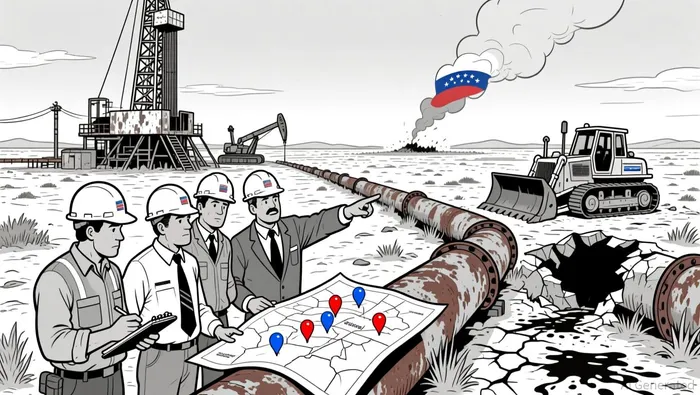
Reviving Venezuela's oil sector requires not just political will but also capital. Trump's vision of rebuilding the country's oil infrastructure is ambitious, given that analysts estimate $100 billion and a decade to scale production from 1 million to 4 million barrels per day. ChevronCVX--, the only major U.S. firm still operating in Venezuela, has maintained limited operations under special licenses, but broader reentry by firms like ExxonMobil and ConocoPhillips will depend on infrastructure rehabilitation.
The risks are compounded by global energy transitions. notes, the rise of electric vehicles could dampen long-term demand for oil, making Venezuela's high-cost, low-output projects less attractive. However, for firms with deep pockets and a long-term horizon, the rewards are substantial. Venezuela's reserves represent 1.5% of the world's total, and even a fraction of that could secure decades of production if infrastructure is restored.
Conclusion: A High-Stakes Calculus
The reentry of U.S. oil giants into Venezuela is a high-reward, high-risk proposition. Geopolitical risks-ranging from political instability to regional tensions-remain significant, while distressed-debt recovery offers a partial offset for past losses. The Citgo case demonstrates that legal pathways exist for asset recovery, but success depends on sustained political stability and U.S. policy support.
For investors, the key question is whether the potential returns justify the risks. Venezuela's oil sector could become a cornerstone of U.S. energy strategy, but only if firms are willing to navigate a complex web of legal, political, and economic challenges. As the Biden administration allows licenses to lapse and Trump pushes for aggressive reentry, the coming years will test the resolve of U.S. oil giants-and the patience of global markets.





Comentarios
Aún no hay comentarios