
The Strategic Reemergence of Vicentin: A High-Yield Opportunity in Argentina's Soy Trade Reorganization
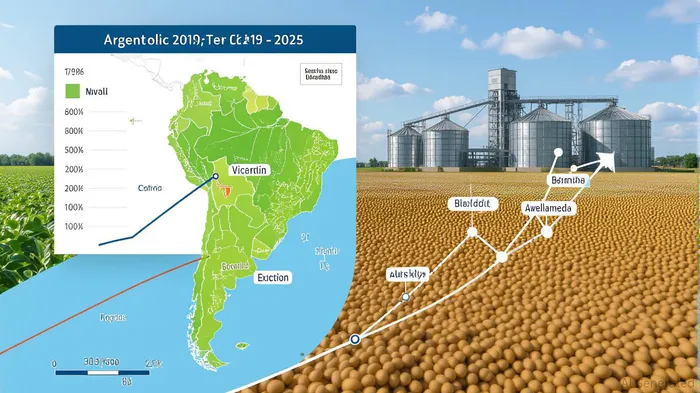
Argentina's agro-industrial landscape is undergoing a seismic shift, driven by the reorganization of its soy trade and the consolidation of its agri-commodity sector. At the center of this transformation lies Vicentin, a once-dominant agro-industrial conglomerate now navigating a complex path through bankruptcy proceedings and distressed debt restructuring. For investors with a high-risk, high-reward appetite, Vicentin's potential reemergence offers a compelling case study in capitalizing on market dislocation and sectoral realignment.
A Crisis of Confidence and Capital
Vicentin's financial troubles began in 2019, when the company defaulted on over $1 billion in debts, triggering a cascade of legal and operational challenges[1]. By 2025, the firm had permanently closed its Ricardone and Avellaneda soybean crushing plants due to a lack of tolling agreements and insufficient liquidity[4]. These closures not only exacerbated unemployment in key agricultural regions but also created a vacuum in Argentina's soy processing capacity, a sector critical to the country's $20 billion annual soy exports[6].
The government's failed attempt to expropriate Vicentin in 2021 underscored the political and economic stakes[3]. While the move was framed as a safeguard for national interests, it instead deepened uncertainty, deterring potential investors and prolonging the company's decline. Today, Vicentin's fate hinges on a contentious cramdown process led by CIMA, an investment group that acquired $447 million of its debt[3]. CIMA's bid to assume control signals a shift from state intervention to private-sector-driven restructuring—a trend that aligns with Argentina's broader push to liberalize its agri-commodity markets[4].
Strategic Assets in a Consolidating Sector
Vicentin's core asset—its 50% stake in Renova, the largest soybean crushing plant in South America—remains a linchpin in Argentina's soy value chain[3]. Renova's processing capacity accounts for nearly 10% of the country's soybean throughput, making it a strategic prize for any entity seeking to dominate Argentina's soy export ecosystem. With global demand for soybean meal and oil projected to grow at 3.5% annually[4], control of Renova could position a new owner to capitalize on rising margins and export efficiencies.
The agri-commodity sector's consolidation trends further amplify Vicentin's investment potential. Argentina's government has prioritized streamlining export logistics and reducing bureaucratic bottlenecks, creating an environment where scale and operational efficiency are rewarded[4]. For CIMA or any successor entity, integrating Vicentin's infrastructure with modern supply chain solutions could unlock significant value, particularly if the company secures tolling agreements or renegotiates debt terms to stabilize cash flow[5].
Risks and Rewards in a High-Stakes Game
Investing in Vicentin's restructuring is not without peril. The company's environmental violations, including a sulfur spill in 2024[1], and allegations of facilitating drug trafficking through its ports[1], cast a shadow over its reputation. Legal battles with creditors and employees—many of whom remain unpaid for over a year[1]—add operational complexity. However, these challenges also represent opportunities for a disciplined acquirer to rebrand and restructure, potentially transforming Vicentin into a leaner, more compliant entity.
For CIMA, the path forward involves navigating Argentina's volatile regulatory environment while balancing the interests of creditors, workers, and shareholders. A successful cramdown could yield a controlling stake at a fraction of the company's historical value, with Renova's strategic importance acting as a catalyst for recovery. Conversely, a misstep could result in prolonged litigation or asset seizures, eroding investor returns.
The Investment Thesis
Vicentin's distressed debt restructuring and Argentina's soy trade reorganization present a rare intersection of market dislocation and sectoral momentum. For investors willing to navigate the legal and operational risks, the potential rewards are substantial:
1. High-Yield Potential: CIMA's $447 million debt acquisition offers a leveraged entry point into a company with critical infrastructure and a dominant market position[3].
2. Sectoral Tailwinds: Argentina's push to optimize soy exports and reduce trade barriers aligns with Vicentin's long-term strategic value[4].
3. Consolidation Premium: A successful restructuring could position Vicentin as a consolidator in a fragmented industry, capturing market share from smaller, less efficient players[6].
Conclusion
The reemergence of Vicentin is far from guaranteed, but its strategic assets and Argentina's evolving soy trade dynamics make it a high-yield opportunity for investors with a long-term horizon. While the path is fraught with legal and operational hurdles, the potential to reshape Argentina's agro-industrial landscape—and reap the financial rewards—justifies a careful, calculated approach. As the country's soy sector continues to consolidate, Vicentin's story will serve as a litmus test for the viability of distressed debt strategies in emerging markets.







Comentarios
Aún no hay comentarios